
A stablecoin payroll card that's real, but thin on the details most readers need
 Available in US

The Toku card is a Visa debit card paid out from a stablecoin balance that an employer deposits on the recipient’s behalf. It exists, it works in the regions it says it does, and it is the first card most readers will find when they search for a crypto payroll product. Beyond that, the picture narrows quickly: the issuer, the fee schedule, the ATM terms, the daily limits, the supported tokens and the supported countries are either partially stated or not stated at all. This review goes through what Toku publishes, what it does not, and what that means if you are considering the card as a contractor paid in stablecoins, or as someone looking for a general-purpose crypto card.
The conditions in this article are current as of October 28, 2026.
Verdict
Toku scores 5.2 out of 10. That number comes from weighing six criteria: who can get the card, what it costs, how it is funded, how reliable it is, how it works day to day, and how it has been received. The breakdown is below.

| Criterion | Score | Reason |
|---|---|---|
| Who can get it | 5 / 10 | Issuance is live in the US, Mexico, Colombia and Brazil, and APAC is listed for Q2 2026; everywhere else is not stated. |
| Cost | 5 / 10 | Issuance, conversion, ATM and monthly fees are not stated. |
| Top-up options | 4 / 10 | The user does not top up. An employer credits stablecoins (USDG, USDC or RLUSD) into a connected Rain wallet; the card draws on the settled balance. |
| Reliability and complaints | 6 / 10 | The card is a Visa issued by a partner; whether the partner is Cross River Bank (the issuer listed on Rain’s general footer) is not stated. Trustpilot shows 3.2 out of 5 from a single review. |
| Everyday use | 6 / 10 | Virtual card available immediately, physical card “where applicable”; Apple Pay, Google Pay and ATM behaviour are not stated. |
| Total | 5.2 / 10 |
The card suits a narrow reader: a contractor or employee in a supported country who is paid by a Toku customer in stablecoins and wants a Visa to spend that balance at merchants and online. It does not suit someone looking for a self-serve card, a general crypto-to-fiat debit card with published fees, or a card with a public mobile wallet story. If you are outside the US, Mexico, Colombia or Brazil today, the card is not available; if you are in one of those countries but your employer is not a Toku customer, the funding model does not work for you.
Who Toku will give the card to
Toku states that the card is “available now” for recipients in the United States and Latin America, and names Mexico, Colombia and Brazil in that group. The Asia-Pacific region is listed for “Q2 2026”. Every other country is unaddressed on the public pages read for this review, so the practical answer is that the card is not on offer elsewhere.
Two things follow from that. First, eligibility is geographic and tied to where you receive payroll, not where you hold citizenship. Second, the card is not a self-serve product: it is positioned for payroll recipients of Toku customers, meaning the employer (or the platform paying you) is the one onboarding you. If you found Toku by searching for a personal crypto card, the door that opens is a payroll door, not a consumer one.
APAC being listed for “Q2 2026” rather than already open is a clear signal that the roll-out is staged. Readers planning around that window should treat the date as Toku’s stated target and check back closer to the quarter.
How to get the Toku card
There is no public sign-up page for an individual. The flow runs through your employer’s payroll arrangement with Toku: the employer signs up as a Toku customer, you are added as a recipient, and your card is issued in that context. Toku says it runs a “standard KYC process at issuance” and that recipients verify identity once. The exact documents, the proof-of-address requirement, and the minimum age are not stated. There is no mention of tiered KYC levels on the public pages; Toku refers to a single “standard” process.
Once KYC clears, the virtual card is available immediately. The physical card is shipped “where applicable” in supported regions; the delivery time and cost are not stated. The card is Visa-network only (Mastercard is not mentioned on the pages read), branded Toku, and the currency it runs in is not stated.
In short, the path to a Toku card looks like: be paid by a Toku customer, complete the standard KYC, receive a virtual card instantly, and wait for a physical card if your region supports it. There is no other way in.
What the Toku card really costs
This is the section where Toku is least forthcoming. The card pages do not state an issuance fee, a monthly fee, a conversion fee, an FX fee, an ATM fee, a daily spending limit or a monthly spending limit. There are no published tiers. The currency the card transacts in is not stated. The honest answer is that Toku does not publish its fee structure, so a reader cannot determine what a coffee, a subscription or a foreign-currency purchase will cost them on a Toku card.
| Fee or limit | Toku public statement |
|---|---|
| Issuance fee | not stated |
| Monthly / annual fee | not stated |
| Conversion fee (crypto to fiat) | not stated |
| FX fee (non-card-currency purchases) | not stated |
| ATM fee | not stated |
| Daily spending limit | not stated |
| Monthly spending limit | not stated |
| Card tiers | not stated (no tiers published) |
| Card currency | not stated |
A few everyday scenarios show what that gap means. Paying for a coffee in your home currency is the simplest case: the card reads from the settled stablecoin balance, your employer paid USDG, USDC or RLUSD, and the merchant is paid in whatever the card settles in. Without a published conversion fee or spread, you cannot tell what fraction of a dollar you lose on that payment. Paying online in a foreign currency adds the same unknowns, plus any FX fee the issuer charges; that fee is not stated. Withdrawing cash at an ATM is the third case: the ATM fee, any withdrawal limit and the issuer’s own ATM policy are all not stated, so you cannot plan a cash budget against the card.
Until Toku publishes a fee schedule, anyone considering the card has to weigh the convenience of being paid in stablecoins against the fact that the cost of spending those stablecoins is opaque.
Top up: how funding actually works
The Toku card does not have a top-up button. The user does not deposit into it. Funding flows from your employer (or the platform that pays you) into a Rain wallet connected to your Toku card, in stablecoins, and the card draws on the settled balance from there. Rain supports three stablecoins for this flow: USDG, USDC and RLUSD. There is no “send USDC from your own wallet” option in the public material; the funding relationship is employer-to-card, not user-to-card.
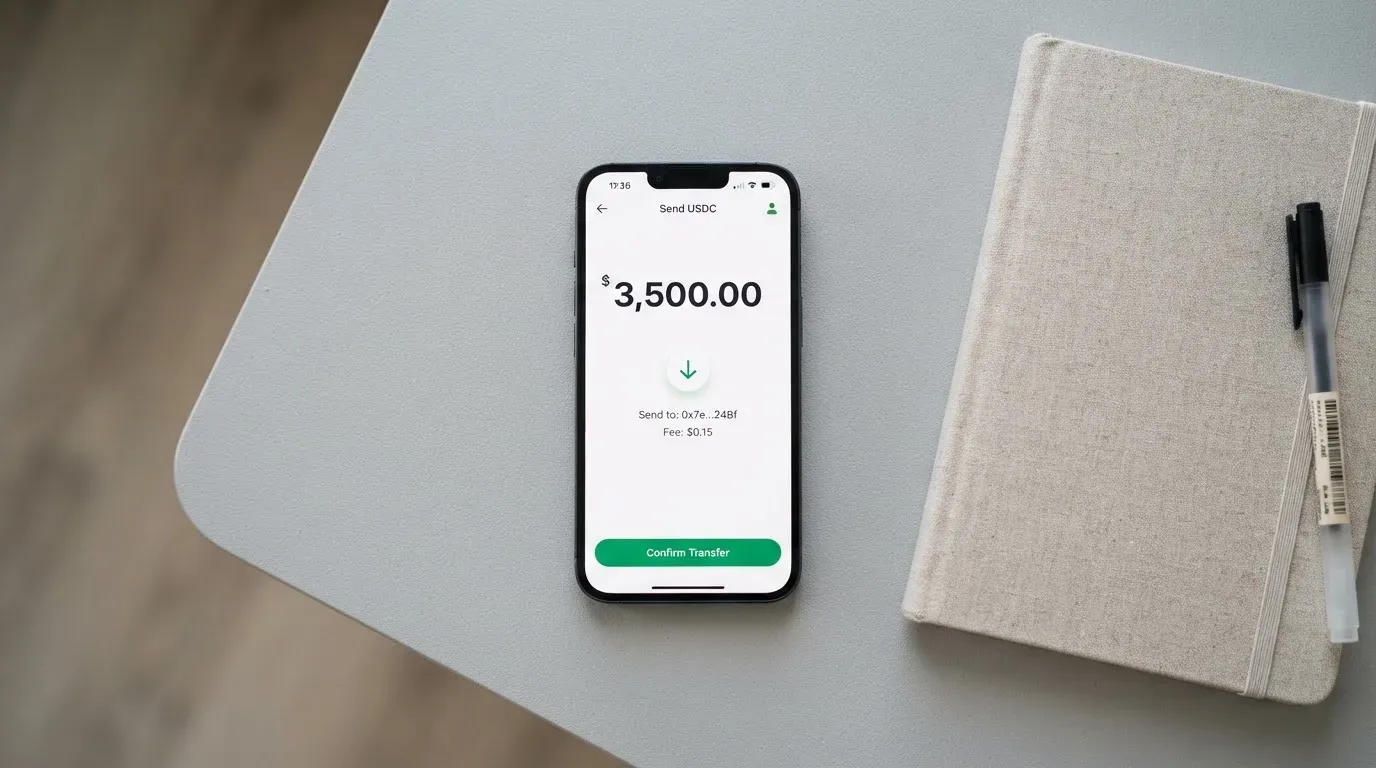
A Rain wallet in this context is a custodial wallet that Toku’s payroll partner provides. The card sits on top of that balance, and the spend happens against the balance Rain holds. The user is not asked which network to send on, because the user is not sending; the employer is, on the payroll side. The networks the employer uses, the minimum payroll amount, the settlement time, and the conversion path from stablecoin to whatever the card spends in are all not stated on Toku’s pages.
For the reader, the practical effect is that “how do I add money to my Toku card” is the wrong question. The right question is “does my employer use Toku, and in which stablecoin are they paying me?” If the answer to either is no, the card is not for you.
Paying with the Toku card every day
The day-to-day picture is thin. The virtual card is available immediately after KYC, so you can use it for online purchases as soon as you are approved. The physical card is shipped where Toku says it is “applicable” (the supported regions for issuance), and is the form you would use in a shop or at a point-of-sale terminal. Toku does not state whether Apple Pay or Google Pay are supported, and there is no dedicated card app mentioned; spend controls, freeze and 3-D Secure behaviour are not described on the public pages.
That leaves several everyday questions unanswered. Can I add the card to Apple Pay or Google Pay? Not stated. Is there a mobile app for the card? Toku points to its general support link rather than a card-specific app. Are there cashback or reward points? Not stated. What happens if a transaction is disputed? Not stated. The most you can say is that the card sits on a Visa network, so the basic rails (online acceptance, chip-and-PIN where supported, chargeback mechanisms defined by Visa) are likely available; the issuer’s own policy on each of these is not published.
For a payroll card, this matters more than it would for a consumer debit card. The card is the way you turn a stablecoin salary into rent, groceries and transport. The less Toku says about how that handoff works, the more you have to take on trust.
What can go wrong with the Toku card
A few risks are specific to the Toku card, and a few are general to crypto cards of this shape. They are worth thinking through before you commit a payroll stream to it.
1. The funding model is a single point of failure. The card only works if your employer keeps paying through Toku, into the connected Rain wallet, in a supported stablecoin. If that relationship ends, the card becomes a wallet holding a stablecoin balance with no clear path to spend it; Toku does not state what happens to the card in that case. There is no general “top up from your own wallet” fallback.
2. The issuer is not clearly named for this card. Toku says the card is “issued by a partner under a Visa licence”. Rain’s general footer says its Visa debit cards are issued by Cross River Bank, Member FDIC, with Rain Products, Inc. as programme manager. Whether that partnership is the one backing the Toku card is not stated. If you need to know who actually holds the money and who your regulator is, the public material does not give you that.
3. The fee schedule is unpublished. Every cost question in this review came back as “not stated”. That is a usability risk in itself: without a fee table, you cannot compare the card to a bank account or to another crypto card on cost, and you cannot budget against it.
4. Reviews are too few to be a signal. Toku has a Trustpilot score of 3.2 out of 5 from a single review (read 2026-10-21), and no Reddit or forum complaints surfaced in the reviews search. One review cannot tell you whether the card works smoothly in practice; the absence of complaints at this volume is not reassurance. There is also one January 2026 user report of a business applicant being told “we are not right fit for you business at this time” after a KYB inquiry — a reminder that Toku can turn down applicants.
5. Stablecoin-specific risks apply. The card spends from a stablecoin balance, and stablecoins are not risk-free. USDC and RLUSD are issued by Circle and Ripple respectively; USDG is issued by Paxos (formerly under the Paxos brand and now Global Dollar). Each of those carries its own reserve, redemption and counterparty story. The card pages do not state which issuer is preferred, how redemptions are handled if a stablecoin depegs, or what happens during a settlement delay. As background reading, it is worth knowing that USDC briefly lost its peg during the US banking turmoil in March 2023, and that the BIS estimated in July 2025 that about 90% of stablecoin market capitalisation sat in USDT and USDC.
6. Support channels are general. Toku points to a “demo call” and a general support link. There are no card-specific channels, no stated languages, no stated hours, and no published SLA. For a payroll product, that is a thin support footprint.
7. Region and citizenship rules can change. APAC is “Q2 2026”, which means the supported list today is the US, Mexico, Colombia and Brazil. If you are on the edge of that list — say, a US recipient whose employer is based in a country Toku has not opened — it is worth confirming directly that your flow is in scope.
None of these are reasons to assume the card is unsafe. They are reasons to ask Toku, in writing, the things the public pages do not say, before you direct a salary through it.
What to take instead of the Toku card
The alternatives below are cards with more public information about eligibility, fees or both. They are not direct equivalents — Toku’s defining feature is the employer-paid stablecoin payroll flow, and none of these replicate that flow exactly. They are the cards a reader in Toku’s situation might compare against.
| Card | Score | Where it works | Cost | Funding | Notes |
|---|---|---|---|---|---|
| MetaMask Card | 7.1 / 10 | 45 listed countries (e.g. Andorra, Argentina, Brazil, Canada, Mexico, Germany, France, Spain, Uruguay); US/UK sign-ups temporarily closed | Virtual free, Metal $199/year; minimal per-transaction fee; no MetaMask fee; no foreign transaction fee | Spends directly from a connected self-custody wallet (Linea, Base, Monad, Solana); mUSD, wETH, EURe, GBPe, USDC, USDT and others | Mastercard, issuer Monovate, provider Crypto Life; one card per user; cashback 1% (Virtual) / headline 3% (Metal) into mUSD |
| KAST | 6.1 / 10 | Country list shown at KYC, list not published; ID/citizenship rules tightened around restricted regions | Standard $0/year, Premium $1,000/year, Private $10,000/year; inactivity $1/month after 12 months | Stablecoins USDT, USDC, PYUSD, RLUSD on Ethereum, Solana, Polygon, Arbitrum, Tron | Up to 10 cards (Standard, Premium, Private; Pengu/Solana/Bitcoin designs); FX 0.5%–1.75% depending on region, transaction country and card programme; cashback 1.5%–3% in USD |
| TokenPocket (TP) Card | 5.8 / 10 | Visa debit in selected European countries (e.g. Germany, France, Spain, Switzerland); Mastercard debit in Australia, Canada, Hong Kong, Japan, Taiwan, New Zealand, Singapore, South Korea, UK; Americas “planned for Q2 2025” | “Apart from these, TP Card does not charge any additional fees”; 1% crypto deposit fee (later refunded via rewards) | Crypto deposits from the TokenPocket wallet; runs on Arbitrum; balances in EUR24 and USD24 | Virtual only (no physical card mentioned) |
MetaMask Card is the closest comparator for a reader who wants to spend a wallet balance directly, and is the most fully published of the three on cost. KAST is the closest comparator for a reader who wants published tiers, published FX fees and a physical card. TokenPocket is a lighter option, virtual-only and Arbitrum-based, with a refundable 1% deposit fee and “no additional fees” beyond that.
If your reason for looking at Toku is specifically that an employer or platform pays you in stablecoins, the comparison question is not “is MetaMask Card cheaper?” but “can I receive that stablecoin payroll in a wallet I control, and spend from there?” For many readers the answer will be yes, and a self-custody-linked card will be the more transparent option.
Who I would recommend the Toku card to
I would recommend the Toku card to a narrow reader: a contractor or employee in the US, Mexico, Colombia or Brazil, paid by a Toku customer in USDG, USDC or RLUSD, who wants a Visa to spend that balance at merchants and online without converting it themselves. The card exists for that flow, and the basics — virtual card immediately, physical card in supported regions, Visa acceptance — work.
I would not recommend the Toku card to a reader who is outside the four supported countries, who is not paid by a Toku customer, who needs published fees before signing up, who needs an Apple Pay or Google Pay story, who needs a dedicated card app, or who needs a clear statement of who the issuing bank is. The public material does not give those readers the answers they would need to commit a salary stream.
Two things I would do before signing up, regardless of which group you fall into. First, ask Toku directly, in writing, for the fee schedule, the issuing bank, the ATM policy, the supported countries for physical shipping, and the support hours; keep the answer. Second, ask your employer (or the platform paying you) which stablecoin they will send, on which network, and what the settlement timing is. Both of those answers will tell you more than this review can.
Frequently asked questions
What is the Toku card?
The Toku card is a Visa debit card tied to a stablecoin balance held in a connected Rain wallet. It is issued as a payroll product for recipients paid by Toku customers; the card draws on the settled balance rather than being topped up by the user. Rain supports USDG, USDC and RLUSD for this flow.
How does the Toku card work?
Your employer (or the Toku customer paying you) sends stablecoins into a Rain wallet connected to your card. The card settles payments from that balance, the way a prepaid card would. Toku says the card is issued by a partner under a Visa licence; the partner is not named on the Toku pages read for this review.
Is Toku a bank?
No. Toku describes itself as providing payroll and compliance infrastructure, and says the card is issued by a partner under a Visa licence. Rain, which provides the wallet layer, says it is not a bank, exchange or asset custodian. The issuing bank for the Toku card specifically is not stated.
Who owns Toku?
Toku is operated by WorkCo Inc per the starting information used for this review. The ownership structure, investors and corporate parent are not detailed on the public pages read here.
Is the Toku card available in my country?
Today, Toku states that issuance is “available now” for recipients in the US, Mexico, Colombia and Brazil, with APAC listed for “Q2 2026”. Other countries are not addressed on the public material. The right place to confirm is the payroll contact at your employer or at the platform paying you.
How do I get the Toku card?
You get it as a payroll recipient. Your employer (or the platform paying you) signs up with Toku, you are added as a recipient, you complete the standard KYC, and your virtual card is issued immediately. There is no public sign-up for an individual who is not on a Toku payroll flow.
Does the Toku card require KYC?
Yes. Toku says recipients verify identity once through a “standard KYC process at issuance”. The specific documents, the proof-of-address requirement, and the minimum age are not stated on the public pages.
How do I add the Toku card to Apple Wallet or Google Pay?
Not stated. The Toku pages do not confirm Apple Pay or Google Pay support, and there is no dedicated card app mentioned. This is one of the items to ask Toku directly before relying on mobile wallet use.
Is the Toku card free?
Not stated. Toku does not publish an issuance fee, a monthly fee, a conversion fee or an FX fee. Until the provider discloses a fee schedule, the exact cost of using the card remains unknown.
Is the Toku card safe?
The card sits on a Visa network and the wallet layer is provided by Rain, which is not a bank, exchange or asset custodian. Toku does not state specific card-level safeguards (such as 2FA, instant freeze or spending limits), and the issuer for this specific card is not named. Treat the card as a product that works, but where several policy details are not public; ask Toku for the answers before you route a salary through it.
Wallet cards on the shortlist – cryptocardshortlist
Content created by the «cryptocardshortlist» team