
A crypto card with a $50 fee, no verifiable issuer, and everything important coming from third-party sites
 Available in US

There is a specific kind of frustration that sends people looking for a card like this. Your bank will not open an account for you, or it froze the one you had, or the country you live in is not on any list of places that want your address. In that situation a crypto-funded payment card looks like a clean way out: you load value, you get a card number, and you can pay for things. Nocturne is one of the cards built for exactly that, but public information about the card is incomplete. Most of what is knowable about this card comes from a third-party directory; the company’s own pages do not publish a country list, a fee schedule, the issuer name, or terms of service.
So here is my score: 4.3 out of 10.
Who that suits: someone who already holds the assets, who is comfortable sending an irreversible blockchain transfer to a deposit address without documentation telling them which network to use, and who treats the card as a convenience rather than as a place to keep money. Who it does not suit: anyone who needs to know what happens to their money if the operator disappears, anyone who needs a card that reliably works at a specific shop, and anyone who needs a dispute process that exists on paper.
| Criterion | Mark | Why |
|---|---|---|
| Who can get it | 5 / 10 | The official site was unavailable to me; no country list is published by any official source |
| Cost | 2 / 10 | Unofficial figures: $50 issuance, 5% to load, 1% FX, $0.30 per transaction |
| Top-up options | 7 / 10 | Unofficial: BTC, ETH, USDT, USDC, LTC, XMR; networks not specified anywhere I could read |
| Reliability and complaints | 3 / 10 | Noctavel LLC, with no findable jurisdiction or issuer; unofficial reports of declined payments, domain reliability score 49/100, funds held custodially |
| Everyday use | 6 / 10 | Unofficial: virtual Aurora card, Apple Pay and Google Pay, no ATM fee |
Two things worth saying plainly before the details. First, almost every number in this review is third-party, not company-confirmed, and I will label each one as it comes. Second, where the card’s public pages do not say something, I will say that they do not say it, rather than filling the gap with a guess — because the gap is the finding.
The conditions described here are current as of October 28, 2026.
Who they will give you the card to
The honest answer is that this cannot be established. No official source states which countries are supported, and the official site was unavailable during checking. A third-party directory simply records that no supported countries are listed — which is a slightly different statement from “it works everywhere,” and a very different one from “we will not tell you.”
That absence matters more than it might sound. Card issuance is not a purely online permissionless act. A card number starts with an issuer identification number of 6 or 8 digits, and any shop, acquirer or fraud system in the payment chain can look that number up to see which institution and which country issued it. Merchants may apply extra scrutiny when the issuer country differs from the customer’s billing address. That is the ordinary background to every card; it becomes the central question when you cannot find out which country your card claims to come from.
There is a second layer. In the EU, customer due diligence covers name, address, date of birth, nationality and identity documentation, a sanctions check, the purpose of the relationship, and whether you are a politically exposed person. Nationality is screened separately from residence, because sanctions screening is often applied to citizenship and country of birth as well as to country of address. Under EU rules, if due diligence cannot be completed, the institution is required to hold back from the transaction or relationship and, where necessary, end it. US rules run in a similar direction: the customer identification programme requires name, date of birth, address and an identification number.
None of that tells you what Nocturne does. It tells you that *someone* in the chain above it is obliged to do it, or is not. Which brings me to the question you should be asking: not “is this card anonymous” but “who is the licensed entity whose name is on this programme, and where?” I could not find it. Details of that are in the risks section below.
If your own situation is that you have been refused elsewhere, the practical thing to establish first is not the card but the fallback: what else in your life depends on a card number working this month. A card that declines sometimes is a different problem from a card that never existed.
How to get it
Again, the official position is that nothing is stated. No official source describes the application flow, the identity requirements, the delivery of the card, or the verification levels. A directory entry records the card as “Level 0, no KYC” and lists email, phone number, identity document, proof of address and selfie as not required — but that is a directory’s characterisation, not the company’s, and I did not see it confirmed by Nocturne.
Let me be careful about how I present that, because “no KYC” is exactly the kind of phrase that gets repeated without its consequences. Anti-money-laundering rules require regulated businesses to verify customers and assess risk as part of law, including ongoing transaction monitoring and reporting of suspicious activity. A service that claims to verify nobody is either operating outside that framework, or operating under someone else’s licence, or not operating as a regulated business at all. In the first case your recourse when something goes wrong is the ordinary civil one — no ombudsman, no regulator with your file, no chargeback scheme. I am not making a claim about which case applies here. I am telling you that the claim is not free, and that “no KYC” describes a business model, not a benefit.
On the card itself: the directory lists a virtual card called Aurora. The network is not listed there; another directory page describes a “virtual Visa/Mastercard.” Delivery is not stated, and only a virtual form is listed, which means there may be nothing in the post at all — no plastic, no waiting, nothing that has to arrive.
What I would do before typing anything into a form: check whether the domain behaves like a real business. One directory gave Nocturne’s domain a reliability score of 49/100. That is not a verdict, but for a company asking you to send an irreversible transfer it is worth noticing.
Fees: what Nocturne really costs
Here is the part that should decide this for most people. These are the figures a third-party directory publishes, for October 2026, and none of them are confirmed on the card’s own pages.

| Fee or limit | Value (unofficial) |
|---|---|
| Issuance fee | $50 |
| Monthly fee | Free |
| Loading the card | 5% of the balance |
| Currency conversion (FX) | 1% |
| Per transaction | $0.30 flat |
| ATM fee | Free |
| ATM withdrawal limit | Unlimited |
| Daily spending limit | $30,000 (a sponsored banner on the same site says $50K daily limit) |
| Monthly spending limit | $600,000 |
Notice that the daily limit is reported inconsistently by the same source. That is worth holding on to, because it tells you something about the quality of the rest of the unofficial record.
Now let me put three ordinary payments through those numbers, because a percentage list does not tell you what a Tuesday costs.
Coffee, $4. If you loaded the balance with crypto, the 5% loading fee has already taken $0.20 of whatever you sent. If the coffee is priced in something other than dollars, add 1% for the conversion — $0.04. Then the flat $0.30 per transaction. Total friction on a $4 purchase: about $0.54, which is roughly an eighth of the price.
A $40 supermarket shop, paid in a non-dollar currency. The 5% load fee, 1% conversion fee, and the $0.30 flat transaction fee all apply to this purchase.
A $25 fuel fill-up. The 5% load fee, 1% conversion fee, and the $0.30 flat transaction fee apply.
The structure is what matters rather than the individual totals: a flat per-transaction charge punishes small payments hardest, and the percentage fees compound on every top-up rather than being paid once. If you load $1,000 and spend it over a month, the loading fee alone is $50 — the same as the issuance fee, every month.
One more cost, and it is not on the list. Blockchain transfers are typically irreversible, and the on-chain network fee — gas or bandwidth — is charged by the blockchain, not by the card provider. On Ethereum that means you need ETH in the wallet to send USDT at all, because gas is paid only in ETH. Tron prices fees with bandwidth and energy and often burns TRX. Send on a network the provider does not support, or to an address belonging to another network, and the funds can be gone or need manual support recovery with no guarantee attached.
There are two card names floating around — Aurora and Shadow — and Shadow’s link points to Aurora’s page, so I would not treat them as separate products. Deposits are described as being converted to a USD balance on arrival; other currencies are not mentioned anywhere I could read.
Top up: which networks, and why that is the sharp edge
A third-party directory lists BTC, ETH, USDT, USDC, LTC and XMR as fundable, with the networks not specified. That is the good part of this card: the coin list is unusually wide for something in this category, and the person this card was built for — someone holding Bitcoin, Monero or USDT who needs to spend — will recognise their own assets in that list.
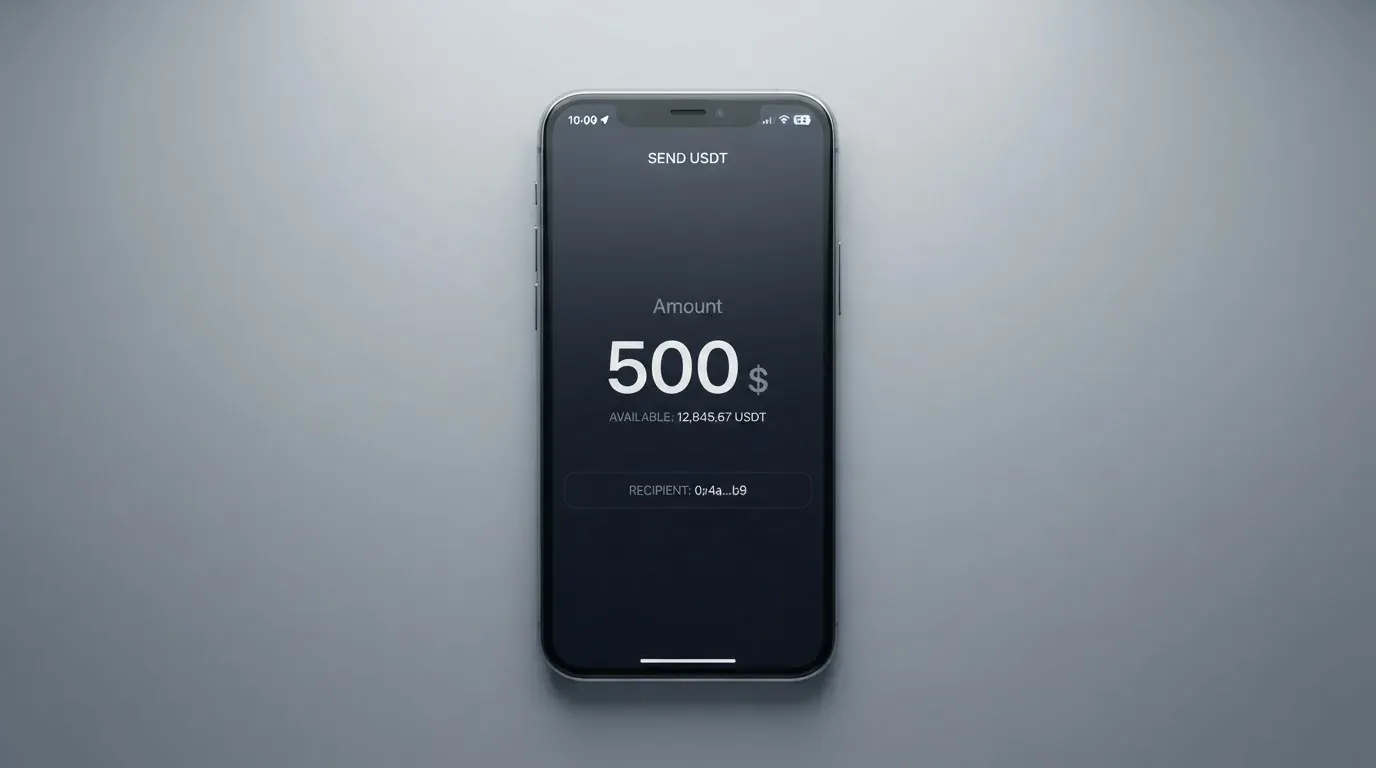
The missing part is the network. And this is where I would slow you down more than anywhere else on this page.
A stablecoin is not one thing. Tether’s USDT and Circle’s USDC are both dollar-pegged, and the BIS in July 2025 put about 90% of stablecoin market capitalisation in these two — but each of them exists in multiple versions, one per chain, and they are not interchangeable. USDC, for example, is natively supported on 38 networks as of 16 September 2026, including Ethereum, Solana, Base, Polygon PoS, Avalanche, Arbitrum and Stellar. USDT has been issued on Ethereum, Tron, Solana, Polygon, Avalanche and others. Circle stopped supporting USDC on Tron in February 2024, so “USDC over TRC20” is not a native option any more. If a card’s documentation does not tell you which network to use, you are being asked to guess — and on some chains a wrong guess is not a failed payment but a permanent loss.
Two further points that bear on your money rather than on convenience. Stablecoins can lose their peg: TerraUSD collapsed in May 2022, and USDC briefly lost its peg in March 2023 during the US banking crisis. The name is aspirational, not a guarantee. And they are not censorship-proof — Tether says it disables tokens in wallets on the OFAC sanctions list and has frozen funds tied to illicit activity.
So the top-up flow, as far as I can reconstruct it, is: you send crypto to an address; it arrives; it is converted to a USD balance; you pay 5% for that. The step where it goes wrong is the one with no documentation behind it.
Paying with it every day
The everyday-use picture is the strongest part of this card, and it comes almost entirely from unofficial sources too.
Apple Pay and Google Pay are listed as supported, with contactless. A directory adds that there is no cashback (unofficial: 0%) and a $15 referral bonus. No app is described anywhere official; the directory notes that there is no Play Store sentiment to read, which means there is effectively no public review footprint from people who installed it. Blocked merchant categories are not stated, and I would want to know that before relying on it.
Two mechanisms explain most real-world failures, and both apply here whether or not the card is at fault. Address Verification Service compares the numeric parts of the billing address a buyer typed with issuer records; it is mainly offered in the US, Canada and the UK and is generally unavailable for foreign-issued cards, which causes declines. Some merchants decline prepaid or foreign BINs outright, because the lookup reveals the card type and the issuer country. 3-D Secure adds an identity check to online payments — Visa’s version is Visa Secure, Mastercard’s is Identity Check — and under that scheme liability for a fraudulent online payment can shift from the merchant to your bank, or, per critics, to you.
One detail that causes quiet confusion: a declined authorisation may leave a hold on your funds that stays for several days, typically up to 7. If a card “keeps failing” and the balance looks wrong, the first question is whether money is actually gone or merely held.
And what happens when a shop takes your money and never delivers is not stated for Nocturne. A chargeback is a refund ordered by the issuer, with reason codes such as fraud, duplicate billing or goods not received. In the US, debit card reversal rights come from Regulation E and credit card rights from Regulation Z; prepaid-card coverage varies and should not be assumed. For a virtual, possibly prepaid, card issued by an entity I could not identify, I would plan as though there is no chargeback safety net rather than as though there is one.
What can go wrong
This is the section I would ask you to read twice, because the low scores in my table come almost entirely from here.
The operator is hard to identify. The name attached to the card is Noctavel LLC. Jurisdiction and issuer: not found. That is the whole of the corporate information I could establish. It matters for more than tidiness. Behind every card there is a chain: the network (Visa or Mastercard) routes the messages and sets the rules, the issuer is the bank or e-money institution licensed under that network’s licence and actually holds the programme, and the crypto brand is often only a programme manager or front end that markets it. An electronic money institution in the EU can issue e-money, payment cards and wallets but cannot lend, and it may serve the whole EU from a licence granted in one member state — but it has to be a licensed entity with a name. I could not find that entity here.
The funds are held custodially. A directory lists custodial funds management as a con, not a feature. What that means: the provider holds the credentials, so you must trust the provider completely. Control of crypto belongs to whoever holds the private key; a seed phrase of 12 to 24 words is an unencrypted form of it, and anyone who obtains it can restore the wallet and spend the funds. Transfers are irreversible and a stolen key has no built-in recovery — the network cannot freeze or return. This is not hypothetical for the category: custodial platforms have a genuine record of failure. Mt. Gox reported about US$350 million stolen in 2011–2014, Coincheck about US$400 million in 2018, and the Ronin Network US$625 million in 2022.
Programmes end. Card programmes do close. Visa said in November 2022 that it had terminated its global agreements with FTX, and the FTX US debit card was wound down by its issuer. WaveCrest, a Visa issuer that supplied crypto card brands, was suspended by Visa in Europe in 2018, closing every WaveCrest-issued Visa programme. The usual pattern is a notice period, then spending and loading stop, then you are asked to withdraw. If you hold a balance on a card whose issuer you cannot name, that withdrawal request is being made to a counterparty you cannot identify.
Complaints. No official incidents surfaced in my checking. What exists is thinner than you would like: a directory notes user posts reporting declined payments, support complaints, and doubts about the card’s origin and longevity, and also says there are no verified reviews. A domain trust scanner score of 49/100 appeared alongside. I looked for Trustpilot and Reddit reviews of the domain on 21 October 2026 and found none. The directory’s own aggregate scores are 7.1/10 overall and 7.8/10 for community, drawn from 9 sources. Those are not the same as 49/100, and the gap between them is itself information: a directory that rates a business well on the basis of nine sources while a domain scanner rates the domain at 49 is telling you that nobody has checked very hard.
Support. A Telegram channel is listed as the contact point. Languages and hours are not stated. Telegram is not a support system with a service level; it is a channel with a moderator.
Money laundering exposure is a practical risk, not just a legal footnote. Under MiCA — the EU’s markets-in-crypto-assets regulation, which ESMA says took legal effect in June 2023 — rules on asset-referenced and e-money tokens applied from 30 June 2024, with the remaining provisions including crypto-asset service provider rules from 30 December 2024. E-money tokens may be issued only by a credit institution or an electronic money institution. The transitional period for providers already operating under national law ran only until 1 July 2026, or until they received or were refused authorisation, whichever came first. ESMA maintains an interim register of authorised providers, and you can check one there. A card is a payment service regulated separately from the crypto side, so a card like this normally rests on two licences. If a provider cannot point you at the register entry for both, that is not a technicality.
What to take instead
I want to be fair here: the alternatives are also thin. None of these is a bank, and none of them solves the underlying problem of being unbanked. But each publishes something Nocturne did not, and that is the comparison that matters.
| Nocturne | CardFlow | HyperCard | Card.fi | |
|---|---|---|---|---|
| My score | 4.3 / 10 | 4.9 / 10 | 4.7 / 10 | 6.6 / 10 |
| Who it is for | Not stated officially | Aimed at Nigeria: “Nigeria’s smartest fintech card platform”, and “Nigerians and global users”; no country list or exclusions stated | Official pages state no country list; App Store says it works in “more than 176 countries” — acceptance, not eligibility | Ships to “200+ countries”; terms bar residents of, or orders from, a country subject to sanctions that would prohibit the service |
| Card | Virtual Aurora; network not listed, another page says virtual Visa/Mastercard | Virtual USD Mastercard, created in about 3 minutes | Prepaid HyperCard, network not stated; balance in USD or EUR | Virtual Classic and Premium, physical Classic and Premium, metal; issued under licence from the relevant card schemes |
| Cost | $50 issuance, free monthly (unofficial) | Creating a virtual card is “completely free”; monthly fee not stated | Not stated; App Store lists no fees | One-time: Virtual Classic $49, Virtual Premium $249; physical and metal prices not listed; no monthly, annual, inactivity or minimum-balance fee |
| Fees | Load 5%, FX 1%, $0.30 per transaction, free ATM (unofficial) | Not stated | Not stated on pages I could read | Top-up Classic 1.5% + $1.00, Premium 1%; FX Classic 3.5%, Premium 2.5%; conversion shown before each top-up |
| Funding | BTC, ETH, USDT, USDC, LTC, XMR; networks not listed | Bitcoin, USDT, ETH or Naira bank transfer; networks not stated | Crypto such as USDT, BTC, ETH, converted to USD or EUR; networks not stated | 32 coins across 5 networks — Ethereum, Base, BNB Chain, Solana, Kaanch |
| Rewards | No cashback (0%), $15 referral (unofficial) | Not stated | Not stated | Cashback on spending only: Classic 0.8%, Premium 1%, Metal 1.2% or 2%, with monthly caps |
Where Card.fi is the more serious proposition: it names its networks, which removes the single most dangerous ambiguity in this category; it publishes a price list for its virtual tiers; it does not charge a monthly fee; and it has a documented dispute position, since its cards are issued under licence from the card schemes. It is also not free — the FX fee of 3.5% on Classic is worse than Nocturne’s unofficial 1%, so the cheaper-looking headline can go the other way on currency-heavy spending. Its own terms warn that sending on the wrong chain risks permanent loss, which is the same warning every provider in this category eventually has to give.
CardFlow and HyperCard are weaker on documentation but better on one thing: CardFlow offers a free virtual Mastercard, and HyperCard states a supported span of 176 countries. Nocturne publishes neither.
Who I would recommend it to
I would recommend it to someone in a specific and fairly narrow position: you already hold crypto, you need a card number more than you need a relationship with a financial institution, you can absorb a 5% loading fee without it mattering because you are moving large amounts rarely, and you are psychologically comfortable with a provider whose name and jurisdiction you cannot verify. If all four of those are true, Nocturne is a reasonable tool. The coin list is genuinely broad, the monthly fee is reportedly nil, and ATM withdrawals reportedly carry no fee.
I would not recommend it to anyone who is asking the questions people usually ask first: is this safe, is it worth it, who owns it. On this card, those questions do not have answers I can find. That is not me being cautious for its own sake — a 4.3 out of 10 is not a rounding error, and the two criteria that drag hardest are cost and reliability, and both drag because of missing information rather than because of anything the card demonstrably does wrong.
My own test, if you want one. Before you send anything: ask the operator which legal entity issues the card and where it is licensed; ask which network to use for the exact coin you hold; ask what happens to your balance if the service stops. If those three questions come back with clear answers, the picture changes. If they do not, then whatever the card does well, you are not its customer — you are its risk.
One last thing that is not this card’s business but will be yours. The IRS treats digital assets as property, so exchanging them for goods, services or dollars generally produces a taxable gain or loss. For personal holdings the result is a capital gain or loss, short-term if held a year or less, measured in local fiat currency at fair market value on the date of the transaction — which means each card payment funded from crypto may be its own disposal. I am not giving you tax advice and rules differ where you live; I am flagging that a card does not remove the reporting, it just makes the disposals smaller and more frequent.
Frequently asked questions
What is the Nocturne card?
Nocturne is a crypto-funded payment card. You load crypto, it converts to a dollar balance, and the card spends that balance. The card I could find is virtual only, called Aurora, described by a third-party directory as a virtual Visa/Mastercard. The company name attached to it is Noctavel LLC, and I could not find its jurisdiction or the entity that actually issues the card.
How does the Nocturne card work?
You send crypto to a deposit address, it arrives, it is converted to a USD balance on arrival, and you spend from that balance like any prepaid card. Loading is reported to cost 5%. The network to send on is not specified in any official source I could read, and that is the part I would want written down before sending anything.
Is Nocturne a bank?
Not on the evidence available. It appears to be a card programme front end rather than a deposit-taking bank, and the funds are described as held custodially. That distinction matters: bank deposits are protected by deposit guarantee schemes in many jurisdictions, and e-money balances held by an electronic money institution are a different category again — those must be safeguarded, by segregating them in dedicated accounts or insuring them, but they are not the same as bank deposits.
Who owns Nocturne?
The name I found is Noctavel LLC. Jurisdiction and issuer were not found. Nothing about that company — where it is registered, who regulates it, who holds the customer funds — could be confirmed from a public official source.
Does the Nocturne card require KYC?
No official source states this. A directory describes it as “Level 0, no KYC” and lists email, phone, identity document, proof of address and selfie as not required. I did not see that confirmed by Nocturne, and I would treat it as unverified in both directions — it may be true, and it may also mean the service sits outside the regulated framework entirely.
How much does the Nocturne card cost?
Unofficial figures: $50 issuance, no monthly fee, 5% to load the balance, 1% on currency conversion, $0.30 flat per transaction, and no ATM fee. None of these appear on the card’s own pages. Each transaction involves a 5% load fee, 1% conversion fee (where applicable), and a flat $0.30 fee, before any blockchain network fee.
Can I use the Nocturne card in my country?
I cannot answer that. No supported country list is published by an official source, and the official site was unavailable to me when I checked. Since merchants can look up the card’s issuer country from its number and may scrutinise foreign-issued or prepaid cards, the honest position is that acceptance abroad is unverified even if acceptance at home is fine.
Is the Nocturne card safe?
I would not call it safe, and I would not call it unsafe either — the information needed for either verdict is missing. What I can say is that funds appear to be held custodially, which means you are trusting an operator whose jurisdiction and licence I could not find, and that custodial platforms in this category have a real history of large losses.
What are the limits on Nocturne?
Unofficial: daily spending of $30,000 and monthly spending of $600,000, with unlimited ATM withdrawal reported. Note that a sponsored banner on the same directory site quotes a $50K daily limit instead, so even the unofficial numbers disagree with each other. Nothing official is stated.
Is Nocturne worth it?
At these reported fees it is worth it only if you load rarely, spend in larger amounts where the flat $0.30 does not dominate, and mostly in dollars to avoid the 1% conversion. For everyday small spending elsewhere the fees run into the high single digits as a percentage, and I would look at Card.fi instead, which publishes its networks, prices and fee schedule even if its FX fee is higher.
Virtual cards on the shortlist – cryptocardshortlist
Content created by the «cryptocardshortlist» team