
A nameless Mastercard you buy with roubles in Telegram — and the gaps in what the card tells you
 Available in US
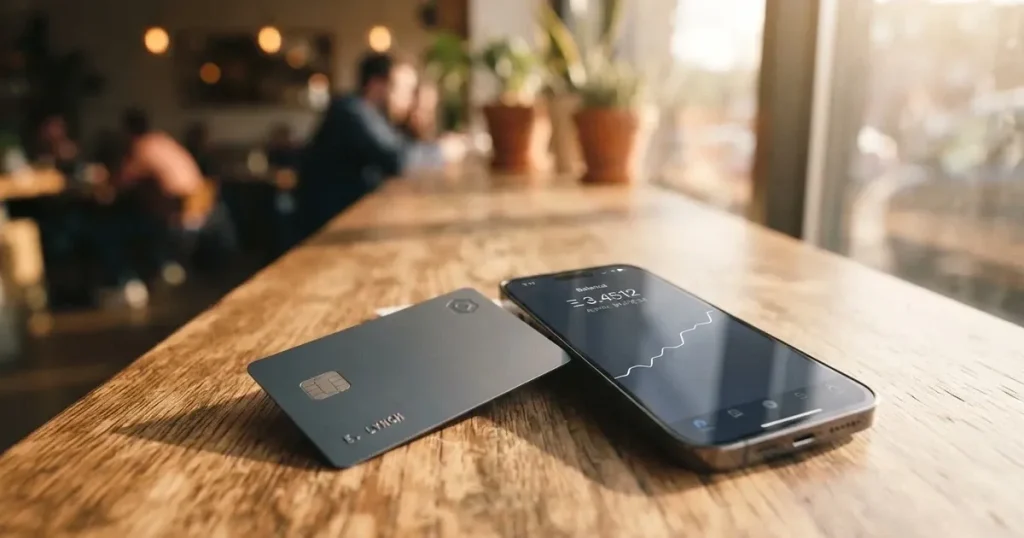
MIG Pay is a prepaid Mastercard that you buy and reload inside a Telegram mini-app, in roubles, without a passport and without any check the card’s pages describe. That is the whole pitch, and in a market where most crypto card signup routes run through a video call with a compliance officer, it is a genuinely different offer. It is also an offer whose public pages leave a long list of things unsaid — which countries, which bank, which limits, which fees on a foreign purchase. I have read what is published, compared the card against other options in the same category, and tried to separate what is a real feature from what is simply unstated.
The conditions described here are current as of October 28, 2026.
My score for MIG Pay is 4.7 out of 10. That is not a rounding of something more flattering. The card is fast, inexpensive to hold, and built for a specific person — anyone paying abroad in roubles without checks — and for that person it does something few competitors do. But it scores badly on the things a payment card is judged on: who is behind it, what it costs you on a real purchase, and what happens when something goes wrong.
Who gets the card
Short answer: the page does not say. There is no country list, no eligibility statement, and no distinction drawn between citizenship and residence. What the page does say is a positioning line — the service is aimed at paying abroad “from Russia, in roubles”. That tells you the intended market, not the rules. Nothing on the public pages tells you whether a resident of another country, or a resident of another country, can apply, and nothing says anything about Belarus.
That gap matters more here than it would for an ordinary bank card. Payment providers are required in most regimes to identify their customers and screen them against sanctions lists, and screening is normally applied to nationality and country of birth, not just to where you live. MIG Pay’s own page takes the opposite approach: it advertises the absence of checks rather than describing them. The absence of a published country list is not evidence that anyone can sign up — it means you cannot tell from the public pages, and you would find out at the moment of trying.
The service is positioned for spending roubles abroad. If you are elsewhere, you are outside the stated positioning and effectively guessing.
| Criterion | Mark | Why |
|---|---|---|
| Who can get it | 5 / 10 | No list of eligible countries is published; the service positions itself for paying abroad from Russia, in roubles |
| Cost | 6 / 10 | Issuance 800 ₽, maintenance free, fee folded into the rate and amount-dependent; FX fee undisclosed |
| Top-up options | 2 / 10 | Top-up in roubles via SBP inside the Telegram mini-app; crypto top-up not confirmed on the page |
| Reliability and complaints | 5 / 10 | TriB Group LLC (Bishkek), a British bank whose name is not given, licences unnamed; no reviews found |
| Everyday use | 4 / 10 | Mastercard valid 2 years, ready two minutes after payment, reloadable; type, Apple Pay, Google Pay and ATM not disclosed |
| Total | 4.7 / 10 | A narrow, cheap tool with too much of its substance unstated |
How to get it
The card is nameless and, in the page’s own words, issued without a passport and without checks. There is no identity verification step of any kind described. The route runs entirely through Telegram: you pay inside the mini-app by SBP — the Russian bank-to-bank transfer system — and the card is ready two minutes after that payment lands. There is no delivery step; the card simply exists in the app when the payment clears.
The card itself is a Mastercard issued by a British bank, valid for two years, and reloadable. The page also mentions UK and US billing addresses, which is a detail that matters at checkout more than it looks like it should. Whether you receive a physical card, a virtual one, or both is not stated, and neither is the currency the card is denominated in — though payments themselves are made in roubles, which is a fairly clear signal about what it is for.
Age is not stated. Verification levels are, per the page, not applicable because there is no verification at all. So the practical answer to “how do I get it” is: an SBP transfer in Telegram, and a card two minutes later. Whether that is a good idea for you is a question about who is behind it, which I come to below.
Fees: what it really costs
The headline cost is an 800 ₽ issuance fee and, after that, no monthly fee. That is genuinely cheap — cheaper to hold than almost anything in this category. The trouble is everything that happens when you actually spend the money.
The card states that its fee is included in the exchange rate and depends on the amount, and that larger top-ups get a better rate. Transfers between your own MIG Pay cards are free. That is the whole published cost structure. The FX fee is not stated. The ATM is not stated. Daily and monthly spending limits are not stated. There are no tiers — the page shows a single card product, so there is no higher-spending level that unlocks something better. And because the card currency is not published, you cannot work out from the page what happens when you pay in euros, dollars or pounds.
What that means in practice: you can predict the 800 ₽ and the absence of a monthly charge, and you cannot predict the rest. The rate you get is a variable you will only discover by watching your balance, and the larger the payment and the more foreign the currency, the more the undisclosed parts will matter.
| Fee or limit | What the card states |
|---|---|
| Issuance | 800 ₽ |
| Monthly maintenance | Free |
| Conversion fee | Included in the rate, depends on the amount |
| FX fee | Not stated |
| ATM | Not stated |
| Daily limit | Not stated |
| Monthly limit | Not stated |
| Transfers between your own MIG Pay cards | No commission |
| Tiers | Not stated — a single card product is shown |
| Card currency | Not stated; payments are made in roubles |
Three everyday payments, and what you can and cannot say about what each costs you:
- A small coffee in a city where you have just arrived. Issuance is behind you. What you cannot predict is the rate applied and whether any foreign-currency fee exists — the card does not say.
- A hotel booking. The page says larger amounts get a better rate, so this is the case where the amount-dependency works in your favour. Whether the undisclosed FX fee scales with the amount is not stated, so you cannot net the two off against each other.
- A monthly subscription in roubles. This is the closest thing to a predictable cost, and still only if you are spending in the currency the card was built around. The daily and monthly limits, which would tell you whether a month of subscriptions even fits under them, are not published.
Top up
Top-up is in roubles, via SBP, inside the Telegram mini-app. The partners named on the page are SBP and Exnode. That is the documented route and, as far as the published material goes, the only one.
Crypto top-up is not confirmed. The idea that you can fund the card with USDT or another digital asset appears in the wider description of this card, but the card’s own page does not confirm it, and I would not plan around it. The top-up fee is again folded into the rate and is amount-dependent; there is no stated minimum, and withdrawal is not addressed at all.
This is the weakest part of the card, and the reason the top-up mark sits where it does. If you already hold roubles in a Russian bank account, SBP works and this is a non-issue. If your money is in crypto, the published route does not connect to your position, and the one thing you would expect a crypto card to be good at is the thing it does not clearly document.
Paying with it every day
A Mastercard, valid two years, ready two minutes after payment, and reloadable. That is the daily-use story the page tells, and for a short trip or a subscription it is a workable one — you load a balance, you spend from it, and you top it up when it runs low. This is the shape of a prepaid card rather than a debit card, which means the balance is what you spend and it cannot overdraw.
Where the picture thins out is the practical detail you need every day:
- Physical or virtual — not stated. If it is virtual only, that changes what you can do at a terminal that wants to tap or swipe.
- Card currency — not stated.
- Apple Pay and Google Pay — not stated. This is a real gap for a phone-first service, and it also closes off the usual workaround of tokenising a foreign-issued card.
- Bank ATM — not stated.
- Digital wallets, cashback, rewards — none mentioned.
You reach the service through the Telegram mini-app, or a browser version. There is no App Store or Google Play app mentioned and therefore no ratings to read. Support is a Telegram handle, an email address, and a bot; the site is in Russian; hours are not stated.
Failed payments are addressed in the FAQ, and the answer is the right shape: the money does not disappear, the balance stays on the card, and support investigates the cause. That is reassuring in a way that matters — but it is a description of a process, not a statement of chargeback terms, and those are not stated. Under what conditions you could win money back from a merchant, and in what timeframe, is simply not on the page.
What can go wrong
The largest risk here is not a declined payment or a bad rate. It is that you are putting money into a product whose published record is thin.
- The company. TriB Group LLC, registration 214410-3301-LLC, with an address in Bishkek, Kyrgyzstan. Licences are not stated — no named regulator, no authorisation number.
- The bank. The card is described as a Mastercard of a British bank, and the bank is not named. You are told a British institution stands behind it and given no way to verify which one.
- Complaints. I found no official incident and no reviews at all for MIG Pay or migpay.app — no Trustpilot page, nothing to triangulate against. No evidence of trouble is not the same as evidence of safety, and the absence here is closer to the former.
- Unstated security. No description of how the account is protected, no two-factor story, no freeze or spending-limit controls mentioned.
- The card network as a dependency. Mastercard and Visa do not issue crypto cards to consumers; they license issuers and can suspend a programme. Visa terminated its agreements with FTX in November 2022, and WaveCrest’s Visa programmes were closed in 2018. A nameless card from an unnamed bank through an unnamed programme manager is precisely the structure where one termination upstream ends your ability to spend.
- No dispute terms. Failed payments are handled; chargeback rights are not described.
- No news, no news either way. Nothing published on developments, funding or pivots.
Where the money sits, and who can move it, is the question I would want answered before I loaded anything meaningful. In this category that question has bitten people repeatedly: custodial platforms have a documented history of failures, from Mt. Gox at roughly US$350 million to Coincheck at roughly US$400 million to Ronin at US$625 million. Transferring crypto is typically irreversible and a stolen key has no recovery path. None of that is a specific accusation about this card — it is why “who holds the funds” is not a detail I skip past.
Alternatives worth comparing
Four other cards in the same broad space, and how they line up.
Azul Card — 5.3 / 10. The clearest rules of the four. Usable worldwide except Russia, Belarus, North Korea, Iran, Syria, Cuba, Sudan, Venezuela, Ukraine and the Crimea, Donetsk, Luhansk, Zaporizhzhia and Kherson regions, and the card states the restrictions apply regardless of nationality. Virtual only, works wherever Mastercard is accepted, balance in USD. Creation costs $20, refunded after $2,000 in spending; $5 monthly. Crypto top-up 4% and $0.25 per transaction. Referral pays up to 40% of fees from your referrals’ transactions. Timings are published: first top-up up to 10 minutes, later ones one to five.
Telecard — 6.1 / 10. The strongest score here, and the most complicated pricing. Usable in over 150 countries wherever Mastercard is accepted, identity check available in most major regions, no supported/excluded country list, and terms that bar only users blocked or sanctioned by the US Government, including OFAC. Virtual Mastercard, instant, USD, with a conversion fee on non-USD payments. Standard plan $5 one-time; VIP $49 setup then $19 per month; VIP reissuance $15; the main page says signup is free with no monthly fee on the basic plan. A $99 minimum deposit to activate, stated as “NOT a fee” because it stays in your wallet. Currency conversion 1.5% on non-USD payments, gas 0.5 USDT per successful card transaction, FX and cross-border fees “up to 3% each”, deposit fee advertised as 0%. Funds with USDT on Tron or Ethereum, USDC on Ethereum, Polygon unsupported; the main page also lists ETH and TRX where the help page does not. Referral in Fiorini.
OnCards — 4.6 / 10. A Telegram card like this one, but with less on the page than MIG Pay. Virtual only, “a virtual Mastercard / Visa card directly in your Telegram” with the network not fixed, funded by USDT on BEP20; bank transfers not accepted. Fees are described as “simple and clear — no hidden charges” without a single amount attached, which is not the same as being cheap. No country information at all, no rewards mentioned.
Against those, MIG Pay’s advantages are real: it is cheaper to hold than any of them, it is the only one of the four that takes roubles directly, and it asks for nothing. Its disadvantages are also real: it publishes less about its fees than OnCards and less about its rules than Telecard, and it is the only one where I could not find a single review from anyone.
| MIG Pay | Azul Card | Telecard | OnCards | |
|---|---|---|---|---|
| Score | 4.7 / 10 | 5.3 / 10 | 6.1 / 10 | 4.6 / 10 |
| Who can get it | Not stated; positioned for paying abroad from Russia in roubles | Worldwide except 10 named countries and regions, regardless of nationality | 150+ countries; barred only if US-sanctioned | Not stated |
| Card | Mastercard, British bank unnamed, 2 years, reloadable | Virtual Mastercard, USD balance | Virtual Mastercard, USD | Virtual, network not fixed |
| Issuance | 800 ₽ | $20, refunded after $2,000 spent | $5 standard; VIP $49 + $19/month | Not stated |
| Monthly | Free | $5 | Free on basic plan | Not stated |
| Conversion | In the rate, amount-dependent | Not stated for FX | 1.5% on non-USD; FX/cross-border “up to 3% each” | Not stated |
| Top-up | Roubles via SBP in Telegram | Crypto in Telegram | USDT on Tron/Ethereum, USDC on Ethereum | USDT on BEP20 |
If you want clarity of rules and a published country list, Azul Card is the better-documented option. If you want the widest stated reach and can handle layered fees, Telecard scores highest and at least tells you what those fees are. Neither takes roubles, and that is the gap MIG Pay occupies.
Who I would recommend it to
I would recommend MIG Pay to someone with roubles in a bank account who is travelling or paying subscriptions abroad, wants a card in two minutes, and has decided — knowingly — that a no-check card is worth having. I would recommend it as a spending tool for money you have already decided to spend, loaded in modest amounts, rather than as a place to keep a balance.
I would not recommend it if you intend to hold significant funds on it, if you need chargeback protection you can rely on, if you are outside the stated market and cannot tell whether you are eligible, or if you need to know who the bank is before you hand over money. The absence of published reviews means you would be the first, and if something goes wrong you would be working from the same thin page I did.
The honest summary: this is a cheap, fast, convenient card for one specific situation, built by a company in Bishkek through an unnamed British bank, with almost nothing published about its costs or its protections. That combination is not disqualifying. It does mean you should size your exposure to the part of your money you would not mind losing.
Frequently asked questions
What is MIG Pay card?
MIG Pay is a prepaid Mastercard sold through a Telegram mini-app. You pay 800 ₽ by SBP transfer inside the app and the card appears two minutes after payment, without a passport and without any checks the card’s pages describe. It is reloadable, valid for two years, and issued by a British bank the card does not name. Spending is designed around roubles abroad rather than around a linked bank account.
How does MIG Pay card work?
You open the Telegram mini-app, pay 800 ₽ by SBP, and receive a nameless Mastercard two minutes after the payment. The balance you load is what you spend, which is how a prepaid card works rather than a debit card, so it cannot overdraw. The card is issued by a British bank and is reloadable through the same mini-app. Its currency, and whether you get a physical or virtual card, are not stated.
Is MIG Pay a bank?
No — not on the published evidence. The operating company is TriB Group LLC, registration 214410-3301-LLC, with an address in Bishkek, Kyrgyzstan. The card is described as a Mastercard of a British bank, but that bank’s name is not given, and no licences or authorisation numbers are stated anywhere on the public pages. So the card brand is a card network, not an institution you can check.
Who owns MIG Pay?
The card’s own material names only TriB Group LLC (Bishkek, Kyrgyzstan) as the operating company, and refers to an unnamed British bank as the issuer. No parent company, funding or ownership structure is published, and there is no regulator named. I found no reviews of MIG Pay or migpay.app and no Trustpilot page, so there is no third-party account of who runs it either.
Does MIG Pay card require KYC?
No, and this is stated plainly: the card is nameless and issued without a passport and without checks, and no verification step of any kind is described. The flip side is that the card’s own pages also publish no country list, so whether you are eligible is something you find out by trying. Age is not stated either. Providers everywhere are expected to identify customers under anti-money-laundering law, so a total absence of checks is unusual enough to notice.
How to top up MIG Pay card?
Top up in roubles by SBP transfer inside the Telegram mini-app; the page names SBP and Exnode as partners. The top-up fee is folded into the exchange rate and is amount-dependent, with larger top-ups getting better rates, and there is no stated minimum. Crypto or USDT top-up, which you might expect from a crypto card, is not confirmed on the page. Withdrawal is not addressed at all.
Is MIG Pay card free?
Not quite. Issuance costs 800 ₽, and after that the monthly maintenance fee is stated as free, which is cheaper to hold than any other card I compared. What you cannot predict from the published pages is the rest: the FX fee, ATM charges, daily and monthly limits, and the card currency are all unstated, and the rate itself varies with the amount you load. There are no tiers to upgrade into.
How to add MIG Pay card to Apple Wallet?
I cannot tell you, because the card does not say. Whether Apple Pay and Google Pay are supported at all is not stated anywhere on its public pages, nor is the card currency or whether the card is physical or virtual. In this category, cards issued in one country and used in another are often declined online by address verification anyway. If wallet support matters to you, ask support directly before loading money.
Is MIG Pay card safe?
Honestly unproven rather than unsafe. There is no reported incident and no complaint I could find, but there are also no reviews at all, so nobody independent is vouching for it either way. No licences are named, the issuing bank is unnamed, security features are not described, and no chargeback terms are published. Load it with money you would not mind losing, and treat it as a travel tool rather than a store of value.
How do I delete MIG Pay account?
The card’s public pages do not describe account closure, and there is no privacy or terms page that sets out what happens to a remaining balance when you leave. Support is reachable through Telegram at @MIGPaySupport, by email at [email protected], or through the bot at telegram.me/migpaybot; hours are not stated. Before you load anything substantial, ask support directly what happens to your balance and card on closure, and keep the answer.
Virtual cards on the shortlist – cryptocardshortlist
Content created by the «cryptocardshortlist» team