
Bitwala card: a euro Visa debit paid from a crypto balance, with a 2022 cloud over it
 Available in US
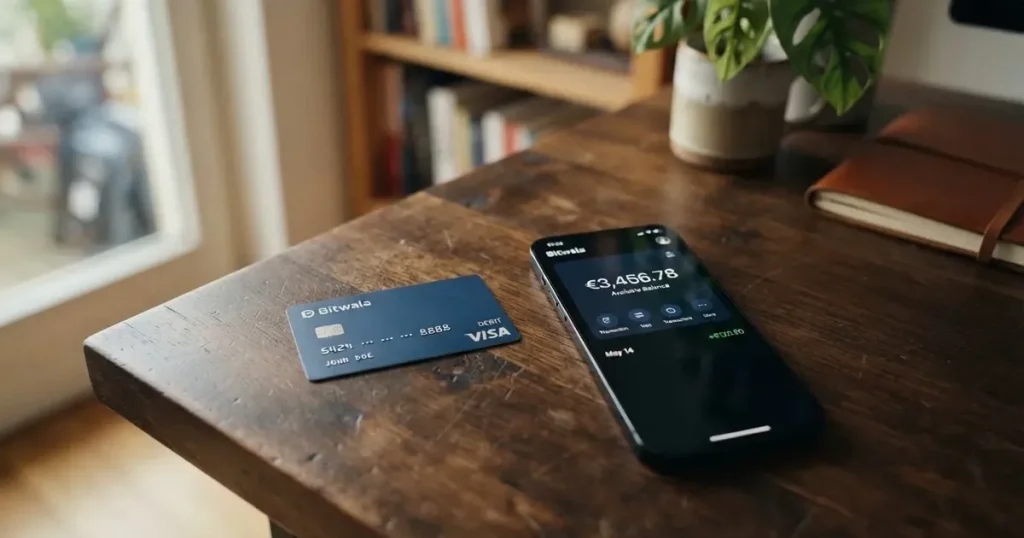
Bitwala is a German company that pairs a euro account with a Visa debit card. You can fund that card from a euro balance, or from Bitcoin, Ether or USDC that the app converts to euros before the card spends. For anyone in the EEA who wants a normal-looking card paid from a crypto balance, the basic idea is straightforward. The harder questions are about who actually issues the card, what the all-in cost looks like for everyday payments, and what the 2022 insolvency of the previous company, Nuri, means for the Bitwala name today. I went through Bitwala’s public pages, the news around the Nuri wind-down, and the rules crypto cards live under in the EU, and I lay it out below.
The information in this review is current as of October 28, 2026.
Verdict
Bitwala scores 6.1 out of 10. The number is built from the six criteria below, each marked out of 10.
| Criterion | Mark | Reason |
|---|---|---|
| Who can get it | 5/10 | Verified account and EEA residency only; the rest of the world is excluded. |
| Cost | 7/10 | The account and the subscription are free, euro payments cost nothing, but crypto payments add €0.20 + 1% and the ATM fee is €2 + 1%. |
| Top-up options | 6/10 | Bitcoin, Ether, USDC and euros are supported, and the conversion happens in the app, but the specific blockchains are not named. |
| Reliability and complaints | 5/10 | The euro account and IBAN sit with Solarisbank, a licensed German bank, but the card issuer is not named publicly, and the 2022 insolvency of Nuri (the previous name) still colours the picture. |
| Everyday use | 8/10 | It is a Visa debit with both virtual and physical versions, Google Pay works, Apple Pay works through Curve, and the app lets you freeze the card and set limits. |
| Total | 6.1/10 | A euro Visa debit for an EEA resident who wants to spend a crypto balance, held back by a narrow audience and an unstated card issuer. |
In plain English: if you live in the EEA, you can hold euros and crypto in the same Bitwala app, convert crypto to euros when you want to spend, and use a Visa debit that works much like any other European card. That core flow is simple, and the everyday cost in euros is genuinely low. The card is not aimed at a global audience, the person who actually issues it is not stated on the public pages, and the Bitwala name still carries the shadow of the 2022 Nuri insolvency. If any of those three points matters to you, read the rest of the review before you sign up.
Who will they give you the card
Bitwala says it gives the card to “anyone with a verified Bitwala account and residency in the EEA”. That is the short version, and it is the line I would plan around. Two things follow from it.
First, eligibility is by residence, not citizenship, which is the more permissive of the two tests. A US citizen living in Berlin qualifies on residence; a German citizen living in Dubai does not. The reason this matters is that sanctions and issuer risk policy are often applied to citizenship and country of birth as well as to the country of address, so even when the headline test is residence, the underlying checks may still look at where you were born or hold a passport.
Second, the rule is EEA-wide, so you do not have to be in Germany to qualify. France, the Netherlands, Spain, the Nordics and the rest of the EEA member states are all in. Outside the EEA the offer does not extend, so this is not a card for a global crypto user. If you live somewhere the EEA does not reach, you will need to look at a different option in the comparison section below.
The cards themselves come in two versions: a virtual Visa debit and a physical Visa debit. The card is denominated against your euro account, even though Bitwala does not state a card currency separately on the public page.
How to get it
Sign-up starts with the Bitwala app and runs through a standard KYC check. Bitwala describes registration as “instant”, with the verified account then giving you access to the card. The specific identity documents, the proof of address and the minimum age are not stated on the card pages, so I cannot give you a checklist. The general shape of an EU crypto onboarding looks like name, date of birth, address, nationality and an identity document, plus a sanctions check and a politically exposed person (PEP) screening, and if any of that cannot be completed the institution is required to step back from the relationship. I would expect Bitwala’s flow to look like that, but the exact set of fields belongs to the in-app form, not to the marketing page.
Two practical points about the card itself:
- Virtual card: a one-time €0.99 to issue, useful for online subscriptions and for trying the card out before the physical version arrives.
- Physical card: a one-time €9.99, plus shipping on top. The countries it ships to and the delivery time are not stated, so if you need a card by a particular date I would write to support first rather than assume.
If you lose the physical card, the app lets you freeze it, and you can order a replacement. The replacement price is not stated.
There is no published tier structure (no Silver / Gold / Platinum split) and no different KYC levels for higher limits. The card programme is one tier.
What it really costs (Fees)
The cost picture has a clear base, a few small extras, and a couple of blank spots you should not fill in yourself.
| Fee or limit | Amount |
|---|---|
| Account | Free |
| Monthly subscription | None |
| Virtual card issuance | €0.99 one-time |
| Physical card issuance | €9.99 one-time, plus shipping |
| Euro payment | Free |
| Crypto payment | €0.20 + 1% per transaction |
| Foreign exchange (FX) fee | Not stated separately |
| ATM withdrawal | €2 + 1% |
| ATM free allowance | Not stated |
| Daily and monthly limits | Not published; can be set in the app |
A few of these numbers are worth dwelling on, because what they mean depends on what you actually do with the card.
Paying a café bill in euros in Berlin. The card pulls from your euro balance and the payment is free, so this is the cheapest way to use Bitwala. The only drag on the cost is the FX line on the card statement if the merchant settles in a different currency, and that line is not stated separately on the public pages. If you are spending inside the eurozone, you should not see an FX line at all.
Paying a streaming subscription in dollars, paid from a crypto balance. First you convert crypto to euros in the app at the in-app rate, which carries the 1% plus €0.20 the moment you spend. Then your euros may be converted to dollars by the card network, and that second conversion does not have a published Bitwala fee attached to it. So a dollar subscription paid from Bitcoin can quietly stack two costs: the crypto-payment fee and an unstated FX fee. The right thing to do is to test with a small payment first and look at the actual settlement on the statement, not on the in-app estimate.
Taking cash out of an ATM in a non-euro country. On top of the €2 + 1% you will likely see a foreign-currency conversion by the ATM operator or the card network. The free allowance is not stated, so I would not assume there is one.
The free-euro-payments line is the real strength here. If your day-to-day spending is in euros and you keep euros on the card, the cost is essentially zero per transaction, which is not a common shape for a crypto-linked card.
Top up
Bitwala takes four assets: Bitcoin, Ether, USDC and euros. Crypto is swapped to euros in the app, and the card then spends those euros. The networks on which the crypto arrives are not stated on the card pages, which is a real gap. USDC, for example, exists on dozens of networks (Ethereum, Solana, Base, Polygon PoS, Avalanche, Arbitrum, Stellar and more), and transfers are irreversible: send USDC on a network Bitwala does not support, or to an address of another network, and the funds can be lost or stuck in manual support recovery with no guarantee. Treat the network question as a blocker, not a footnote, and check the deposit screen in the app before you send anything.
A short tour of what each top-up path means in practice:
- Euros by SEPA. The Bitwala home page mentions SEPA funding without fees, which is the most predictable option. A normal SEPA credit transfer from another EEA bank should land on the euro account at no Bitwala cost, although your sending bank may charge its own fee.
- Crypto to the in-app wallet. Bitcoin, Ether or USDC arrives at the deposit address the app shows you, and you sell some of it for euros in the same app at the in-app rate. The cost of that step is the 1% + €0.20 you will see again at payment time, but you can also choose to convert at top-up time and hold euros for later.
- On-chain gas. Whatever the deposit, the blockchain charges its own fee (gas on Ethereum, bandwidth and energy on Tron, and so on), and that fee is paid by the sender, not by Bitwala. If the wallet you are sending from has no native token for fees (for example USDT but no ETH on Ethereum), the transfer will not go through.
There is no published list of supported countries for top-up beyond the EEA residency rule. Withdrawal mechanics are not stated either, and the historical reference point here is not reassuring: when the previous entity Nuri was wound down, customers were told to withdraw by 18 December 2022, which is a reminder that withdrawal paths on a crypto platform are part of the cost picture, not an afterthought.
Paying with it every day
Once the card is loaded, everyday use looks like a normal European Visa debit.
- Contactless and online payments work in the usual way. Bitwala does not publish a list of blocked merchant categories, so I cannot tell you whether, say, gambling (MCC 7995) is allowed on the card. If that matters, the in-app support centre is the place to check.
- Google Pay works. You add the card through the Google Wallet flow and the tokenised Device Account Number is what the phone presents at the terminal.
- Apple Pay works “if you sign up with Curve”. Curve is a separate UK-based wallet that fronts the Apple Pay integration; you add the Bitwala card to Curve and Curve presents the tokenised number to Apple Pay. It is an extra hop, and it is worth knowing about because Apple Pay is often the first thing people try to set up.
- ATM withdrawals are available, at the cost described in the fees section.
- Limits and freezes are managed in the app. You can set your own daily and monthly limits and freeze and unfreeze the card, which is the right tool to have if the card number leaks through a data breach or a phishing page.
- 3-D Secure is part of the standard Visa flow, so online card payments will sometimes ask for an extra confirmation (a one-time code or a biometric prompt) when the issuer considers the transaction risky.
- Rewards and cashback are not stated on the card page. Do not expect any.
One practical thing worth flagging for foreign merchants: a Visa debit issued in Germany can look “foreign” to a US merchant that runs Address Verification Service, because AVS mainly covers US, Canadian and UK addresses and is generally unavailable for foreign-issued cards. That can produce a decline even when the card is fine. It is not a Bitwala-specific problem, it is a category problem, and it is the kind of thing that gets blamed on the card when it is really about the merchant’s fraud rules.
What can go wrong
There are three areas I would weigh carefully.
The 2022 insolvency of Nuri. Bitwala was previously called Nuri. In August 2022 Nuri filed for insolvency, in October 2022 it announced it was winding down, and customers were told to withdraw funds by 18 December 2022. Digital-asset trading stopped on 30 November 2022. The brand re-emerged as Bitwala, but the wind-down is part of the history of the name. The lesson is not that Bitwala today is the same company as Nuri in 2022, the lesson is that a single-licence crypto platform with a small banking partner is a thin structure, and the cards and balances it holds depend on those partners staying solvent and willing. The current company is Bitwala GmbH in Germany, and the euro account and IBAN are provided by Solarisbank, a licensed German bank. That is a more reassuring set-up than the Nuri version, but it is still a relationship with a partner rather than a self-custody wallet.
User complaints from 2022. A Trustpilot review from July 2022 reported SMS and card functions failing, an account being suspended without explanation, and support being unreachable. A Google Play review from October 2022 reported a locked account, with access later restored. The current Trustpilot score and review count were not available to me, so I cannot tell you whether the picture has changed. Take the 2022 reports as a reminder of what failure looked like for users, not as a verdict on today’s product.
The card issuer is not named. The public card pages do not say which bank or e-money institution actually issues the Bitwala Visa. That is a meaningful blank. A card programme usually sits with a licensed issuer, and the issuer is the party that handles disputes, holds the BIN, and ultimately stands behind the card. When the issuer is unstated, the user has to do more work to find out who their counterparty is on a chargeback or a programme change. I would ask support to confirm the issuer before I relied on the card for any spend I could not afford to lose.
A few other small risks to keep in mind, all of them category-level rather than Bitwala-specific:
- Stablecoin depegging. USDC is the stablecoin Bitwala lists, and USDC held its peg through the March 2023 US banking scare only because the US government backstop kicked in. A future depeg would briefly change the value of your USDC balance.
- Custodial counterparty risk. When your balance is on a custodial platform, the platform holds the credentials and you rely on its solvency and its security. The history of the category includes Mt. Gox, Coincheck and Ronin, and the rule is the same in all of them: holding funds with a custodian is a bet on the custodian.
- Programme closure. Card programmes can be wound down by the network. Visa terminated its global agreements with FTX in November 2022 and the FTX US debit was wound down by its issuer. The pattern is the same each time: a notice period, then spending stops, then a window to withdraw the remaining balance. If you keep a meaningful balance on a crypto card, you want an off-ramp you have already tested.
What to take instead
Bitwala is one option among several. The right alternative depends on which of Bitwala’s limits is biting you. The three below are not in a ranked order; they are the three I would actually compare against.
International Visa Card
The International Visa Card from the same shortlist scores 6.7 out of 10. It is a US-issued Platinum Visa, virtual for now with the physical version listed as “coming soon”, and it pays in US dollars. The plan structure is explicit: a free Classic plan, a $9.00/month Pro plan and a $19.00/month Max plan, with a $5 one-time fee for the virtual card and no maintenance fee. Card spending in US dollars is free on all plans, and the foreign-currency line is a clear “Visa exchange rate + 2% FX fee”. Deposits of any kind are free, and the funding list is broader than Bitwala’s: USDC and USDT into a USD account at 1:1, plus US dollars, euros, SEPA, SWIFT and FedNow. The country list is the reason to read it carefully: the card is not available to residents or legal registrants of a long list of countries, and FATF grey-list countries are reviewed case by case. Purchases are blocked in a separate, smaller set of countries, including Russia and Ukraine. If Bitwala’s EEA-only rule excludes you and you are in one of the International Visa Card’s supported countries, that is the most natural pivot.
UNi Card
UNi Card scores 6.1 out of 10, the same overall mark as Bitwala but for different reasons. It is a multicurrency Mastercard on the UNi.Global account, and the headline is “no annual fee or foreign transaction fee”, with conversions at live OTC rates and no hidden exchange fees. The flip side is that the country list, the issuance fee and the funding options are not stated on the public pages I read, so you would have to confirm those before relying on it. The “Spend-to-Earn rewards” line is the real draw here: up to 3% back with UNi Card, where Bitwala offers no rewards at all.
Morse
Morse scores 7.5 out of 10, the strongest of the four. The Morse Card is “fully virtual for now”, a Visa prepaid debit, and it spends from a Morse Balance in any currency. The fee picture is unusually clean: “zero foreign exchange fees or markups” at the real-time Visa rate, no markup on conversions, and “paying with the Morse Card, online and contactless, is free”. Deposits are by debit card, stablecoin transfer, or Account Details in USD, EUR, MXN and COP, and USDC, USDG and EURC on Solana are free to deposit, with other tokens and chains carrying a fee. The wallet is self-custodial, which is a different model from Bitwala’s: the funds stay in your own wallet until the moment of payment, and you carry the responsibility for key loss, phishing and clipboard-hijacking malware. The audience is much wider than Bitwala’s, with the app in “over 140 countries” and local add/withdraw in over 70, but eligibility is still by residence, not citizenship, and the card itself is “available only in certain countries” (the list is checked in the app, not published on the card page). A long closed-beta list (the UK, Switzerland, Singapore, Australia, Japan and more) needs an invite code. If you want a low-fee, self-custody, multicurrency card and you live somewhere Bitwala does not reach, Morse is the one to look at first.
Who I would recommend it to
I would point Bitwala at a fairly specific kind of reader. If you live in the EEA, you already hold Bitcoin, Ether or USDC and you want a euro-denominated Visa debit that draws from a balance you can top up in crypto, the basic flow does what it says. The everyday euro payment is free, the app freeze and limit controls are useful, and the Google Pay integration plus a Curve bridge for Apple Pay cover the wallet side. For someone with that profile, Bitwala is a reasonable place to keep a small euro balance and a crypto balance side by side.
I would not point Bitwala at everyone else. If you live outside the EEA, the residency rule stops you at the door. If you are looking for a global, multicurrency card, Bitwala’s euro-only account and unstated card issuer do not give you the breadth you want. If you want self-custody, the Bitwala wallet is custodial and you do not get to hold your own keys. If you want a rewards line or a cashback programme, Bitwala does not publish one. And if the Nuri insolvency is a concern for you, treat the Bitwala name with the same caution you would treat any rebrand of a wound-down crypto platform: ask who the card issuer is, ask what the balance actually sits on, and keep only what you are willing to lose.
The honest summary is that Bitwala is a euro Visa debit for an EEA resident who wants to spend a crypto balance, and the cost in euros is low. The honest warning is that the card issuer is not stated publicly, the 2022 Nuri insolvency is part of the brand’s history, and the user experience outside the EEA is a closed door. Score 6.1/10 is the right shape for that combination: not a bad card, not a complete one, and not a card to commit a large balance to without doing the rest of the homework first.
Frequently asked questions
What is the Bitwala card?
The Bitwala card is a Visa debit, available as a virtual or physical card, that spends from a Bitwala euro account. The account can be funded in euros or in Bitcoin, Ether or USDC, with the crypto converted to euros inside the Bitwala app.
How does the Bitwala card work?
You top up the euro balance from euros by SEPA, or you send Bitcoin, Ether or USDC to the in-app deposit address and convert to euros in the app. The card then pays merchants in the normal Visa way, drawing from that euro balance.
Is Bitwala a bank?
Bitwala is not a bank. Bitwala GmbH is a German company, and the euro account and IBAN are provided by Solarisbank, a licensed German bank. The card issuer is not named on the public pages.
Who owns Bitwala?
Bitwala GmbH is incorporated in Germany. The wider ownership is not stated on the card pages. The previous brand name was Nuri, which filed for insolvency in August 2022 and was wound down later that year.
Is the Bitwala card available in my country?
Bitwala says the card is for “anyone with a verified Bitwala account and residency in the EEA”. If you are not an EEA resident, the card is not offered to you under the current rules, regardless of your citizenship.
How do I get the Bitwala card?
Sign up in the Bitwala app, complete the verification, and order the virtual card for €0.99 or the physical card for €9.99 plus shipping. Registration is described as “instant” and the verification documents are not listed on the public page.
Does the Bitwala card require KYC?
Yes. A verified account is a precondition for the card. The exact list of documents, the proof of address and the age rule are not stated on the card pages, but the standard EU onboarding covers name, date of birth, address, nationality and an identity document, plus a sanctions and PEP check.
How do I top up the Bitwala card?
By SEPA in euros, or by sending Bitcoin, Ether or USDC to the deposit address the app gives you and converting to euros in the app. The blockchains accepted for crypto deposits are not stated, so check the in-app deposit screen before sending.
Is the Bitwala card free?
The account and the subscription are free. Euro payments are free. The virtual card is €0.99 one-time, the physical card is €9.99 one-time plus shipping, crypto payments cost €0.20 + 1% per transaction, and ATM withdrawals are €2 + 1%. An FX fee and ATM free allowance are not stated.
Is the Bitwala card safe to use?
The card has the standard safety tools: app-based freeze and unfreeze, user-set limits, and 3-D Secure for online payments. The structural risks are the unstated card issuer, the 2022 insolvency of the previous Nuri entity, and the general custodial-platform risks that come with any non-self-custody crypto balance.
App and neobank cards on the shortlist – cryptocardshortlist
Content created by the «cryptocardshortlist» team