
Ruvo card review: spending dollars from a self-custody wallet, with Pix at the front door
 Available in US
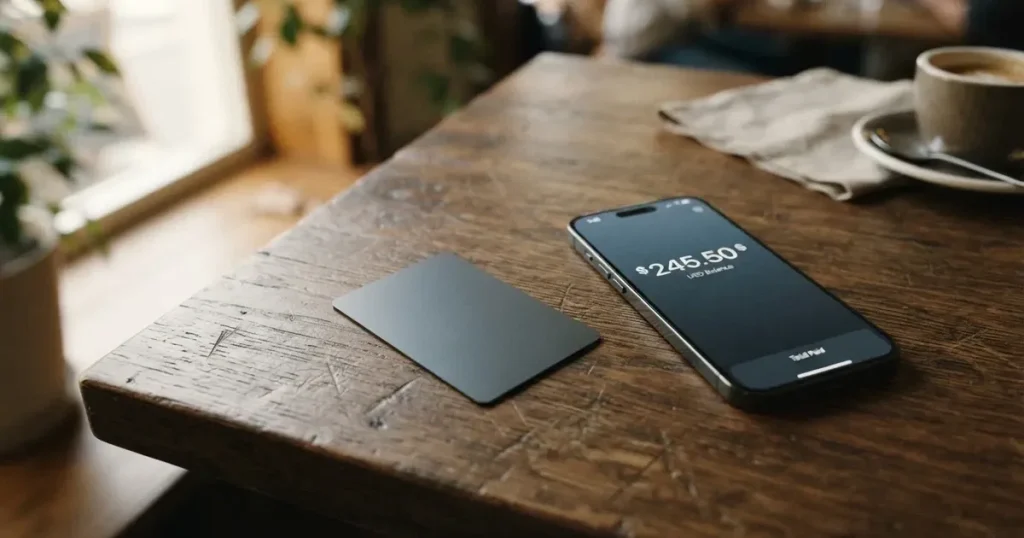
I went through Ruvo’s card page and terms, looked for complaint threads, and compared what they publish with what people search for about the product. Ruvo is unusual in one specific way: it leans heavily on Pix in Brazil while presenting itself as a US dollar card. That tension is the story of this review. If you live in Brazil and move dollars from a self-custody wallet, the design is built around you. If you don’t, a lot of the page is describing someone else’s use case.
The conditions below are current as of October 28, 2026.
Verdict
Ruvo scores 6.1 out of 10. The number reflects a real strength on cost in the dollar and the Pix path, weighed against gaps where the company simply hasn’t published the figure: an issuance fee, monthly fees, ATM access, the network of the card, and which entities back the programme. The card page says “accepted worldwide” and then narrows the practical story to Brazil (Pix funding) and the United States (USD balance). If you’re outside that corridor, you’re betting on a product that hasn’t explained itself to you.

Where Ruvo fits: Brazil-based users who want to fund a US dollar card with Pix, and US-based users who want to top up in dollars and spend in dollars without paying a foreign transaction fee. The earlier material on the card also describes USDT coming from a self-custodial wallet, which means people who already hold their own keys get a clean bridge to a payment card.
Where it does not fit: anyone who needs a published issuance fee, monthly fee, ATM policy, or physical card before signing up; people outside the US and Brazil; anyone uncomfortable with a card programme whose issuer is unnamed in the public documents.
Score
| Criterion | Mark | Reason |
|---|---|---|
| Who can get it | 5/10 | “Accepted worldwide” with Brazil (Pix) and the US (USD balance) called out; availability “varies by jurisdiction, user type, provider, and product.” |
| Cost | 8/10 | USD purchases carry no fee, non-USD purchases add 1% foreign transaction fee plus the exchange rate, IOF 0%, Pix example 0.5% conversion; issuance not disclosed. |
| Top-up options | 5/10 | Reais via Pix or dollars, under a minute; previously USDT from a self-custody wallet and ACH/wire for USD; specific coins and networks not listed. |
| Reliability and complaints | 6/10 | Ruvo Financial Inc., “NOT A BANK”, issuer not named, partners licensed in the US and Brazil; no public complaints found; App Store 4.9 across 31 ratings. |
| Everyday use | 6/10 | Virtual card in USD, Apple Pay and Google Pay supported; physical card and ATM access not disclosed. |
| Total | 6.1/10 | Strong on cost in the dollar, weak on transparency elsewhere. |
Will they give you the card
Ruvo’s card page says the card is “accepted worldwide” and highlights two corridors: Brazil (funding in reais through Pix) and the United States (balance held in US dollars). The terms then narrow that claim. Section 1.1 says availability “varies by jurisdiction, user type, provider, and product.” Section 1.4 lets Ruvo restrict access by jurisdiction and sanctions, and asks the user to confirm they are not on a US, UN, EU, UK or Brazil sanctions list.
For a reader weighing this up, the practical translation is: the card is sold as global, but the people who can realistically load and spend it today are in Brazil or the US, or in places where the partner rails reach. There is no published country list to check your location against before you download the app, and there is no residency-based sign-up flow described. Ruvo’s own framing in the terms is that nothing is guaranteed until the partner side has approved you.
The terms also require users to be at least 18 years old. There is no separate minor pathway or family product described.
How to get it
The card page presents a digital, in-app experience. The product is a virtual card in US dollars, managed in the Ruvo app: you can view the card details, freeze it, set a PIN, replace it, set spending limits, and add it to Apple Wallet. Ruvo does not publish the steps to sign up on the card page. The terms do spell out what the partner side will ask for when you try: legal name, date of birth, address, government ID, taxpayer ID, and biometric verification. If the partner cannot complete that check, the consequences listed in section 3.4 are limits, suspension, or termination of the account.
What I couldn’t confirm: whether a physical card is offered at all, the network on the card, how long delivery takes, and what the per-user KYC limits are. The card page shows only a digital card and the wallet setup. Unofficial reporting from Brazil Journal in January 2026 describes a Visa Platinum card for USD spending; Ruvo’s own pages do not name Visa or Mastercard.
So as a reader, the workflow looks like this on paper. Download the Ruvo app, create an account, go through the partner’s identity checks, get a virtual card, top it up, and add it to your phone wallet. At every step the missing details (network, physical card, KYC levels) only become clear when the app shows them to you. If you prefer to make decisions from a website first, Ruvo is not set up for that.
What it really costs
This is where the card has its clearest advantage and its clearest gap.
The published fees are good in the dollar. A purchase in USD carries no Ruvo fee. A purchase in another currency carries a 1% foreign transaction fee on top of the exchange rate that applies. IOF — the Brazilian tax on foreign-exchange transactions — is 0%. Ruvo gives a worked example on the card page: a Pix of R$1,000 converts to roughly 196.41 USDC at a rate of 5.0915 BRL per USDC “after a 0.5% fee.” The Pix path therefore costs 0.5% on top of the rate shown, with no IOF on top.
Unofficial reporting from Brazil Journal (January 2026) puts individual conversion fees at 0.9% for USDT to USD or BRL and 1.8% for USD to BRL, with businesses at 0.2% and 0.4% and crypto-to-crypto conversion free. These figures are not in Ruvo’s own pages.
The gaps on the public documents are the ones that usually matter to readers. Ruvo has not published an issuance fee or a monthly fee, has not published an ATM fee or whether ATM access exists at all, and has not published minimum top-up amounts. The card’s spending is capped by the balance you have loaded — there is no credit — and you choose how much of your Ruvo balance is exposed to the card at any time. That is a sensible design but it is also a limit, not a benefit, and it is one of the reasons this card is hard to compare to a credit-card product.
Costs
| Fee or limit | Amount |
|---|---|
| Issuance fee | not stated |
| Monthly fee | not stated |
| USD purchase | no Ruvo fee |
| Non-USD purchase | 1% foreign transaction fee + applicable exchange rate |
| Pix conversion (worked example) | 0.5% fee + spot rate; IOF 0% |
| IOF (Brazil) | 0% |
| ATM fee | not stated |
| Daily spending limit | not stated (user-controlled in app) |
| Monthly spending limit | not stated (user-controlled in app) |
| Card network | not stated on Ruvo’s own pages |
Top up
Funding is one of the two areas where Ruvo is concrete. The card page lets you “add money in reais (Pix) or dollars” and says the funds arrive in under a minute. The 0% IOF applies to that flow. The example on the page shows the 0.5% Pix conversion fee I mentioned in the cost section. If you top up via blockchain, terms section 4.7 warns that on-chain network fees fluctuate and are separate from anything Ruvo charges.
Earlier in the product’s history, the funding path included USDT from a self-custody wallet, and ACH or wire for USD. Ruvo’s own wallet is self-custodial: the terms say Ruvo does not hold private keys and does not custody fiat (4.2), so the dollars you load are sitting in regulated partner accounts rather than on the wallet. The current card page does not list the specific coins or blockchain networks you can deposit from. That is worth knowing if you only hold a token on a network Ruvo’s partner doesn’t support.
There is no published minimum top-up. Closing the account is by email to [email protected] or [email protected], processed within a reasonable time, and closing Ruvo does not affect the self-custodial wallet, which is yours.
What I’d check before topping up: which stablecoins are accepted today, on which networks, and whether the address the app shows you matches the network you intend to send on. Sending a token to an address of the wrong network is the classic irrecoverable mistake in this product category, and Ruvo’s page does not list the supported networks.
Paying with it every day
The card is virtual, denominated in US dollars, and managed in the app. Apple Pay and Google Pay are supported, which covers both contactless in store and most online checkouts. There is no published list of blocked merchant categories, and no rewards, points or cashback programme described anywhere in the public material. If you’re comparing cards for perks, this is the section where Ruvo loses ground.
The Ruvo app on iOS is called “Ruvo – Global Dollar Account” and, as of 2026-10-21, sits at 4.9 from 31 ratings, with version 2.1.9. Google Play is listed on the site; the rating was not read for this review. A 4.9 with 31 ratings is a small sample, so I would treat it as “no red flags so far” rather than “loved at scale.”
The terms give a clear picture of who owns a dispute. Section 4.11 says fiat and card transactions may be returned, reversed or charged back, and the user stays liable. Section 4.4 puts fiat-rail disputes on the partner’s rules. Section 10.3 says informal resolution comes first, and Ruvo has up to 30 days to respond. The help-centre FAQ that would answer a day-to-day question like “what happens if my card is declined” is not visible on the public pages, which is a friction point: you only find out what the FAQ says after you are a user.
Two things I would treat as everyday-use assumptions, not promises. First, that a virtual USD card will be accepted by US merchants who use address verification, because AVS works mainly in the US, Canada and the UK, and a card issued through a non-US partner rail can fail AVS. Second, that a card with no public rewards programme is competing on cost and simplicity, not on perks, so the comparison with cashback cards like KAST and MetaMask Card comes down to fees, not back.
What can go wrong
The honest answer is that I could not find a public complaint thread to read. There is no Trustpilot page for ruvo.com as of 2026-10-21, and no user complaints came up in search. The App Store rating is high but small. So the risk picture is what you can build from the terms, the company disclosures, and the category.
On the company side: the operator is Ruvo Financial Inc., the terms are governed by Delaware law (10.4), and the marketing copy is explicit: “NOT A BANK.” Ruvo works with regulated partners in the US and Brazil. The card issuer is not named in the public documents, which is a meaningful gap: a card programme’s protections — chargeback rights, fraud handling, scheme-level recourse — depend on the licensed issuer, and Ruvo’s pages do not tell you which bank or e-money institution is on the other end. Ruvo itself does not custody funds and does not perform regulated activities in Brazil; the partners hold VASP and payment licences (4.3). The company has its headquarters in Brazil and a CEO, Alec Howard, named in coverage. 2026 These are positive signals for a young company but they are signals, not assurances.
On the product side: the self-custody wallet is a real safety feature. Ruvo does not hold your private keys, so the worst-case where the company disappears is that you still own your wallet and your tokens. The fiat you have loaded is, however, in partner accounts, and Ruvo’s own documents warn that those funds are not FDIC- or SIPC-insured. Card freeze and PIN are available in the app. Two-factor authentication is not described on the card page, so I would treat it as something to set up the moment the app offers it.
On the dispute side, terms section 10.3 lets Ruvo take up to 30 days to respond to a complaint, which is long for a payment card. If a problem goes to the partner’s dispute process, that adds another layer of time. Crypto-to-fiat transactions are, as a rule, hard to reverse once executed, and Ruvo’s terms put the liability for the transaction on the user.
On the regulatory side, the card is described as global while the practical footprint is the US and Brazil. If you sit outside both, the conditions of your access depend on partners Ruvo names only in the app.
The support channels listed are the help centre at ruvo.com/help, WhatsApp, and [email protected]. Languages are Portuguese and English. Hours are not stated.
What to take instead
A single card review has to do two things: tell you whether the card is right for you, and tell you what to look at if it isn’t. The alternatives below are listed because they cover the same ground as Ruvo — a card funded by crypto, often with self-custody in the design — and they happen to publish more of the details Ruvo keeps off the page. I haven’t used any of these cards; these are notes from their own terms and pages.
TokenPocket (TP Card) — 5.8/10
A Visa debit card for a list of European countries (Germany, France, Spain, Switzerland among them) and a Mastercard debit for Australia, Canada, Hong Kong, Japan, Taiwan, New Zealand, Singapore, South Korea and the UK. The cards run on Arbitrum and the balances are EUR24 and USD24. There is an NFT creation fee that TokenPocket partly covers, and the FAQ says “Apart from these, TP Card does not charge any additional fees.” The visible fee is a 1% deposit fee when you move crypto into the card, which the page says will be refunded later through rewards or reduced transaction fees. FX fees aren’t stated, and other fees can come from inter-institution settlement. No cashback. If you want a euro balance, TokenPocket is a more honest fit than Ruvo; if you want a Pix corridor, Ruvo is.
MetaMask Card — 7.1/10
Open in 45 listed countries and territories — Andorra, Argentina, Brazil, Canada, Mexico, Germany, France, Spain, Uruguay are examples — with a waitlist elsewhere. Proof of residency is required and “ineligible regions limit sign-ups, not spending.” US and UK sign-ups are temporarily closed per the FAQ. The card is a Mastercard, virtual first, with a Metal version that can be pre-ordered. One card per user. The issuer is Monovate, with Crypto Life as card provider. Virtual is free, no annual or maintenance fee; Metal is $199 a year. A “minimal fee” applies per transaction and the fee table is linked from the page. No foreign transaction fee, Mastercard’s rate applies. Spending is direct from the connected wallet on Linea, Base, Monad or Solana, and the tokens named include mUSD, wETH, EURe, GBPe, USDC and USDT. Cashback is paid in mUSD: 1% on Virtual, headline 3% on Metal with a footnote that caps 3% at the first $10,000 spent and drops to 1% after that. MetaMask Card is the cleanest comparison to Ruvo in a non-Pix context, with a real issuer, a real fee page, and a real cashback line.
KAST — 6.1/10
The KYC is residence-based: if your country isn’t listed at sign-up, the product isn’t available. A Restricted Locations list is referenced but the countries aren’t named on the public pages, and dual citizens whose ID is from a supported country can pass. Only the account holder’s own ID is accepted and a VPN does not bypass. KAST offers virtual and physical cards, up to 10 per user, with Visa Platinum (Standard), Visa Infinite metal (Premium) and Visa Infinite gold plated (Private) tiers, plus themed designs. Account balance in USD; stablecoin deposits convert 1:1 with 0% spread. Annual membership: Standard 0 USD, Premium 1,000 USD, Private 10,000 USD, billed annually upfront with no monthly option. Extra virtual card 2 USD; Standard physical card 0 USD card fee plus 40 USD delivery; Premium and Private physical cards are included; inactivity fee 1 USD a month after 12 months. Stablecoin top-up 0%, USD card spend 0%, Apple/Google Pay 0%, non-USD FX fee between 0.5% and 1.75% depending on residence country, transaction country and card programme; non-USD transactions under 25 USD add 0.10 USD; declined transactions for insufficient balance add 0.50 USD. Funded in USDT, USDC, PYUSD or RLUSD on Ethereum, Solana, Polygon, Arbitrum or TRON. Cashback in USD: 1.5% on the first 2,000 USD a month (Standard), 2% on the first 10,000 (Premium), 3% on the first 40,000 (Private), with extra KAST Points for Premium and Private. KAST is the most direct competitor in the no-fee, stablecoin-funded, multi-network category, with the trade-off of an annual membership if you want a premium tier.
How Ruvo stacks up
| Card | Score | Where it works | Card currency | Visible fees | Cashback |
|---|---|---|---|---|---|
| Ruvo | 6.1/10 | Brazil and US corridors; “worldwide” in marketing | USD | USD 0%, non-USD 1% FX, Pix 0.5% example | not stated |
| TokenPocket | 5.8/10 | EU list and APAC list; Americas “planned” | EUR24 / USD24 | 1% deposit fee, refunded later | none stated |
| MetaMask Card | 7.1/10 | 45 listed countries; US/UK sign-ups paused | not stated | minimal per-transaction fee, no FX fee | 1% (Virtual), 3% then 1% (Metal) |
| KAST | 6.1/10 | Residence-based list, not published | USD (stablecoin 1:1) | 0% USD spend, 0.5–1.75% FX, 0.10 USD small-ticket, 0.50 USD decline | 1.5–3% on tier caps |
If Pix is your everyday top-up, Ruvo is the only card in this set built around that rail. If you want a self-custody card in dollars with a public fee page and a real issuer, MetaMask Card is the stronger shortlist. If you want a stablecoin-funded card with no FX in USD and a tiered cashback line, KAST is the one to look at. TokenPocket is a useful fit for a euro balance.
Who I would recommend it to
I’d recommend Ruvo in one specific case. You live in Brazil, you have a self-custody wallet or a Pix account, and you want a US dollar card that funds cheaply in reais, spends at no Ruvo fee in USD, and has Pix at the front door. For that reader the 0.5% Pix conversion example and the 1% foreign transaction fee for non-USD spending are the numbers that matter, and the rest of the page reads as marketing.
I would not recommend Ruvo to a reader outside the US and Brazil, to anyone who needs a published ATM policy before signing up, to anyone who needs to see a real card issuer and a real card network on the website, or to anyone who expects a cashback or rewards line. I’d also be careful as a US-only user: the company and partner side are Brazil-heavy, and the support language list is Portuguese and English. If your life is in dollars, MetaMask Card or KAST give you a published issuer, published fees, and a published rewards curve.
The honest summary: Ruvo is a clean design for a narrow reader, with real gaps in what the public documents say. Where it works, the cost line is hard to beat in this category. Where it doesn’t, the gaps are the things you would usually check first on a card website — and they’re not there.
Frequently asked questions
What is the Ruvo card?
A US dollar-denominated virtual card, managed in the Ruvo app, designed to be funded in reais via Pix or in US dollars and spent at merchants that take card payments. Earlier descriptions of the product also support USDT from a self-custody wallet.
How does the Ruvo card work?
You create an account in the app, complete the partner’s identity checks, get a virtual card, top it up through Pix in reais or in dollars (or, per earlier material, USDT from your own wallet), and add the card to Apple Wallet or Google Pay. Spending is capped by the balance you have loaded, and you control how much of your Ruvo balance the card can see in the app.
Is Ruvo a bank?
No. Ruvo’s own pages say “NOT A BANK.” It works with regulated partners in the US and Brazil, and those partners hold the VASP and payment licences. Ruvo Financial Inc. is the operator, and the card issuer is not named in the public documents.
Who owns Ruvo?
Ruvo is operated by Ruvo Financial Inc. The company is headquartered in Brazil and lists Alec Howard as CEO. YC’s directory records the company as formerly called Cacao, and a 2026 seed round of US$4.6 million led by 1confirmation has been reported by industry press.
Is the Ruvo card available in my country?
Ruvo’s card page says “accepted worldwide” with Brazil (Pix) and the US (USD balance) called out, and the terms say availability “varies by jurisdiction, user type, provider, and product.” There is no published country list to check before downloading the app.
How do I get the Ruvo card?
The card page shows a digital path: download the Ruvo app, create an account, complete the partner’s KYC, receive the virtual card, and add it to your phone wallet. The page does not publish a step-by-step sign-up flow or delivery times for a physical card.
Does the Ruvo card require KYC?
Yes. Ruvo’s terms say partners may require legal name, date of birth, address, government ID, taxpayer ID and biometric verification, and that the user must be at least 18. If the partner cannot complete the check, Ruvo lists limits, suspension or termination of the account as possible outcomes.
How do I top up the Ruvo card?
You top up in reais via Pix or in US dollars, with funds arriving in under a minute. Earlier descriptions of the product also include USDT from a self-custody wallet and ACH or wire for USD. Ruvo’s current card page does not list which specific coins or networks are supported for on-chain deposits, and a blockchain network fee is separate from anything Ruvo charges.
Is the Ruvo card free?
Ruvo’s published fees are: no fee on USD purchases, a 1% foreign transaction fee on non-USD purchases plus the applicable exchange rate, 0% IOF, and a worked Pix example that includes a 0.5% conversion fee. Ruvo has not published an issuance fee, a monthly fee or an ATM fee on the public pages, so “free” depends on what isn’t on the page.
Is the Ruvo card safe?
The wallet side is self-custodial, so Ruvo does not hold your private keys, and a worst-case company failure doesn’t take your tokens with it. The fiat you load sits with regulated partners and is not FDIC- or SIPC-insured. The card issuer is not named in the public documents, dispute handling allows up to 30 days, and there is no public complaint thread I could find. Treat it as “no public red flags” rather than “vouched for at scale.”
Wallet cards on the shortlist – cryptocardshortlist
Content created by the «cryptocardshortlist» team