
A self-custody Visa with honest fees and a lot of blank spaces
 Available in US
Karma is the kind of crypto card that stops being a crypto card at the moment you spend. You hold your own keys, the balance is yours, and the card is a thin layer of Visa plumbing on top. That design is genuinely different from most of the field, and it is the reason to look at Karma at all. It is also why the product is hard to judge: a lot of the basics you would check first — what identity documents are needed, whether you get a plastic card or a virtual one, what your daily limit is, what currency the card holds — are simply not written down on the public pages.
I gave it 6.4 out of 10. That is a middling score that reflects a genuinely promising structure sitting next to a genuinely incomplete information set. The fees are the best part: a flat 0.5% per transaction, 1% on a fiat on-ramp, 0.5% to cash out, no subscription, no monthly fee, no signup fee. The everyday-use score is the worst part at 3 out of 10, because Apple Pay and Google Pay support is not stated, cash advances are not available, and the card type is undefined.
Who is this for? If you already keep your crypto in a self-custody wallet and you want to spend it without handing a custodian your keys, the idea fits you well. If you are looking for a metal card, a big cashback rate, a generous spending limit or a smooth Apple Pay experience, this is not the card to pick, and you will spend a lot of time asking support questions before you find that out.
The conditions described here are current as of October 28, 2026.
Score card
Here is how the card scored on each criterion, with the reasoning behind each mark.
| Criterion | Mark | Why |
|---|---|---|
| Who can get it | 8 / 10 | Issuance is blocked for residents or registrants of 17 named countries; other countries are not excluded, and FATF grey-list countries need case-by-case approval |
| Cost | 8 / 10 | No registration, subscription or hidden fees; 0.5% service fee per transaction; FX 1% on non-USD plus $0.30; 1% to buy crypto, 0.5% to withdraw |
| Top-up options | 5 / 10 | The card loads USDC, with Solana mentioned; USD, EUR and GBP are converted through Bridge into crypto; the coin list is not disclosed |
| Reliability and complaints | 6 / 10 | Cards issued by Third National under a Visa licence; Karma Fintech LTD, registration country not named, programme runs on Rain; no complaints found; App Store 5.0 from 6 ratings; the card terms are written like a credit line |
| Everyday use | 3 / 10 | Apple Pay and Google Pay not disclosed (unofficial sources say not supported); credit advances and ATM unavailable; virtual or physical not clarified |
Total: 6.4 / 10.
The shape of that table tells the story better than the total does. The top two scores are eligibility and price — the things you can find out before you commit. The bottom score is daily use — the thing you will live with every single day, and the thing the card is least forthcoming about.
Will they give you the card?
Short answer: probably, unless you live in one of seventeen specific places.
Issuance is blocked for residents or registrants of the following countries: Belarus, mainland China, Cuba, India, Iran, Iraq, Israel, Myanmar, Nepal, Nicaragua, North Korea, Russia, Syria, Turkey, Ukraine, Venezuela and Vietnam. The rule says *residents or registrants*, which is a residence and registration test, not a citizenship test. That is a reading of the published wording, not an assurance; the issuer applies its own policy on the ground. If you fall anywhere near that boundary, the only reliable answer is the one the support team gives you in writing.
Beyond that list, other countries are not excluded. Countries on the FATF grey list are handled individually, which in practice means additional checks and possibly a refusal with no appeal process described.
Spending is separately restricted in Cuba, Iran, North Korea, Russia, Syria, Ukraine and Venezuela — a narrower list than the issuance ban. So in some of the countries where you cannot get the card at all, and in some where you can, the card will decline or the platform will block the transaction.
One point of general context, because it explains why these lists exist. Merchants can look up the first six or eight digits of your card number — the issuer identification number — and see which institution and country issued it. If that country differs from your billing address, some merchants apply extra scrutiny or decline the payment outright. Cards issued in one country routinely look “foreign” to a shop in another. Nothing about that is specific to Karma; it is how the card network identifies issuers, and it is one of the reasons prepaid and foreign-issued cards get refused at the counter.
How to get it
Here I have to tell you something unhelpful: the card’s public pages do not state what the identity process is. Not stated — not “it’s easy”, not “it’s automatic”, not stated.
What the card terms do say is that there is no KYC process, and that you must confirm you are not a US citizen and not sanctioned. That is a short list of declarations rather than a verification routine, and for someone whose whole reason for choosing a self-custody card is to avoid handing over documents, it will sound appealing. It is also the single most important gap in this review. I am not going to fill it in for you.
One unofficial source — a third-party page describing a “Karma Card by Karma Wallet”, Visa, Solana and SEPA focus, which it assumes is the same product — lists the requirements as email, phone and an identity document, with no proof of address and no selfie. That is not confirmed by Karma and I could not date the page. Treat it as a rumour with a plausible shape, not as the answer to your question.
The card itself: a Visa. The App Store listing says the card is accepted at 80 million-plus merchants, which is normal Visa boilerplate and tells you nothing you do not already know. Whether you receive a physical card, a virtual card, or both is not stated, and neither is the currency the card holds. That combination of unknowns is what drops the everyday-use score.
Delivery is also not stated. The card terms mention that physical or virtual cards may be limited, and that replacements can be requested through the account, possibly with new numbers — no countries, no time, no cost. So if you are outside a major market, you have no basis for estimating how long you might wait or what it might cost to have one sent.
Practical advice, none of which is a workaround for anything: before you send a single document or a single coin, ask support three questions in writing — what documents are required, is the card virtual or physical or both, and what is the delivery time and cost to my country. If the answers are vague, that is itself information about how much support you will get after you are a customer rather than a prospect.
Fees: what it really costs
This is the strongest part of the product, and it is worth reading carefully because the numbers are unusually clean.
| Fee or limit | What it is | Value |
|---|---|---|
| Signup fee | One-off charge to open an account | None — “No subscriptions” |
| Monthly fee | Recurring charge to keep the account | None |
| Service fee | Per card transaction | 0.5% |
| FX fee | On spending in a currency other than USD | 1%, charged by Visa with no Karma markup (card terms cite up to 3%) |
| International fee | Flat charge on non-USD transactions | $0.30 |
| Buying crypto | Fiat on-ramp, converted via Bridge | 1% (“additional fees may apply”) |
| Selling crypto | Off-ramp back to a bank account | 0.5% |
| Swap | Converting between assets | 0.5% |
| ATM / cash advance | Cash withdrawals and balance transfers | Not available |
| Spending limit | Set by Karma; the issuer may add its own | No numbers stated |
Fee summary
- No signup fee, no monthly fee, no hidden charges. The company states plainly that there are no subscriptions.
- 0.5% per card transaction — a service fee on every purchase. This is the number to hold in your head, because it applies to everything you buy.
- 1% FX fee on non-USD plus $0.30. Spending abroad costs you the 0.5% service fee plus 1% FX and $0.30 on top of the exchange rate the network gives you.
- 1% to buy crypto, 0.5% to sell. A round trip through the on-ramp and off-ramp costs 1.5% before any network fee.
- A $KARMA token discount ladder. Holding the token reduces the swap-fee rebate and, at higher balances, the card service fee.
Token holding tiers
| Amount of $KARMA held | Swap-fee rebate | Card service fee |
|---|---|---|
| $10+ | 10% | Full fee |
| $100+ | 20% | Full fee |
| $500+ | 35% | Full fee |
| $2,500+ | 50% | 50% off |
| $5,000+ | 70% | 50% off |
| $10,000+ | 90% | Free |
There are no card-product tiers — no metal, no premium, no black. The only tier ladder is the token one, which is a lever on the fee structure rather than a status level.
Now, two or three everyday payments, with the fees applied, so you can see what the percentages actually do:
A €12 coffee in Berlin, card loaded with USDC. The 0.5% service fee is €0.06. The €12 is a non-USD transaction, so the 1% FX fee adds €0.12 and the $0.30 international fee adds roughly $0.30. Total on a €12 purchase: about €0.48. Small-ticket purchases abroad are where this card is most expensive in percentage terms, and the fixed $0.30 does most of the damage.
A $60 grocery shop in the United States. The 0.5% service fee is $0.30. If the card balance is in USD, there is no FX fee and no international fee. Total: $0.30. This is the card’s best case — domestic spending, USD, nothing exotic.
A $1,200 flight booked in a third country, paid from a EUR-denominated account. The 0.5% service fee is $6. The 1% FX fee is $12 and the $0.30 international fee adds a little more. Total around $18 on $1,200 — roughly 1.5%. Here the percentages behave as you would hope; the problem is concentrated in small payments, not large ones.
Worth knowing about the exchange rate itself: foreign-currency transactions are converted to US dollars by the card network, not by Karma. Visa sets the rate, the card terms cite an FX fee of up to 3% that is currently 1%, and it is charged by Visa with no markup from Karma. What you pay is Visa’s rate plus Visa’s fee plus Karma’s 0.5%.
Two unofficial claims circulate that you should treat with suspicion. A third-party page says ATM withdrawals are free and “unlimited” on a virtual Visa card; the official material says cash advances and balance transfers are not available. Another says daily and monthly spend are “unlimited”; the official material says Karma sets the spending limit, the issuer may add its own per-card or total limits, those limits can be changed at any time including down to zero — and gives no numbers. Where unofficial and official material disagree, believe the official material, and believe the absence of numbers over the “unlimited” in a third-party table.
Top up: how money gets in
Non-custodial, so you top up from your own wallet, and the mechanics are specific rather than generic.
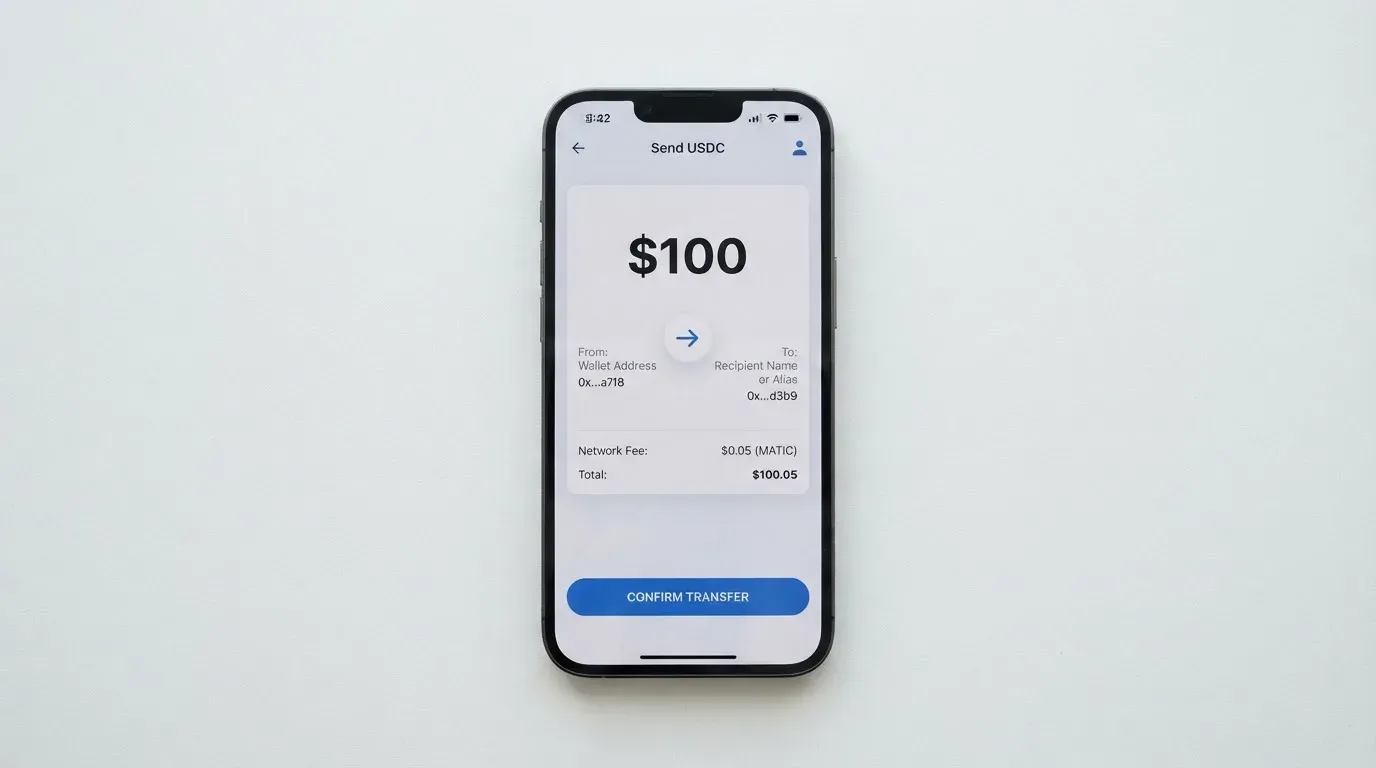
The primary route is stablecoin. The card loads USDC, with the Solana network referenced. The App Store listing says Karma covers on-chain transaction costs for USDC transfers on Solana. The full list of coins accepted for top-up is not stated, which means the practical question — “can I send the token I already hold?” — has no published answer.
The second route is fiat, and it is indirect. USD, EUR or GBP arriving in your account is not held as fiat. It is converted into crypto by Bridge and deposited into your wallet. That is a meaningful detail: your money goes through a conversion before it ever reaches the card, so the on-ramp fee applies even if you intended to hold cash.
Fiat deposit fees
- On-ramp fee: 1%, with the note that “additional fees may apply”.
- SEPA transfer: $1.45
- ACH transfer: $0.95
- EUR, GBP and MXN conversion: mid-market rate plus 0.50%
- “High-risk payments” attract an extra fee, capped at 5% of the deposit
- Karma sponsors network gas on default routes
- No monthly or signup fees
- Minimum top-up: not stated
The “high-risk payments” line is not defined in the card’s official documentation. If your funding source is considered higher-risk, or if your behaviour pattern trips an internal check, you could be charged up to 5% on a deposit. That is a real number, and it is the kind of clause you only discover when you try to withdraw funds. Ask support what triggers it before you rely on this route.
Getting money back out. Withdrawals convert back to fiat and settle to your bank account, with an off-ramp fee of 0.5%. The App Store listing says you can withdraw to a bank account or an external wallet “at any time”. There is a line in the card terms you should read twice: the issuer may suspend or cancel access at any time, and the terms are written in the language of a credit line — 0% APR, late payment up to $40, returned payment up to $29, and a repayment obligation that survives closure. Those are terms for borrowing, and they do not match a card that is described as loaded with USDC. I will return to this in the risks section, because a document written in the wrong register is a signal about how much precision you should expect elsewhere.
Two general warnings that apply here as they do to every card in this category. On-chain transfers are irreversible — a deposit sent on a network the provider does not support, or to an address belonging to a different network, can be lost or need manual recovery with no guarantee. And stablecoins can depeg: TerraUSD collapsed in May 2022, USDC temporarily lost its peg in March 2023. Circle says USDC is redeemable 1:1 for USD and fully backed by cash and cash equivalents with monthly reserve attestations, and the BIS put about 90% of stablecoin market capitalisation in USDT and USDC in July 2025. “Backed” is not “fixed”.
Paying with it every day
This is where the card is thinnest, and I want to be plain about that rather than dress it up.
Mobile wallets: not stated. Whether you can add the card to Apple Pay or Google Pay is not on the official pages. One unofficial source says they are not supported. If that is true — and I cannot confirm it — then your payment experience is a physical card or a copy-pasted card number, which is a different and less pleasant thing than tapping a phone.
Cash: not available. Cash advances and balance transfers are not offered. So the ATM in the airport is out. Cash advances are expensive everywhere anyway, and not having them is arguably a feature, but it is a constraint.
Rewards: named but unquantified. The App Store notes for version 1.1 mention “Reward tiers with cashback on fees”, “Karma Points” earned on card spend, and “Pending cashback tracking”. The rates are not stated. A rewards programme you cannot price is not a rewards programme in any decision-making sense.
App quality: too little data. On the App Store the listing shows 5.0 out of 5 from 6 ratings — a perfect score from six people, which is statistically close to meaningless. The app requires iOS 15.1 or later, and version 2.0.2 was current when I checked. A Google Play listing exists (xyz.karmapay.app) but the rating was not readable.
Where you cannot spend it. Prohibited: purchases of digital currency except through Karma, cannabis and CBD, the dark web, unlicensed pharmacies, firearms, escort services, payday lending, multi-level marketing and Ponzi schemes, counterfeit goods, and “illegal gambling operations or unregulated betting platforms”. Regulated gambling and fantasy sports are permitted but reviewed more closely, as are crypto platforms and exchanges and money-service businesses. That last group is the one to think about if you are a crypto person: paying a crypto exchange directly from this card puts you into enhanced review every time.
When something goes wrong with a payment. Try the merchant first. Report a chargeback in your Karma account no more than 60 days after the charge posts. Won chargebacks are credited to a current or future statement. Unresolved ones can lead to fees, lower limits, or suspension of the card.
A note on why a payment might fail even when your balance is fine. A declined authorisation can leave a hold on funds that stays for several days, typically up to seven. Address verification, which compares the numeric parts of the billing address you type against the issuer’s records, is mainly available in the US, Canada and the UK and is generally unavailable for foreign-issued cards — a common cause of declines abroad. And if 3-D Secure challenges you, Visa’s version is called Visa Secure: the issuer assesses the risk and either approves frictionlessly or asks for a one-time code or a biometric.
What can go wrong
The documents describe a credit card, not this card. This is my biggest reservation. The terms refer to a credit line with 0% APR, late payment of up to $40, returned payment of up to $29, and a repayment obligation that survives closure. A card funded by your own USDC is not a credit line. Either the terms are a template reused from the issuer’s other products, or there is a borrowing facility here that the marketing does not mention. Either way, do not sign anything without reading which one it is.
No insurance, by design and by statement. Karma says it is not a bank, exchange or custodian, and that it does not provide FDIC insurance. The programme is powered by Rain; the cards are issued by Third National under a Visa licence. The company says the user controls the wallet and the keys, and that Karma cannot freeze, seize or move the funds — that is a real and meaningful commitment in a category where most providers hold your money. It also means there is no deposit guarantee and no third-party safeguarding behind your balance.
The issuer can pull the plug. The card terms state the issuer may suspend or cancel access at any time. This is not hypothetical in the category: Visa terminated its global agreements with FTX on 13 November 2022 and the FTX US debit card was wound down; WaveCrest, a Visa issuer that supplied crypto card brands, was suspended by Visa in Europe in 2018, closing all its Visa programmes. Closure typically follows a pattern — a notice period, then spending and loading stop, then you are asked to withdraw. Getting out in time is a skill, so keep your own withdrawal route working and do not let your whole balance sit in the card.
Self-custody cuts both ways. Nobody can freeze your funds, which means nobody can rescue them either. A seed phrase is 12 to 24 words in plain form; anyone who obtains it can restore the wallet and spend it. Blockchain transfers are irreversible and a stolen key has no recovery path — the network cannot freeze or return funds. Phishing and clipboard-hijacking malware that swaps a copied address are the everyday attacks. And custodial platforms have a real record of failure: Mt. Gox (about US$350 million reported stolen, 2011–2014), Coincheck (about US$400 million, 2018), Ronin Network (US$625 million, 2022). Self-custody avoids the counterparty risk and hands you the key risk instead.
Audits under NDA are not an audit you can check. The company says audits happen under a non-disclosure agreement. That is a reasonable commercial position and not the same as a published report.
Regulatory overhang. Under the EU’s MiCA framework, the rules on stablecoins applied from 30 June 2024 and the remaining provisions, including crypto-asset service provider rules, from 30 December 2024, with a transitional period running until 1 July 2026 or until a provider is authorised or refused. ESMA keeps an interim register of authorised providers. A card is a payment service regulated separately from the crypto side, so a crypto card often depends on two licences. Karma’s own registration country is not stated in what I read, which makes it impossible for me to tell you which regime it sits under — and that matters, because it determines who you would complain to.
No complaint history — and no track record either. I found no Karma-specific Reddit threads, no Trustpilot page, no news about the company. That is genuinely neutral: it is neither a red flag nor a comfort. It usually means the product is young, which also means it has not yet survived whatever would have surfaced problems. The $KARMA token is live on Robinhood Chain with migration from v1 to v2 available to holders, and a Swiss non-profit, Karma ICM Association, oversees the protocol and treasury. I found no licence news and no issuer-change news.
Taxes are yours. The IRS treats digital assets as property, so exchanging them for goods or dollars generally produces a taxable gain or loss, measured in your local currency at the fair market value on the date of the transaction. Each card payment funded from crypto may be its own disposal. That is a fact about how the tax treatment works, not advice — talk to a professional in your jurisdiction.
What I could not verify. Support channels and hours are not stated on the site or in the App Store listing; the only contact handle I found is X @KarmaWallet. For a product whose public pages omit the KYC process, the card type and the limits, having no stated support route is a more serious gap than it sounds. If your money is stuck, you need a way to reach a person.
What to take instead
If Karma’s self-custody model is what you want but the missing details make you uneasy, these are the alternatives I would look at, with the same scepticism.
TokenPocket — 5.8 / 10. A Visa debit for a list of European countries and territories (Germany, France, Spain, Switzerland among them) and a Mastercard debit for Australia, Canada, Hong Kong, Japan, Taiwan, New Zealand, Singapore, South Korea and the UK, with the Americas planned for Q2 2025. It runs on Arbitrum, and Fiat24 cards are virtual. NFT creation fees are partly covered by TokenPocket with the user paying “a small portion”, and apart from that “TP Card does not charge any additional fees”. There is a 1% fee on depositing cryptocurrency, refunded later via rewards. Balances sit in EUR24 and USD24. The deposit fee refunded in unspecified rewards is the term to watch. Specific coins and networks for top-up are not listed in the FAQ.
MetaMask — 7.1 / 10. Sign-up is open in 45 listed countries and territories (Andorra, Argentina, Brazil, Canada, Mexico, Germany, France, Spain, Uruguay among them); other regions join a waitlist. Proof of residency is required, ineligible regions limit sign-ups rather than spending, and US and UK sign-ups were temporarily closed. It is a Mastercard from Monovate with Crypto Life as card provider — virtual first, instantly, with metal pre-orderable in the app after approval, one card per user. Virtual is free with no annual fee; metal is $199 a year. Fees are “minimal” per transaction with no additional MetaMask fees and no foreign transaction fee, Mastercard’s rate used. It spends directly from your connected wallet on Linea, Base, Monad and Solana, with mUSD, wETH, EURe, GBPe, USDC and USDT named. Cashback in mUSD: 1% on Virtual, 3% on Metal but capped at the first $10,000 then 1%. Its limits are currency-restricted by network rather than being fully open, which is the trade for the metal and the cashback.
KAST — 6.1 / 10. The clearest disclosure of the three, and the most expensive structure. Virtual and physical, up to 10 cards, from Visa Platinum Standard to Visa Infinite metal Private, with other designs. Annual membership: Standard $0, Premium $1,000/year, Private $10,000/year, billed annually upfront. Standard physical card is free with $40 delivery; an extra virtual card is $2; inactivity is $1/month after 12 months. Fees are genuinely low — stablecoin top-up 0%, USD spend 0%, transaction fee 0%, Apple and Google Pay 0% — with a non-USD FX fee of 0.5%–1.75% depending on your country, and small annoyances like $0.10 on non-USD under $25 and $0.50 on a declined authorisation. Cashback: 1.5% on the first $2,000/month (Standard), 2% on the first $10,000 (Premium), 3% on the first $40,000 (Private). It tops up with USDT, USDC, PYUSD and RLUSD on Ethereum, Solana, Polygon, Arbitrum and TRON, with stablecoins converted 1:1 at 0% spread. Two cautions: the country list is not published and if your country is not shown it is simply unavailable, and holding an ID from a restricted region can disqualify you even when you live in a supported country.
| Karma | TokenPocket | MetaMask | KAST | |
|---|---|---|---|---|
| Score | 6.4 | 5.8 | 7.1 | 6.1 |
| Network | Visa | Visa / Mastercard | Mastercard | Visa |
| Custody | Self-custody | Not stated | Self-custody | Custodial balance |
| Entry cost | None | None | Virtual free, metal $199/yr | $0 to $10,000/yr |
| Main strength | Keys stay yours | Broadest country list | Disclosure and cashback | Fee transparency, 10 cards |
| Main gap | KYC, card type, limits undisclosed | Coin/network list not in FAQ | Metal costs $199/yr | Premium tiers are expensive |
Who I would recommend it to
I would recommend Karma to someone who already keeps their funds in a self-custody wallet, who is comfortable with stablecoin risk and with being their own security, and who wants to spend crypto at an ordinary shop without surrendering their keys. That person gets a clean 0.5% per-transaction fee, no subscription, no monthly charge, and a card network accepted almost everywhere — and they get the genuine, unusual thing that the wallet keys never leave.
I would not recommend it to someone buying their first card, to someone who needs a large spending limit today, to someone who lives in a travel-heavy country and depends on ATM cash, or to anyone who wants a metal card and cashback they can actually count. And I would not recommend it — yet — to someone who needs certainty before they commit, because the three things you would check first (identity requirements, physical or virtual card, spending limits) are not published. Wait, or ask, and let the answers decide.
There is also a structural reason to look elsewhere if you want extras. The $KARMA token tier ladder is the only progression on offer, and its top rung — $10,000 held for a free service fee — means you are speculating on a token to get a discount on a card that already charges half a percent. If you would rather pay a flat $199 a year for metal and 3% cashback, MetaMask’s structure is easier to reason about. If you want ten cards and published fee tables, KAST publishes more than Karma does, at a price.
The honest summary: this is a well-priced, well-constructed idea run by a young company that has not yet published the boring details that let you commit with confidence. Ask your three questions in writing. If the answers are good, the fees are good enough that the card is worth the wait. If the answers are vague, you have lost nothing by waiting.
Frequently asked questions
What is the Karma card?
Karma is a Visa payment card linked to a self-custody crypto wallet. You keep control of your wallet and your private keys, and Karma says it cannot freeze, seize or move your funds. Cards are issued by Third National under a Visa licence, and the programme runs on Rain. Unlike most crypto cards, it does not hold your balance — which is the main reason to consider it, and the main thing that makes you responsible for key security.
Is Karma a bank?
No. The company states plainly that it is not a bank, exchange or custodian, and it does not provide FDIC insurance. The App Store seller is Karma Fintech LTD, but its registration country is not stated in what I read, so I cannot tell you which regulatory regime it sits under. Because there is no bank behind it and no deposit guarantee, you should treat the balance as yours alone — including when something goes wrong.
Does the Karma card require KYC?
The card’s own pages do not say. The terms state there is no KYC process and require you to confirm you are not a US citizen and not sanctioned. One unofficial third-party page lists email, phone and an identity document with no proof of address or selfie, but Karma does not confirm this and the page carries no date. Ask support directly — this is the first thing to settle, not the last.
How much does the Karma card cost?
There is no signup fee, no monthly fee and no subscription. The running cost is a 0.5% service fee per card transaction, plus 1% FX fee and a $0.30 international fee on non-USD spending. Buying crypto costs 1%, selling costs 0.5%, and swapping costs 0.5%. Holding $KARMA reduces these progressively, with a free service fee at the $10,000 tier.
How do I top up the Karma card?
The primary route is sending USDC to the card, with Solana named as the network and Karma covering on-chain costs for those transfers. The full list of accepted coins is not stated. You can also deposit USD, EUR or GBP, which are converted into crypto by Bridge before reaching your wallet — so the 1% on-ramp fee applies. ACH costs $0.95 and SEPA $1.45, and “high-risk payments” can add a fee capped at 5% of the deposit.
Does the Karma card work with Apple Pay and Google Pay?
Apple Pay and Google Pay support is not stated on Karma’s official pages. One unofficial source says neither is supported, and I could not confirm or deny it. Given that mobile wallets are the normal way people pay, treat this as an open question and ask before you rely on the card day to day. Spending limits and card type are likewise not published.
Can I use the Karma card in my country?
Issuance is blocked for residents or registrants of Belarus, mainland China, Cuba, India, Iran, Iraq, Israel, Myanmar, Nepal, Nicaragua, North Korea, Russia, Syria, Turkey, Ukraine, Venezuela and Vietnam. Other countries are not excluded, and FATF grey-list countries are reviewed case by case. Spending is separately blocked in Cuba, Iran, North Korea, Russia, Syria, Ukraine and Venezuela.
Is the Karma card safe?
The safety story is honest but two-sided. Because it is non-custodial, Karma says it cannot freeze or seize your funds, which removes the counterparty risk that broke Mt. Gox, Coincheck and Ronin. But that also means nobody can recover them for you: a lost seed phrase or a swapped deposit address is final. Passkeys and biometrics protect sensitive actions, and you can freeze the card in the app. No insurance, and audits only under NDA.
Are there ATM withdrawals and cash advances?
No. Cash advances and balance transfers are not available, so an ATM is not an option for getting cash from this card. Unofficial third-party tables claim free unlimited ATM withdrawals — that directly contradicts the official material, so do not plan around it. If physical cash matters to you, this card will not serve that need.
Is the Karma card worth it?
Worth it if you already hold crypto in your own wallet and want to spend it without giving up your keys: 0.5% per transaction with no monthly fee is a good rate. Not worth it if you need a published spending limit, Apple Pay, cashback you can price, a metal card or support hours you can rely on — because those details are not stated. The deciding move is to ask support the three missing questions in writing before you deposit anything.
Wallet cards on the shortlist – cryptocardshortlist
Content created by the «cryptocardshortlist» team