
A crypto card that skips identity checks — and what that costs you
 Available in US
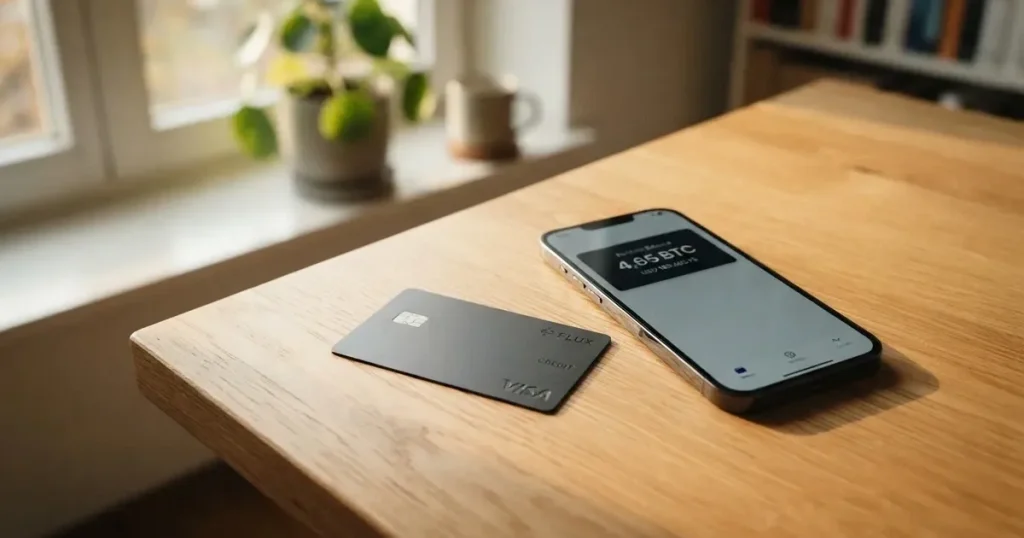
AnomaCard offers something most crypto cards do not: you can open it without showing an ID. No passport scan, no utility bill, no selfie — you log in with a Web3 wallet or a username and password, and the virtual Visa Platinum is advertised as arriving in under 60 seconds. There is no monthly fee, no inactivity fee, and no claimed markup on currency exchange. You load it with BTC, ETH, SOL, USDT or USDC and spend it wherever Visa is accepted, including Apple Pay and Google Pay in 180+ countries. On paper that is a clean, cheap, open-access product for people who cannot get a normal bank card.
My score is 7.8 out of 10. It is a well-shaped offer with an unusually low cost profile, wrapped in documentation that is thinner than the promise. The reason it is not higher is not the fees — it is that the operator names no issuer, no licence and no country of registration, while the terms and FAQ are not publicly accessible. A card you load with your own crypto can at least limit your exposure to a bad operator: your funds never sit on the card’s balance as an account claim. But “non-custodial” is a description of the top-up flow, not a substitute for knowing who stands behind the card when a payment is declined, an ATM swallows cash, or the programme shuts down. My verdict in one line: interesting and cheap, and you should read this page before you move real money.
Conditions on this page are current as of October 28, 2026.
Who will give you the card
The card’s own starting data says “Global”. Online it says you can use the card “wherever Visa/Mastercard is accepted”, and it describes Apple Pay and Google Pay tap-to-pay working in 180+ countries. That is the accessibility claim, and it is the reason I scored this criterion highest of all: I found no list of excluded countries and no rule stated about citizenship or place of residence.
That is genuinely useful if your situation is the one this card seems to be built for. Plenty of people in many countries cannot open a mainstream bank account, do not want their identity tied to a crypto product, or move money across borders in ways a bank will not support. A card that asks for nothing and works on a phone is exactly what that person wants.
But read the “Global” claim carefully, because it is about *availability*, not about *guaranteed issuance*. No country list means no country where the card has formally said yes in detail either. If you live somewhere with capital controls or a difficult relationship with payment providers, the absence of an exclusion is not the same as a promise. And a card issued under one country’s licence will still be judged by that country, whether or not the marketing page says so.
| Criterion | Mark | Why |
|---|---|---|
| Who can get it | 9 / 10 | Stated as “Global”; no excluded countries, no citizenship or residence rules found; Apple Pay and Google Pay in 180+ countries |
| Cost | 8 / 10 | Activation 0%, $0 monthly, top-up from 0.60% (Starter) to 0.30% (Elite), no FX markup claimed; physical card $120.00 one-time; $50 minimum |
| Top-up options | 8 / 10 | BTC, ETH, SOL, USDT (ERC-20 and SPL), USDC (ERC-20 and SPL); Arbitrum, Polygon and BNB Chain “coming soon” |
| Reliability and complaints | 5 / 10 | Operator given as AnomaCard Protocol; issuer, licences and country of registration not named; terms and FAQ are not publicly accessible; no complaints found |
| Everyday use | 9 / 10 | Virtual Visa Platinum plus a physical card, Apple Pay and Google Pay, ATMs worldwide |
| Total | 7.8 / 10 | Cheap and open; thin on who is actually behind it |
How to get it
The signup story is the shortest part of this review. There is no KYC: the page says “No ID scans, no passports, no utility bills.” You log in either with a Web3 wallet (MetaMask or Phantom) or with a username and password, and you can add 2FA at login if you want it. Issuance is advertised as taking under 60 seconds. There are no KYC levels on this card — the tier system here is about deposit fees and cashback caps, not about verification, which is the opposite of most crypto cards in the category.
What you get at the end is a virtual Visa Platinum debit card, with an optional physical card. The page also refers to Visa and Mastercard in places, which is a small inconsistency worth noting if you are trying to work out exactly what you are holding. Card currency is not stated.
If you do want the plastic, it costs: the physical card carries a $120.00 one-time issuance and shipping fee, which is deducted from your crypto balance. Countries of delivery and delivery time are not stated. That is a real number — four figures for a piece of plastic, against a card whose headline fee is zero — and it is the first thing that gives me pause on the “free” framing.
Age requirements are not stated on the pages I could read. Prepaid and debit cards in this category are generally available to adults aged 18 or over, and some issuers set higher limits, so treat 18 as the working assumption rather than a confirmed rule here.
My honest read on the no-KYC signup: it is fast, private in the sense that nobody asked, and easy. It also means the card cannot screen you, so nothing on the account will be there if you ever need to prove who you are to the issuer.
Fees: what it really costs
Here is where the card is strongest, and the headline numbers survive checking against the fee schedule. Activation is 0%. There is a $50 minimum deposit to unlock the full card. The monthly fee is $0.00, with no inactivity fees. The physical card is $120.00 once, for issuance and shipping, taken from the crypto balance. Deposit fees run 0.60% (Starter) down to 0.30% (Elite) depending on your VIP tier; a banner on the site also cites a “0.3% low deposit fee”. The page claims no hidden FX markup and no foreign transaction fees.
Card currency is not stated, and ATM fee and allowance are not stated — the physical card is advertised for worldwide ATM withdrawals, but no ATM charge appears anywhere I could read. That absence matters more than it sounds: worldwide ATM access is the exact thing people without normal banking most want, and it is the place where a card’s real cost usually hides.
| Fee or limit | Value |
|---|---|
| Activation | 0% |
| Minimum deposit | $50 |
| Monthly fee | $0.00 |
| Inactivity fee | none stated |
| Deposit fee | 0.60% (Starter) to 0.30% (Elite), by VIP tier |
| FX markup / foreign transaction fee | none claimed |
| Physical card, one-time | $120.00 issuance and shipping, from crypto balance |
| ATM fee | not stated |
| ATM allowance | not stated |
| Spending limits | $5,000 per day, $20,000 per month |
| Per-KYC-level limits | not applicable (no KYC) |
| Card currency | not stated |
| Cashback | 2% on purchases, no staking or lockup per the page |
The VIP tiers are structured purely around what you pay in and what you get back:
| Tier | Deposit fee | Cashback cap |
|---|---|---|
| Starter | 0.60% | up to $500 |
| Explorer | 0.50% | up to $5,000 |
| Voyager | 0.40% | up to $10,000 |
| Elite | 0.30% | over $10,000 |
Now three everyday payments, because an abstract fee table does not tell you what a Tuesday costs.
A $30 subscription you already pay for. If you hold Starter, a top-up of, say, $200 costs $1.20 in deposit fee, then the $30 purchase earns 2% cashback. There is no monthly fee and no conversion fee claimed, so the running cost is the deposit fee once, not once a month. What the page does not say is what the cashback is paid in — how you receive it, whether it arrives as balance, as a token, or as something else. That is not stated, and it decides whether the 2% is worth anything to you.
A $60 meal paid abroad while you hold USD. The card claims no FX markup and no foreign transaction fee, so in the card’s own account of events this conversion is free. Whether the restaurant accepts the card at all is a separate matter: a card issued in one country and used in another can be declined, because the merchant’s systems read the BIN and see a foreign issuer. This is common across crypto cards, not specific to this one, and it is the difference between “180+ countries” in marketing and “accepted at this particular counter”.
A $120 cash withdrawal at an ATM. The physical card is advertised for ATMs worldwide, no ATM fee is listed, and no allowance is stated. You are therefore in the position of planning a cash withdrawal without knowing whether there is a charge or how much you are allowed to take out. If cash is part of your reason for wanting this card, that unknown is worth resolving before you rely on it — and the card currency being unstated means I cannot even tell you which currency you would be withdrawing.
How to top up
Topping up is the cleanest part of the design and the part where the card’s logic is clearest. Live assets: BTC, ETH, SOL, USDT (both ERC-20 and SPL) and USDC (both ERC-20 and SPL). Marked “coming soon”: Arbitrum (ARB), Polygon (POL) and BNB Chain (BNB).
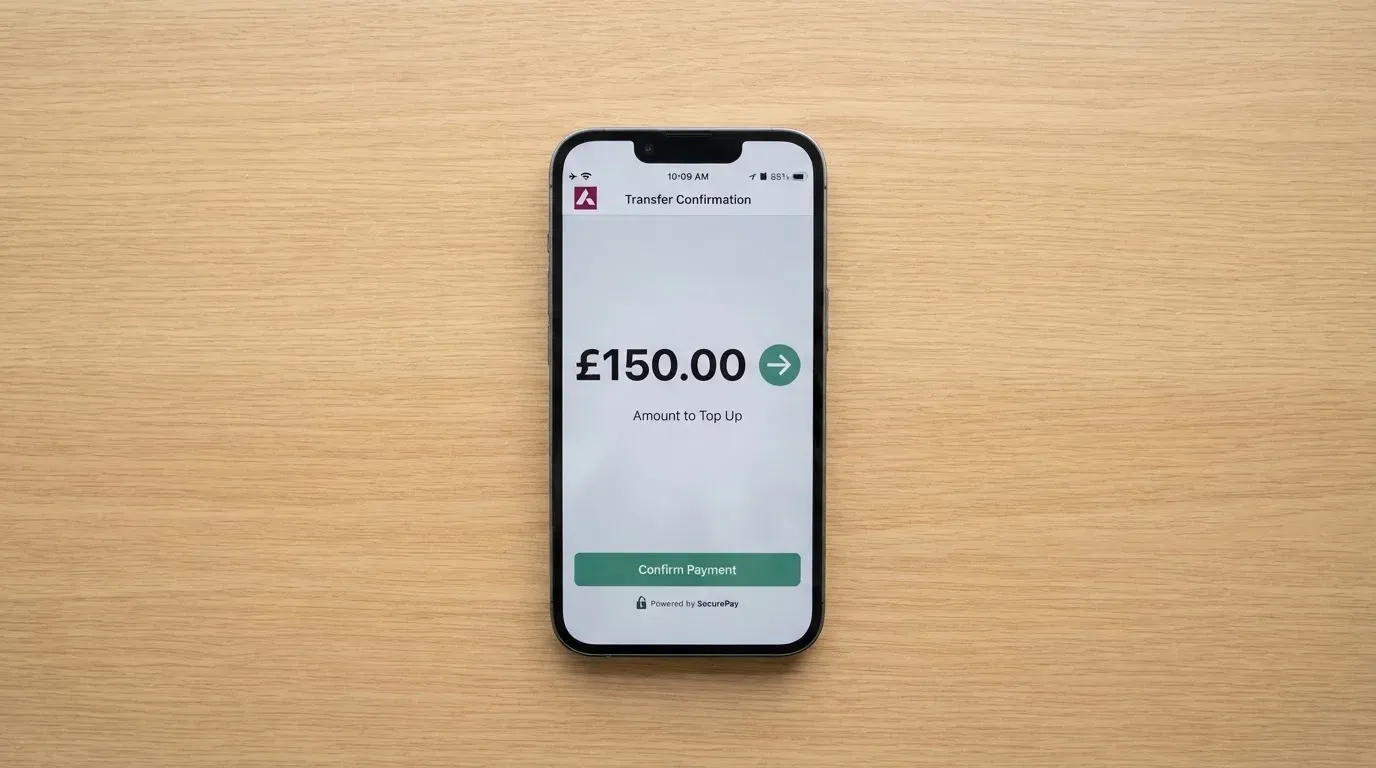
The mechanics: you send to a generated per-network address, and the funds unlock after one blockchain confirmation. That single confirmation is quick on most networks, so the wait between sending and being able to spend is short.
Three rules to hold in your head before your first transfer:
- Match the network exactly. You pick a network, the card shows you an address on that network, and you send that asset on that network. Sending on a network the provider does not support, or to an address belonging to another network, can lose the funds or require a manual support recovery with no guarantee. Transfers are irreversible; the blockchain cannot undo them.
- The deposit fee is 0.30–0.60% depending on your tier, and the $50 minimum deposit is what unlocks the full card. A small first test transfer is the sensible way to learn the flow.
- Network fees are separate. The blockchain charges its own cost for your deposit — that is on-chain gas, set by the network, not by the card. And withdrawals carry only standard blockchain network fees, per the FAQ.
One thing you will not find: fiat top-up is not stated. There is no mention of paying in by bank transfer or card from ordinary money — the documented path is crypto. On Ethereum, a wallet holding USDT with no ETH in it cannot send, because gas is paid in ETH; that is a rule of the network, not of this card, and it catches people out regularly.
Paying with it every day
Day-to-day, the card behaves like a prepaid card. You load a balance, the balance is what gets spent, and it cannot overdraw — which is the main reason crypto cards in this shape are so cheap to run. In this model the card spends only the balance you have already put in.
Wallets. Apple Pay and Google Pay are supported for online payments and tap-to-pay. There is no native app: you run a web dashboard plus the Apple and Google wallets. Blocked merchant categories are not stated, so gambling, adult content and similar categories — which many issuers block on specific cards by policy rather than by law — are simply unknown territory here. If any of that matters to you, ask before you rely on the card.
Rewards. 2% cashback on purchases, with “no staking or lockup” per the page. That last part is the important one: 2% that arrives immediately is a different product from 2% that requires you to lock tokens for months. What you are paid in is not stated.
When things go wrong. A declined payment can leave a hold on your funds that stays for several days, typically up to 7. Online payments may also involve a step-up check — Visa’s version is called Visa Secure — where the issuer decides frictionlessly or challenges you with a one-time code or a biometric prompt. Address verification, which compares the street number and postcode you type with the issuer’s records, is mainly available in the US, Canada and the UK and is generally unavailable for foreign-issued cards, which is a common cause of declines on crypto cards.
Disputes. Whether you can dispute a charge, and on what terms, is not stated. That is the part I would want answered before I put anything on this card that I would be annoyed to lose.
What can go wrong
This is the section where the card’s promise and its paperwork come apart, so I have given it the most space.
Nobody will tell you who is behind it. The operator is named as “AnomaCard Protocol” (copyright 2026). The issuer, the BIN sponsor, the licences and the place of registration are not named. Behind every working card is a chain of parties: the network routes the messages and sets the rules, a licensed issuer holds the programme, and the brand is usually a manager or front-end on top. If you cannot see who holds the programme, you cannot assess who you are actually trusting with your payment rail.
The terms and FAQ are not publicly accessible. That is the single most telling thing in this review. A card that asks for no documents at all also publishes no readable terms or FAQ at the links the site advertises — the withdrawal procedure and the balance owed on closure are not stated. Fine print is where your rights live; if it is not there, you are relying on goodwill.
No complaints, and no history either. I found no official incidents, and a reviews search returned nothing for AnomaCard — no Trustpilot page and no Reddit results. Read that carefully: silence is not a clean record, it is an absence of record. There is also no news I could find about the operator. A brand nobody has ever complained about is usually a brand nobody has used much, or a brand nobody has used at all.
Safety architecture, partly described. The card is described as a non-custodial wallet address model, with optional 2FA at login and a “Privacy & Zero-Log Architecture Policy” page. Freeze and spending controls are not stated — so the two things you would reach for if a phone were stolen are the two I cannot confirm exist. Support is [email protected], with a stated average response under 2 hours; languages are not stated.
If it folds, you get notice, not protection. Crypto card programmes have ended before: Visa terminated its global agreements with FTX on 13 November 2022 and the FTX US debit card was wound down by its issuer; WaveCrest, a Visa issuer that supplied crypto card brands, was suspended by Visa in Europe in 2018 and all its Visa programmes closed. The pattern is usually a notice period, then spending and loading stop, then you are asked to withdraw whatever is left. Under a non-custodial top-up model you would withdraw to your own wallet — that is the genuine advantage of this structure, and it is why I would rather this card folded early than late.
No KYC cuts both ways. It is a real convenience and it is a real risk. Because nobody screened you, there is no verified identity on the account to support a claim, and no indication what happens to a balance if the operator’s own screening obligations change. Anti-money-laundering rules are not optional for regulated businesses; a scheme that grows often acquires the compliance obligations its early users did not want.
The stablecoin layer is not risk-free. USDT and USDC are the two assets behind most of the market, and the BIS put about 90% of stablecoin market capitalisation in these two as of July 2025 — which is concentration, not safety. Stablecoins can and do lose their peg: TerraUSD collapsed in May 2022, and USDC temporarily lost its peg in March 2023. Circle lists USDC as natively supported on 38 networks as of 16 September 2026. Tether also disables tokens in wallets on the OFAC sanctions list and has frozen funds, so stablecoins are not censorship-proof.
A note on your own taxes. Not advice, just the thing people forget. In the US the IRS treats digital assets as property, so converting them for goods or dollars generally produces a taxable gain or loss, measured in local fiat currency at the transaction date — which can make each card payment funded from crypto its own disposal event. Rules differ everywhere; take your own advice.
What to take instead
The honest comparison is awkward, because the alternatives in this category are mostly weaker on paper and stronger on paperwork — or the reverse.
CardFlow (my score for it: 4.9 / 10) is aimed at Nigeria — “Nigeria’s smartest fintech card platform” and “Nigerians and global users” — with no country list or exclusions stated. It gives a virtual USD Mastercard created in about 3 minutes. Creating a virtual card is completely free per its own FAQ, the monthly fee is not stated, and other fees are not stated. You can fund it with Bitcoin, USDT, ETH or a Naira bank transfer, with networks not stated. Cashback is not stated. It is free where AnomaCard costs 0.60% to 0.30% per top-up, and narrower where AnomaCard is open.
HyperCard (4.7 / 10) is a prepaid card with no country list on its official pages; its App Store page says the card works in “more than 176 countries” — that is acceptance, not eligibility, and the distinction matters. Network is not stated there, balance is in USD or EUR, fees are not stated, and you deposit crypto such as USDT, BTC or ETH in the app and it converts to USD or EUR. Networks not stated again.
Card.fi (6.6 / 10) is the one that publishes the most detail, and reading its fee schedule next to AnomaCard’s is instructive. It ships to “200+ countries” but its terms bar residents of, or orders from, “a country subject to sanctions that would prohibit the service” — a rule stated in words rather than left to inference, which on its own is worth something. It offers Virtual Classic and Virtual Premium, physical Classic and Premium, a stainless steel metal card, and every physical order includes a virtual card; cards are issued “under licence from the relevant card schemes”, and card currency is not stated. One-time fees: Virtual Classic $49, Virtual Premium $249; physical and metal prices are not listed; no monthly, annual, inactivity or minimum-balance fee. Top-up fee Classic 1.5% + $1.00, Premium 1%; FX fee Classic 3.5%, Premium 2.5%, with the conversion fee shown before each top-up. You can fund it with 32 coins across 5 networks (Ethereum, Base, BNB Chain, Solana, Kaanch) including USDT, USDC, ETH, BNB, SOL and KAANCH, to a per-card deposit address, converted at market rate on arrival — and it warns that the wrong chain risks permanent loss. Cashback is on card spending only: Classic 0.8% (cap 10 USDT/month), Premium 1%, Metal 1.2% or 2% with monthly and lifetime caps; a headline 10% at coffee shops capped at 10 USDT/month; balances can earn “up to 18%” on Metal, variable.
Read that against AnomaCard’s 0.30–0.60% deposit fee, no claimed FX markup, $0 monthly, and 2% cashback with no lockup, and the trade is legible. Card.fi costs more on almost every line and tells you far more. If your priority is knowing who issued your card, under what licence, at what fee, before you spend — Card.fi is the better-documented product, and its FX fee is a cost you can see rather than one you have to take on trust. If your priority is getting a card in under a minute with no documents and the lowest possible cost of loading, AnomaCard is cheaper. And if you need 32 coins across 5 networks, AnomaCard’s five assets on the networks it supports are a narrower door.
Who I would recommend it to
I would recommend AnomaCard to someone who already holds BTC, ETH, SOL or stablecoins, already has a self-custody wallet, and has found that ordinary cards are closed to them or that their identity documents are not something they want to hand to a crypto company. If that is you, the value is real and hard to get elsewhere: no documents, no monthly fee, a 0.30% deposit fee at the top tier, claimed no FX markup, Apple Pay and Google Pay in 180+ countries, and $5,000 a day and $20,000 a month of room to move.
I would not recommend it as your only card, and I would not recommend it at all if you depend on cash withdrawals, on disputing a charge, on merchant categories being blocked or allowed, or on knowing in advance who is legally responsible for your money. Those four are all unstated on the public pages, and the terms and FAQ links are not accessible. Start small — the $50 minimum deposit is a low bar, and it is also the perfect test — put in an amount you could afford to lose to a support ticket, add it to your phone’s wallet, and make one purchase you do not depend on. If that goes cleanly, and the questions you wanted answered get answered at [email protected], you have your answer. If they do not, you have learned something for $50 rather than for your rent.
I keep coming back to the shape of this card. Non-custodial top-up plus no KYC plus no readable terms is a combination where the absence of risk is mostly the absence of someone else holding the risk. That is not always bad — for this audience it may be the only workable option there is — but you should choose it with your eyes open, not because a page said “Global”.
Frequently asked questions
What is AnomaCard?
AnomaCard is a crypto payment card that turns a balance of BTC, ETH, SOL, USDT or USDC into an ordinary Visa Platinum debit card you can spend in shops and online. It works as a payment card spent from a crypto balance rather than from a bank account: you load it, and the card spends only what you have loaded. The operator is named as AnomaCard Protocol. The issuer, licences and country of registration are not named on the public pages.
How does AnomaCard work?
You log in with a Web3 wallet or a username and password, and the virtual card is advertised as issued in under 60 seconds. You top up by sending crypto to a generated address on a chosen network, and funds unlock after one blockchain confirmation. The card then spends that balance like a prepaid card, so it cannot overdraw. Apple Pay and Google Pay work for online and tap-to-pay, and a physical card is optional.
Does AnomaCard require KYC?
No. The card’s page says “No ID scans, no passports, no utility bills”, and there are no KYC levels on it at all. That is convenient for anyone who cannot or will not provide identity documents, and it also means no verified identity sits on the account to support any later claim. Login 2FA is optional.
Is AnomaCard a bank?
Nothing in the public pages says it is. The operator is given as AnomaCard Protocol, a copyright 2026, and the issuer, BIN sponsor, licences and place of registration are not named. Behind every card is a licensed issuer, a card network and a brand on top; here you can see the brand clearly and the rest not at all.
What does AnomaCard cost?
Activation is 0%, the monthly fee is $0.00 with no inactivity fee, and the deposit fee is 0.60% at Starter down to 0.30% at Elite. The card claims no hidden FX markup and no foreign transaction fees. A physical card costs $120.00 once for issuance and shipping, taken from your crypto balance, and $50 is the minimum deposit to unlock the full card.
How do I top up AnomaCard?
You send BTC, ETH, SOL, USDT (ERC-20 or SPL) or USDC (ERC-20 or SPL) to a generated per-network address, and the funds unlock after one blockchain confirmation. Arbitrum, Polygon and BNB Chain are marked “coming soon”. Check the network twice before you send: transfers are irreversible, and sending on an unsupported network can lose the funds. Fiat top-up is not stated.
Where can I use the card, and is it safe?
Online, wherever Visa or Mastercard is accepted, with Apple Pay and Google Pay described as working in 180+ countries, plus ATMs worldwide on the physical card. Safe is a question I cannot answer for you. There are no official incidents and no reviews found at all, which is silence rather than a clean record, and the terms and FAQ are not publicly accessible.
Is AnomaCard free?
The virtual card is: no issuance fee, no monthly fee, no inactivity fee. The physical card is not — it is $120.00 one-time for issuance and shipping. And “free” ignores the deposit fee of 0.30–0.60% per top-up and the blockchain’s own network fees, which are charged by the network and not by the card.
How much can I spend and withdraw?
Spending limits are $5,000 per day and $20,000 per month, with no per-KYC-level limits because there is no KYC. The physical card is advertised for worldwide ATM withdrawals, but no ATM fee and no allowance are stated, and card currency is not stated either. If cash matters to you, that is the gap to resolve first.
Should I use AnomaCard or Card.fi?
AnomaCard is cheaper and faster: no documents, under 60 seconds, 0.30–0.60% deposit fee, no claimed FX markup, $0 monthly, 2% cashback with no lockup. Card.fi is far better documented and supports 32 coins across 5 networks, but charges $49 or $249 for virtual tiers, 1–1.5% plus $1.00 top-up, and a 3.5% or 2.5% FX fee. Choose by how much the paper matters to you.
Virtual cards on the shortlist – cryptocardshortlist
Content created by the «cryptocardshortlist» team