
KAST card review: spending stablecoins through Visa, with the fine print
 Available in US
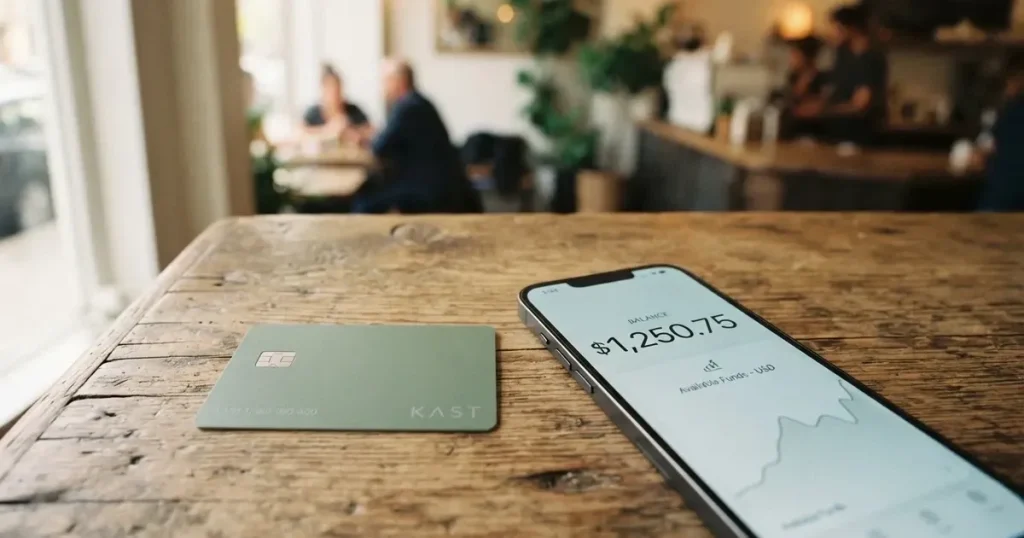
KAST pitches itself as a stablecoin money app with a Visa card attached. You keep your funds in USDT, USDC, PYUSD or RLUSD, the balance shows up as US dollars, and a Visa Platinum (or, on the paid tiers, a Visa Infinite) lets you spend that balance anywhere Visa is taken. The pitch is clean, the on-chain side is generous, and the headline fees are low. The catch sits in the small print and in what real users are posting on review sites, and the rest of this review walks through both.
Conditions are current as of October 28, 2026.
Verdict
KAST lands at 6.1 out of 10. It earns that score by being genuinely easy to fund from stablecoins across many networks, by charging nothing for issuance on the Standard tier, and by giving you a card that works in mobile wallets. It loses marks because the company does not name the card issuer, does not publish licences, is incorporated in Anjouan, and has a thin Trustpilot profile weighted toward complaints about frozen accounts and repeated document requests. The card is best understood as a spending tool for someone who already holds stablecoins, not as a banking replacement.
| Criterion | Mark | Reason |
|---|---|---|
| Who can get it | 5 / 10 | Country list is shown only at KYC; Visa is reportedly accepted in 170+ countries but that is a network claim, not a KAST availability claim |
| Cost | 6 / 10 | Standard tier is free; FX 0.5%–1.75%; ATM 3 USD + 2%; physical card 0 USD plus 40 USD delivery |
| Top-up options | 9 / 10 | USDT, USDC, PYUSD, RLUSD on Ethereum, Solana, Polygon, Arbitrum and TRON, 0% deposit fee |
| Reliability and complaints | 3 / 10 | No named card issuer or licence numbers, Anjouan entity, Trustpilot around 2.5–2.7 with complaints about frozen accounts |
| Everyday use | 9 / 10 | Virtual and physical card, Apple Pay and Google Pay, accepted wherever Visa is taken |
| Total | 6.1 / 10 |
Who it suits: a stablecoin holder with USD-denominated balances on multiple networks who wants a clean way to spend that balance at merchants and ATMs, and who is comfortable holding funds with a custodial app rather than a regulated bank.
Who it does not suit: anyone who needs the protections of a deposit-guaranteed bank account, anyone whose country is on the restricted list, or anyone whose priority is a clear regulatory pedigree and a named issuer.
Who they will give you the card
KAST does not publish a country list. Instead, the app shows you a residence-based list during KYC, and the company’s own wording is direct: “If your country isn’t listed, it means KAST is not available there.” That is a deliberate choice, and it is the first thing to understand about eligibility. The card is not a global product, and the network claim that “Visa is accepted in 170+ countries” is a Visa claim, not a KAST availability claim, so do not treat one as proof of the other.
A second layer sits on top of the country check. KAST also maintains a Restricted Locations list that is referenced but not named publicly, and the rule that catches people is this: even if you live in a supported country, if your ID document is from a restricted region you may still fail KYC. The reverse is allowed: dual citizens whose ID is from a supported country can pass. Only the account holder’s own ID is accepted. Using a VPN to pretend to be somewhere else does not work, and you can create an account from an unsupported country, but KYC will stay locked.
In practice that means the only reliable way to know whether you qualify is to download the app and start the KYC flow. If you live in a jurisdiction that is heavy on sanctions enforcement, expect friction. If you are a US resident, you will be asked for an SSN at enhanced checks. If you are under the legal age in your country (commonly 18), you will not pass.
How to get it
The sign-up ladder has three levels, and each one unlocks more of the product.
Level 1 is account creation: phone number with a one-time code, a PIN, an email, and a country of residence. At this point you have app access but no cards and no ability to send or receive funds.
Level 2 is the identity check. You submit a government ID (passport, national ID card, or driver’s licence; it must be in date), plus a selfie and liveness check. Once that passes, the card tab opens and you can order a virtual or physical card, and sending and receiving funds becomes available.
Level 3 is the enhanced check. You supply proof of address and, in some cases, citizenship; this level unlocks the USD and EUR accounts and global payouts. Source-of-funds documents can be requested at any level. Expired IDs are rejected outright.
Cards come in two forms. The virtual card is instant; the physical card takes 7–10 business days. You can hold up to 10 cards per user, and the design depends on tier: Standard is a Visa Platinum; Premium is a Visa Infinite in metal; Private is a Visa Infinite in gold plating. The app also lists branded designs (Pengu, Solana, Bitcoin) as cosmetic variants. Your account balance shows in USD, because stablecoin deposits are converted 1:1 to a USD balance with no spread.
What it really costs
The cost story is mostly friendly on the Standard tier, and the on-chain costs are zero. The real money gets made on FX and on the physical card delivery, and the paid tiers have annual fees that change the math completely. The fees table below pulls the headline numbers from KAST’s own pages.
| Fee or limit | Amount |
|---|---|
| Standard annual membership | 0 USD |
| Premium annual membership | 1,000 USD/year (billed annually upfront) |
| Private annual membership | 10,000 USD/year (billed annually upfront) |
| Standard physical card | 0 USD card fee, 40 USD delivery |
| Premium and Private physical card | included (no separate delivery fee stated) |
| Extra virtual card | 2 USD (in some regions, also 2 USD on the included Standard virtual card) |
| Stablecoin top-up | 0% |
| Card spend in USD | 0% |
| Transaction fee | 0% |
| Apple Pay / Google Pay | 0% |
| Non-USD FX fee | 0.5%–1.75% (depends on residence country, transaction country, and card programme) |
| Non-USD transactions under 25 USD | 0.10 USD |
| Declined transaction (insufficient balance) | 0.50 USD |
| ATM withdrawal | 3 USD flat + 2% of amount (plus FX for non-USD) |
| Inactivity fee | 1 USD/month after 12 months of no activity |
| Card transaction limit | “Unlimited” (large transactions may be flagged) |
| Account deposit limit | “Unlimited” |
| Balance limit | “Unlimited” |
| KAST Tag transfers | free, max 10,000 USD/day, 5 transfers/day |
A few everyday examples show where the fees actually land. Buying a 4 USD coffee in Tokyo with a USD balance on the Standard tier: the 0.10 USD small-transaction surcharge applies, and on top of that the FX fee for converting USD to JPY sits between 0.5% and 1.75%, so the round-trip cost is around 2–7 cents. A 50 USD supermarket shop in Berlin: 0% in spend, plus the 0.5%–1.75% FX fee, so 25–88 cents. A 200 USD ATM withdrawal in a country that uses a currency other than dollars: 3 USD flat plus 2% (4 USD) plus the 0.5%–1.75% FX fee, so 8–10.5 USD in total before any foreign ATM surcharge the operator adds.
The Premium and Private tiers change the per-transaction math by adding cashback (1.5% on Standard, 2% on Premium, 3% on Private, all paid in USD) and by including the physical card, but the 1,000 USD and 10,000 USD annual fees are steep, and there is no monthly billing option.
One pricing wrinkle worth flagging: KAST’s own pages disagree on the ATM limit. The concierge page says “Up to $500 per withdrawal; up to 3 withdrawals or $1,500 per 24-hour period”, while the card marketing page says “$250 per withdrawal, including fees, and three withdrawals per rolling 24 hours ($750/day)”. If you plan to use ATMs, treat the lower numbers as the working assumption until KAST confirms which set applies to your account.
How to top it up
Funding is where KAST is strongest. The accepted stablecoins are USDT, USDC, PYUSD and RLUSD, and USDT and USDC are accepted across Ethereum, Solana, Polygon, Arbitrum and TRON (the app lists the current networks; check before sending). The deposit fee is 0%, the deposit limit is “Unlimited”, and on-chain network fees are paid by you but not by KAST. No bank account is needed, which is part of the point.
There is one inconsistency in KAST’s own documents. The Terms say “currently USDT and USDC” are acceptable, which is narrower than what the rest of the app lists (PYUSD and RLUSD included). The safe assumption is that the app reflects what is actually supported, but if you plan to deposit a less common stablecoin, double-check the in-app list before sending anything. Blockchain transfers are irreversible, and a token sent on a network KAST does not support can be lost or stuck in manual recovery.
If you want to top up from a bank rather than from crypto, the app also supports USD ACH (2 USD), FedWire (15 USD), SWIFT (30 USD) and EUR SEPA (0.5%). The minimum top-up amount is not stated on the pages read.
Stablecoin withdrawals are priced per network. On Solana (USDT, USDC) the fee is 1 USD plus 0.1%. On Arbitrum (USDC) it is 0.20 USD plus 0.1%. On Ethereum (USDT, USDC) it is 6 USD plus 0.1%. On Tron (USDT) it is 5 USD plus 0.1%. The minimum withdrawal is 5 USD. The treatment of the balance on account closure is not stated.
The KAST Tag transfer feature is free for moving funds between KAST users, with a 10,000 USD-per-day cap and a five-transactions-per-day cap.
Paying with it every day
The card is accepted wherever Visa is taken, and the claim is 150 million-plus merchants in 170-plus countries. Apple Pay and Google Pay are supported for both virtual and physical cards at no extra fee; Samsung Pay support is not stated. Adding the card to a phone wallet takes a couple of taps in the iOS app “KAST: Global USD Account” (developer listed as Troia Limited) or the Android app.
The spending experience is the standard prepaid-card experience: the balance is pre-loaded, each purchase is deducted immediately, and the card cannot overdraw. The app lets you set lower spend limits than the published ones, which is worth doing if you are nervous about card theft or want to lock down exposure.
Cashback is paid in USD as soon as a transaction is authorised, with a monthly cap that depends on tier: 1.5% on the first 2,000 USD/month for Standard, 2% on the first 10,000 USD/month for Premium, 3% on the first 40,000 USD/month for Private. Premium and Private also earn KAST Points at 1% and 2% of eligible spend respectively; Standard earns no Points. There is a separate rewards layer on idle USD balance, called Reserve, paying 8% (Standard), 10% (Premium) or 12% (Private) — that offer ends 1 July 2027, and the rates are subject to change. SOL staking paid in Points is also available at 0.25 Points per 1 SOL roughly every two days on Standard, and 0.5 on Premium and Private.
The Terms prohibit using the card for weapons, controlled substances, Ponzi/pyramid/MLM schemes, counterfeit goods, darknet or Tor purchases, adult content, and pseudo-pharmaceuticals. Gambling (MCC 7995) is not mentioned in the prohibited list, but that does not mean the card will work at every gambling site; the merchant, the issuer and the merchant’s bank all have separate policies, and at least one of them can decline. Some merchants place a pre-authorisation hold that can take several days to release; that is normal and not specific to KAST.
On the support side, the app has a 3.97 rating on the iOS App Store from 276 ratings as of 2026-10-08, and Google Play ratings were not read for this review. The KAST Concierge help center is advertised as 24/7 for all tiers, with a VIP Concierge for Private. Email [email protected] appears in KAST’s replies to negative reviews.
Disputes are governed by the Terms: contact KAST within 90 days of the transaction, and KAST’s liability is capped at USD 500. The chargeback process itself is not described step by step, so for any non-trivial dispute you should expect to push, in writing, with evidence.
What can go wrong
This is the section to read carefully, because the on-page product and the off-page track record diverge.
The company structure is unusual for a card product. KAST describes itself as “a financial technology company, not a bank”, and says cards, custody and the on/off-ramp are “provided by licensed partners”. The Terms name the entity as KAST Tech (registration number 16223), incorporated in Anjouan in the Comoros, with governing law in Seychelles and SIAC arbitration in Singapore. The App Store developer is listed as Troia Limited. The card issuer and BIN sponsor are not named — KAST refers only to “one of our Partner”. Two partners are named in the Terms (Tazapay, BitGo), and the homepage carries logos for Stripe, Privy, Fireblocks, Visa, Sardine and Elliptic. No licence numbers appear on the pages read. The phrase “subject to regulatory approval” appears in the availability section without specifying which regulator.
Anjouan-based financial entities are not unusual in the crypto world, but they sit outside the main regulatory regimes (no MiCA-equivalent in the EU, no FinCEN money-transmitter registration in the US, no UK FCA authorisation). The protections a cardholder might expect from a UK or EU e-money institution — segregated funds, formal complaints procedures, regulator escalation — are not part of the picture as KAST presents it. That does not mean the product is unsafe, but it does mean the floor is lower.
The user-reported track record reflects that. Trustpilot sits around 2.5 on the regional pages and 2.7 on the main page, across roughly 170 reviews read on 2026-10-20. The negative reviews cluster around a few themes: accounts frozen or restricted shortly after a deposit was made, deposits placed on hold, repeated 0.50 USD declined-transaction fees that pushed balances negative (one report dated April 2026), ATMs failing to dispense cash while still debiting the account, and repeated document requests on what users described as self-transfers between their own accounts. Positive reviews praise the low fees and the stablecoin-spending experience. KAST’s replies to most negative reviews point to security and compliance systems restricting the accounts, which is consistent with a custodial platform applying transaction monitoring, but does not address the user experience of being locked out.
The Terms cap KAST’s dispute liability at USD 500, which is modest, and the dispute process itself is not laid out. A declined authorisation can leave a hold on funds for up to about a week, which is industry-wide rather than KAST-specific. There is no mention of insurance, 2FA is not confirmed in the pages read, and instant card freeze is not confirmed either — although for Premium and Private the Visa Infinite benefit set includes travel and purchase protections, lounge access and eSIM, but those require registration on the Visa Benefits portal.
The bigger category risk, and one that has played out across the industry, is programme closure. Card programmes can be wound down by the network (Visa terminated FTX’s global agreements in November 2022) or by an issuer (WaveCrest was suspended in 2018, closing its programmes in Europe). When that happens, the usual pattern is a notice period, then a stop on new loads, then a stop on spending, then a request to withdraw the remaining balance. A single secondary source reported a 2026 closure where new loads ended on 8 July 2026 and spending stopped on 8 August 2026; that single source is unconfirmed and not tied to KAST, but it is the kind of timeline to be aware of.
What to take instead
Three alternatives sit on a similar curve. None of them is a like-for-like swap, and each one makes a different trade-off.
| Card | Score | Best for | Issuance | Top-up | Cashback | Watch out for |
|---|---|---|---|---|---|---|
| KAST | 6.1 / 10 | Stablecoin holders spending USD across many networks | 0 USD Standard, 40 USD delivery | USDT/USDC on 5 networks, 0% | 1.5% Standard | No named issuer, Anjouan entity, Trustpilot complaints |
| MetaMask Card | 7.1 / 10 | Self-custody users who want to keep funds in their own wallet until payment | 0 USD virtual; 199 USD/year Metal | Spends from connected wallet on Linea, Base, Monad, Solana | 1% virtual; 3% Metal on first 10,000 USD then 1% | Sign-up only in 45 listed countries; US/UK sign-ups temporarily closed; one card per user |
| TokenPocket (TP Card) | 5.8 / 10 | Existing TokenPocket wallet users in Europe, Australia, Canada, Singapore, South Korea, Japan and similar | not stated (NFT creation fee partly covered) | Crypto deposits from the TP wallet on Arbitrum | No cashback stated; 1% deposit fee later refunded | 1% deposit fee (refunded later); Americas “planned for Q2 2025”; no physical card mentioned |
| Zeal (Gnosis Pay) | 6.1 / 10 | EU/UK/Brazil/Colombia/Mexico/Japan/Singapore/Philippines/Indonesia/Thailand users who want a Visa with on-chain accounting | not stated | Balances in EUR/USD/GBP stablecoin accounts | Up to 4% in GNO (Gnosis Chain), up to 5% variable APY advertised | GNO must be held in card Safe; rates can change; physical card not stated |
MetaMask Card is the closest spiritual cousin if your priority is keeping custody of your funds until the moment of payment: it spends directly from your connected self-custody wallet on Linea, Base, Monad or Solana, and the headline cashback on Metal is 3% (capped at the first 10,000 USD, then 1%). The trade-off is the closed country list and the closed US/UK sign-ups.
TokenPocket’s TP Card is a fit if you are already in the TokenPocket ecosystem and you live in one of the supported European or Asia-Pacific jurisdictions; the 1% deposit fee is later refunded through rewards or reduced transaction fees, and no additional card fees are charged on top.
Zeal (which runs on the Gnosis Pay programme) is the pick for users who want a Visa that draws from on-chain balances in EUR, USD or GBP and pays cashback in GNO; the rates are higher than KAST at the top end, but GNO is a less liquid asset than USD, and the rates can change.
Who I would recommend it to
I would recommend KAST to a stablecoin holder who already has USDT or USDC across more than one network and wants a single card to spend that balance. The multi-network support, the 0% deposit fee, the 0% spend-in-USD fee and the 0% Apple Pay / Google Pay fee make the everyday math work. The cashback on the Standard tier is a small but real 1.5%, and the Reserve rate on idle balance (8% as of writing, ending 1 July 2027) is unusually high for a custodial product.
I would not recommend KAST to anyone who is unwilling to hold funds with a custodial app incorporated in Anjouan, anyone who needs a named card issuer and a clear regulator on the page, or anyone whose country or ID might land them on the Restricted Locations list. The Terms cap KAST’s dispute liability at USD 500, the dispute process is not spelled out, and the Trustpilot profile leans negative. If any of those points are deal-breakers, MetaMask Card (if your country is on the list) or a regulated bank card funded by an on-ramp is a more conservative route.
A small practical tip before you commit: top up with a small test amount first, on the network you intend to use long-term, and confirm the funds arrive and the card spends before scaling up. The on-chain side is the part KAST does well; the operational side is where the complaints live, and a small test is the cheapest way to find out which one you will experience.
Frequently asked questions
What is the KAST card?
KAST is a stablecoin money app with a Visa card attached. You deposit USDT, USDC, PYUSD or RLUSD, the app converts that to a USD balance, and the card spends that balance wherever Visa is taken. The Standard tier is a Visa Platinum; the paid tiers are Visa Infinite variants.
Is KAST a bank?
No. KAST describes itself as a financial technology company, not a bank, and says cards, custody and the on/off-ramp are provided by licensed partners. The Terms name the entity as KAST Tech, incorporated in Anjouan in the Comoros, with governing law in Seychelles. The card issuer is not named.
Where is the KAST card available?
KAST does not publish a country list. The list is shown at KYC, and the company says “If your country isn’t listed, it means KAST is not available there”. A separate Restricted Locations list is referenced but not named, and ID origin matters as well as residence, so dual citizens can be judged on their ID document.
How do I get a KAST card?
You download the app, create an account with a phone number and email, complete Level 2 KYC (government ID plus a selfie and liveness check), and order a virtual card (instant) or a physical card (7–10 business days). The physical Standard card costs 0 USD plus 40 USD delivery.
Does KAST require KYC?
Yes. Level 1 is account creation. Level 2 is the ID and selfie check, which unlocks the card and the ability to send and receive funds. Level 3 is proof of address and, in some cases, citizenship, which unlocks USD and EUR accounts and global payouts. Expired IDs are rejected; source-of-funds documents can be requested at any level.
How do I top up the KAST card?
You send USDT, USDC, PYUSD or RLUSD to the deposit address shown in the app, on one of the supported networks (Ethereum, Solana, Polygon, Arbitrum or TRON for USDT and USDC). The deposit fee is 0%, and the deposit limit is “Unlimited”. On-chain network fees are paid by you, not by KAST.
Is the KAST card free?
The Standard tier has no annual fee. The Standard physical card costs 0 USD plus 40 USD delivery. The Premium tier is 1,000 USD/year and Private is 10,000 USD/year, both billed annually upfront. Extra virtual cards cost 2 USD, and there is a 1 USD/month inactivity fee after 12 months.
How do I add the KAST card to Apple Wallet?
Open the iOS app “KAST: Global USD Account”, go to the card details, and tap Add to Apple Wallet. The card supports Apple Pay and Google Pay at no extra fee for both virtual and physical cards. Samsung Pay support is not stated in KAST’s pages.
Is the KAST card safe?
That depends on what you mean by safe. The on-chain side is the usual self-custodial risk; the funds on the platform are custodial, with custody by licensed partners. The Terms cap KAST’s dispute liability at USD 500, no licence numbers are published, and Trustpilot sits around 2.5–2.7 with complaints about frozen accounts and repeated document requests.
How do I delete my KAST account?
The in-app flow is the supported route; account closure is not described in detail on the pages read, and the treatment of the remaining balance on closure is not stated. Withdraw any balance you want to keep before requesting closure, and keep records of the request in writing.
Wallet cards on the shortlist – cryptocardshortlist
Content created by the «cryptocardshortlist» team