
A virtual Visa card you load with stablecoins and spend anywhere
 Available in US
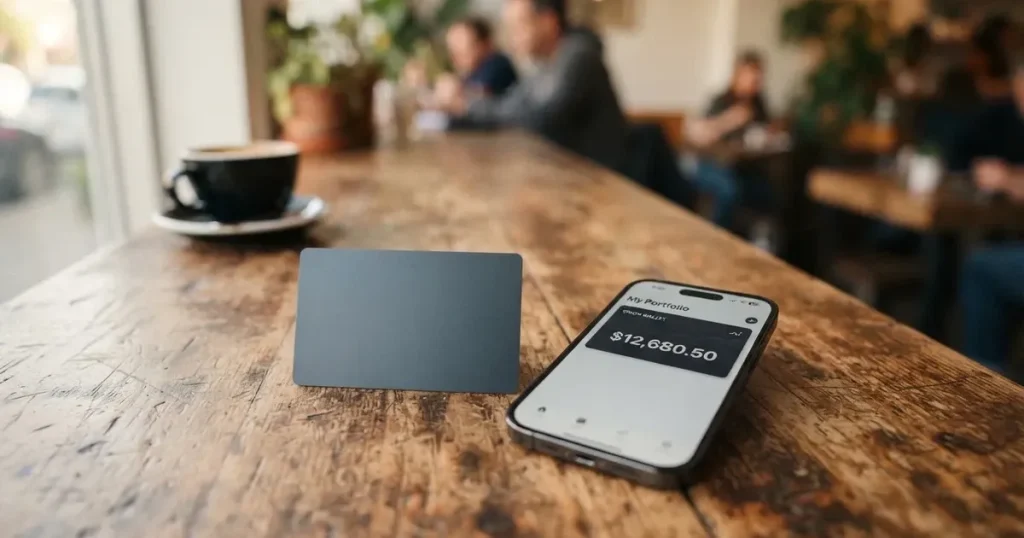
The Morse card is a fully virtual Visa prepaid debit card that you fund with stablecoins and other crypto, then spend anywhere Visa is accepted. It converts crypto to USDC (or digital euros in Europe) and spends from a stored Morse Balance “in any currency,” with no foreign-exchange markup and no fee for paying with the card itself. It is a solid 7.5 out of 10 — good if you want a lightweight way to spend a stablecoin balance abroad with clean conversion and no FX markup, poor if you need a physical card, ATM access, or fully published fees.
If you have trouble getting an ordinary bank card and you already hold stablecoins, this is one of the more straightforward options: the app works in over 140 countries, identity verification is a single selfie-and-ID step, and the card is added to Apple Pay or Google Pay in seconds. What you give up for that convenience is a lot of transparency — most of the numbers you would want to check before signing up are simply not published.
The conditions described below are current as of October 28, 2026.
Verdict: who this card is for
Morse is built around one idea: hold stablecoins, spend them abroad without losing a slice to FX markup. Its whole value proposition is the conversion side. On the score sheet it earns its 8/10 on cost and top-up because conversion happens at the real exchange rate with no markup, stablecoin deposits over Solana are free, and card payments are free. It earns 7/10 on access because the app reaches a huge number of countries even though the physical-less card is limited to certain ones. It drops to 6/10 on everyday use because there is no physical card and no ATM support — you live or die by the virtual card in your phone.
Here is the score in full:
| Criterion | Mark | Why |
|---|---|---|
| Who can get it | 7 / 10 | App in 140+ countries; card itself only in some countries; sanctioned countries closed |
| Cost | 8 / 10 | Issuance and monthly fee not disclosed; conversion has no markup; card payments free; zero FX fee |
| Top-up options | 8 / 10 | Free USDC, USDG and EURC deposits over Solana; other tokens and chains accepted; self-custodial wallet |
| Reliability and complaints | 8 / 10 | Issuer is a regulated bank, platform is a licensed US MSB and Dutch AFM-registered CASP; no official incidents found |
| Everyday use | 6 / 10 | Apple Pay and Google Pay supported; card is virtual only; no ATM withdrawals |
| Total | 7.5 / 10 | A strong spend card for stablecoin holders, not a full banking replacement |
Who it suits: you already hold USDC, USDG or EURC, you travel or buy things in currencies other than dollars, and you want a card that converts at the real rate without a percentage skim. The self-custodial wallet is a genuine plus if you care about holding your own keys.
Who it does not suit: anyone who needs a physical card in the post, cash from an ATM, or published monthly fees up front. It is also a poor fit if you want to spend directly from a normal bank account, or if the idea of a self-custodial wallet makes you nervous.
Will they give you the card
Eligibility is by residence, not citizenship. You must be “at least 18 years old” and “a resident in a supported country.” The app is available in “over 140 countries” for peer-to-peer use, and local adding and withdrawing of money works in over 70. But the card itself is “available only in certain countries,” and Morse does not publish that list on the card page — you check the app. Morse also “cannot serve customers subject to sanctions issued by the United States” (and by the UK, EU and UN).
Some countries are in closed beta and need an invite code: American Samoa, Australia, Cape Verde, Guernsey, Hong Kong SAR China, Isle of Man, Japan, Jersey, New Zealand, Serbia, Singapore, Switzerland, Thailand, Türkiye, United Kingdom and Western Sahara.
So the honest answer to “can I get it in my country?” is: probably, but the app is the authority, not any web page. What is not stated anywhere public is a definitive published list of card countries, so treat the app as the final word and expect the card side to be narrower than the app side.
How to get it
Morse does not advertise a special tier structure or a tier ladder — there is a single stated tier and no published card tiers. The process is straightforward:
- Install the app (iOS or Android; it was formerly called Sling Money).
- Complete identity verification. You may need your name, phone number, date of birth and residential address, plus “a selfie” and “a picture of a photo ID card.” The card’s own words: “requirements vary by country.” Proof of address is not stated as a required document.
- Fund your Morse balance (see the top-up section below).
- Add the virtual card to your phone and start spending.
The card is “fully virtual for now” — there is no physical version, so delivery timelines do not apply. It is a Visa prepaid debit that draws on your Morse Balance “in any currency.”
What is not stated: how many identity-verification levels exist or what triggers an upgrade. There is one published identity step, and the card notes it may “review larger deposits for compliance” — so a large first top-up can attract extra scrutiny even without a formal tier system.
Fees and costs: what it really costs
This is where a careful reader has to do the most work, because the fee picture is half-published. The card’s public page says only “Fees may apply. See Cardholder Agreement” — it does not state an issuance fee or a monthly fee. That is the biggest single gap in this review, and it is exactly the number you want before you commit.
What is published is genuinely good:
- Conversion. Crypto converts to USDC (digital euros in Europe) using the real exchange rate “with no markup.”
- Paying with the card. “Paying with the Morse Card, online and contactless, is free.”
- Foreign exchange. “Zero foreign exchange fees or markups,” at the real-time Visa exchange rate.
What you need to plan around instead of a card fee: network fees on non-free chains, and international deposit/withdraw fees on the fiat side (covered in top-up). ATM is simply not available — “Morse Card does not currently support ATM withdrawals” — so cash withdrawal is not a cost you can incur, because it is not a feature.
Here are the numbers the card does publish:
| Fee or limit | Value |
|---|---|
| Issuance fee | not stated (“Fees may apply”) |
| Monthly fee | not stated (“Fees may apply”) |
| Conversion markup | none — real exchange rate |
| Card payment (online, contactless) | free |
| FX fee / markup | zero |
| ATM withdrawals | not supported |
| Card daily spending limit | 2,000 USD (first 30 days), rising to 5,000 USD/day after 30 days |
| Money-transfer services weekly cap | 500 USD |
| Weekly/monthly deposit & withdrawal limits | shown in the app Limits screen (amounts not stated) |
Two everyday payments, so you can feel what this looks like:
- Buying a coffee abroad for about 4 USD. The crypto in your balance converts at the real rate with no markup, the card payment is free, and the FX leg costs zero. The only cost, if you funded with a token on a paid network, is that network fee you already paid on the way in.
- A 200 USD online purchase in a non-dollar currency. Same story: no card fee, no FX markup, real Visa rate. It sits under your 2,000 USD daily limit in the first month and under 5,000 USD thereafter.
The daily limit is worth internalising. At 2,000 USD per day for the first 30 days you can buy most of what a person buys in a month in a single day, but you cannot, for example, pay a large rent or a big one-off transfer from the card in that window.
How to top it up
Topping up is Morse’s other strong suit, and the routes are wide. You can add money by debit card, by stablecoin transfer, or via local Account Details. Account currencies are USD, EUR, MXN, COP and BRL (BRL requires a Brazilian CPF).
On the crypto side, deposits of USDC, USDG and EURC over Solana are free. Other tokens and other blockchains carry a fee. Bitcoin, USDT, Ethereum and other tokens can all be deposited. The wallet itself is self-custodial — you hold the keys.
On the fiat side:
- Domestic deposits are free in most countries.
- International deposits via a linked bank account, card or mobile money carry a fee; the first three international transactions with linked payment methods are free, then US$0.50 flat.
- International deposits to Account Details are 0.1%.
- Network (gas) fees are charged by the blockchain separately, not by Morse.
- Minimum top-up: not stated.
One practical point in your favour: “Morse shows any fee before you confirm,” so you should always see the cost on screen before committing a deposit.
What is not stated: a minimum top-up amount, and what happens to an unwithdrawn balance if you close the account. On closure you must first “Withdraw any money from your Morse Balance”; closure is permanent, and the treatment of funds still sitting there at that moment is not published. That is a real loose end — clear your balance before you ever think about closing.
Paying with it every day
Because the card is virtual, daily life happens through your phone wallet. You can add it to Apple Pay or Google Pay, which is how most people will actually use it — a tap at the terminal, with a tokenised number rather than your card details.
What works: contactless and online payments anywhere Visa is accepted, in any currency, converted at the real rate.
What does not:
- Merchants that only accept a physical debit card (a surprising number of parking meters, small offline terminals and some hotel desks still do).
- ATM withdrawals — not supported at all.
Some everyday-use details are simply not published: which merchant categories are blocked is not stated, the card pages say nothing about rewards (the help centre has an “Earn rewards” collection, but the terms are not on the card page), and the App Store rating could not be read directly. Unofficial, and not confirmed by the card: a third-party snapshot shows 4.5 stars from 400 reviews on the App Store under the old Sling Money name, undated.
The virtual-only design is the single biggest constraint on everyday use, and it is why this scores 6 rather than 8 here. If most of your spending is in shops that take contactless or online, that constraint barely touches you. If you expect to need a physical card or cash, it is disqualifying.
What can go wrong
No official incidents came up in my checks, and I could not find a Trustpilot page or meaningful user-review trail for Morse — which cuts both ways. No complaints is not the same as proven reliability; it is partly a young, low-profile product.
Who is actually behind it matters more here than a review score:
- Platform: Avian Labs. Avian Labs, Inc. (Delaware) is a registered US Money Services Business (NMLS ID 2639252, FinCEN MSB registration 31000315485256). Avian Netherlands B.V. (company reg. 91273323) is authorised by the Dutch AFM (registration 41000005) under MiCAR as a CASP.
- Card issuer: Lead Bank, under licence from Visa U.S.A. Inc.
- Programme manager: Bridge Ventures LLC, which “operates as an agent of Lead Bank.”
In plain terms: the crypto brand is the front-end, a licensed bank issues the card, and the platform sits under both US and Dutch money/ crypto regulation. That structure is reassuring. It also means you are trusting several parties, not one.
Self-custody cuts both ways too. The Morse Wallet is self-custodial and your private key is exportable — nobody can move your crypto except you, which is the point. But that also means a lost seed phrase is gone; crypto transfers are irreversible and a stolen key has no recovery path. There is no built-in “support will get it back” if you write your key down wrong.
Everyday safeguards on the card side are reasonable: instant card lock/unlock in the app, instant transaction notifications, and 24/7 fraud monitoring. Not stated: how customer funds are safeguarded, and whether two-factor authentication is offered on the account.
Support is in-app chat (profile > Support > Chat) plus email, with AI support “24/7/365” and human chat support; the hours for human agents are not stated. If your issue needs a human, that gap is worth knowing about in advance.
How you protect yourself is ordinary and worth stating once: back up any seed phrase offline, treat the “Morse” app and any pop-up as real only if they come from the official app, and remember a declined card authorisation can leave a hold on your balance for several days.
What to take instead
I compared Morse against three other crypto-linked cards. None is a clean sweep; each trades something away.
| Card | Score | Card & fee basics | Best for |
|---|---|---|---|
| Morse | 7.5 / 10 | Virtual Visa; zero FX markup; conversion at real rate; issuance/monthly fee not stated; no ATM | Spending a stablecoin balance abroad, no FX markup |
| International Visa Card | 6.7 / 10 | U.S.-issued virtual Platinum Visa; $5 issuance, plans from free to $19/mo; 2% FX fee; deposits free | Someone who wants a US-issued Visa and can accept the 2% FX fee |
| Bitpanda | 6.5 / 10 | Physical Visa debit, EUR only; no monthly fee; non-EUR FX fee €0 but Visa mark-up applies | Euro-area residents who want a physical card and a regulated exchange |
| UNi Card | 6.1 / 10 | Multicurrency Mastercard; no annual fee and no FX fee; live OTC conversion; up to 3% spend-to-earn | Multicurrency spending with rewards and no annual fee |
A few things stand out. International Visa Card is the one to consider if a US-issued card number matters to you, but it is closed to residents of a long list of countries and it charges a 2% FX fee on foreign-currency spend — the exact thing Morse avoids. Bitpanda requires a verified account and residence in a euro-area country and is EUR-only, so it does not help a reader outside that zone, but for those inside it, it is a regulated exchange with a physical card. UNi Card advertises no FX fee and rewards up to 3%, but its eligibility, top-up routes and physical/virtual form are not stated on the pages I saw, which is a thinner public picture than Morse’s.
If your priority is a physical card or cash, Morse is the wrong pick regardless of its fee advantages. If your priority is spending stablecoins abroad without a conversion skim, none of these three beats it on that one point.
Who I would recommend it to
I would recommend the Morse card to someone who already holds stablecoins, spends regularly in non-dollar currencies, and is comfortable with a virtual-card-only, app-first setup and a self-custodial wallet. The zero-markup conversion and free stablecoin deposits over Solana are a real, tangible advantage over the alternatives above, and the regulatory structure (a bank issuer, a licensed platform) is solid on paper.
I would hold off if any of these are true of you: you need a physical card in the post; you need cash from an ATM; you want a published monthly fee before you start; you are not comfortable managing a self-custodial wallet; or you are in a sanctioned country or a country where the card is not yet offered. In those cases the UNi Card or Bitpanda (if you are eligible) or a plain bank card is the more honest recommendation.
My one piece of due diligence: before you commit money, open the app, read the Cardholder Agreement for the issuance and monthly fee that the website hides, and check the Limits screen — those are the three numbers the public pages do not give you.
Frequently asked questions
What is the Morse card?
The Morse card is a fully virtual Visa prepaid debit card funded with stablecoins or crypto. It converts assets to USDC (or digital euros) and spends in any currency. It is virtual-only, so you use it through Apple Pay or Google Pay. It offers free conversion and no FX markup.
Does the Morse card require KYC?
Yes. Identity verification is required for setup. You must be 18+ and a resident in a supported country. You may need a selfie and photo ID. The card may also review larger deposits for compliance, so a big first top-up can attract extra checks beyond the standard identity verification process.
What does it cost to hold and use the Morse card?
Conversion uses the real exchange rate with no markup, and online or contactless payments are free. There are zero FX fees. However, the card does not publicly state its issuance or monthly fees, meaning you should check the Cardholder Agreement carefully before signing up to avoid surprises regarding those specific costs.
Is the Morse card free?
Using the card is free—no payment fees or FX markups—and USDC, USDG, and EURC deposits over Solana are free. However, it is not entirely free. Issuance and monthly fees are not specified, and international deposits can cost US$0.50 flat after three free transactions, 0.1% to Account Details, or extra chain fees.
Can I use the Morse card in my country?
App availability extends to over 140 countries, but the card itself is limited to certain countries, and Morse does not publish a full list. You must check the app for your specific location. If you are subject to US, UK, EU, or UN sanctions, you cannot use the service. Always check the app first.
How do I top up the Morse card?
You can add funds via debit card, stablecoin transfer, or local Account Details (USD, EUR, MXN, COP, BRL). Solana deposits for USDC, USDG, and EURC are free. Other tokens usually carry fees. Domestic fiat deposits are mostly free; international fiat deposits often carry small fees. Check the app for specific costs before confirming any transfer.
Does the Morse card work with Apple Pay and Google Pay?
Yes, you can add the virtual card to both. This is the primary way to use it, as there is no physical card. However, it will not work at merchants that require a physical card, and ATM withdrawals are unsupported. If you primarily use contactless or online payments, it works well.
Is the Morse card safe, and who is behind it?
The platform, Avian Labs, is a US MSB and a Dutch AFM-registered CASP. The card is issued by Lead Bank. The wallet is self-custodial, giving you control. However, funds are not FDIC-insured, and a lost seed phrase is unrecoverable. Use caution, as crypto transfers are irreversible and security relies on your careful key management.
Does Morse pay cashback or rewards?
Morse’s official pages do not explicitly state any rewards. While their help centre contains an “Earn rewards” collection, I have not verified the specific terms or conditions. If rewards are a key factor in your decision, treat this as unconfirmed and check the app details before relying on any potential benefit.
How do I withdraw money and close a Morse account?
Withdraw to a bank account, debit card, or stablecoin transfer. Solana-based USDC/USDG/EURC withdrawals are free, while others carry fees. To close your account, first withdraw your balance entirely. Closure is permanent, so ensure you have moved your funds before finalizing this process, as remaining balances may not be recoverable or explicitly protected post-closure.
App and neobank cards on the shortlist – cryptocardshortlist
Content created by the «cryptocardshortlist» team