
Wenia card review: a virtual Mastercard paid from crypto, in Colombia
 Available in US
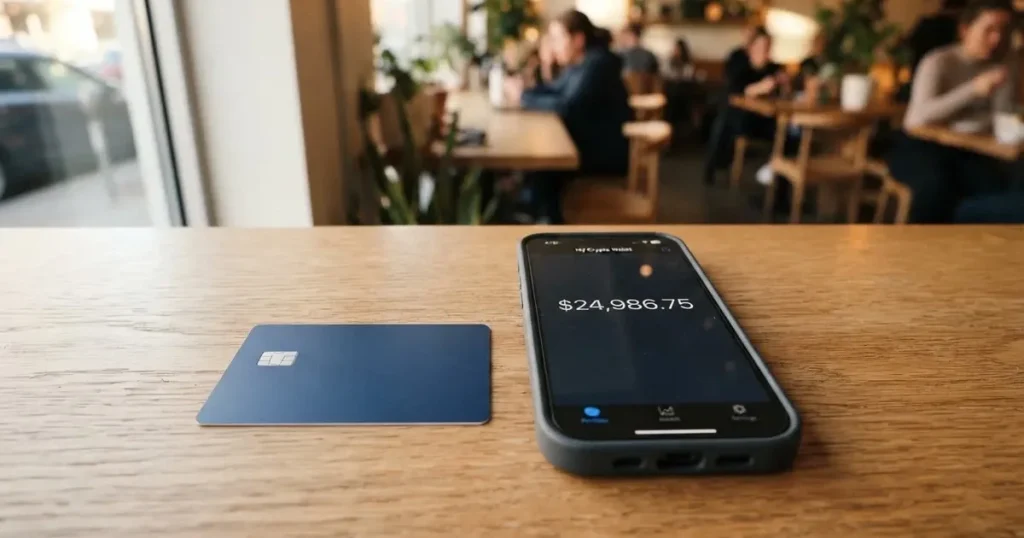
Wenia is one of the more unusual names in the crypto-card space. It is offered by a Colombian company, Wenia S.A.S., it lives entirely inside the Wenia mobile app, and there is no physical card — only a digital Mastercard you can use online and, the company says, through Apple Pay and Google Pay “soon” for in-store payments. The product is positioned for people in Colombia who already hold crypto and want a way to spend it directly, without first moving it to a bank.
The score I came away with is 6.1 out of 10, and the short version is this: if you are in Colombia, hold COPW, USDW or EURC, and want a no-monthly-fee virtual card for online spending, the cost story is genuinely strong. If you are outside Colombia, want a physical card, want ATM withdrawals, or want a clear published list of who is eligible, you will not find those answers here. Wenia’s public pages simply do not state them.
Conditions are current as of October 28, 2026.
Verdict
I rate the Wenia card 6.1 out of 10. The cost score is the standout: 9 out of 10, because creating the card is free, there is no monthly management fee (“cuota de manejo”) and no monthly charges, interest is 0%, and purchases paid in COPW, USDW or EURC carry no extra fee. The top-up options score is also high, 8 out of 10, because the card can draw on eleven different digital assets, including the Colombian peso stablecoin COPW, the dollar stablecoin USDW, the euro stablecoin EURC, and a long list of majors (BTC, ETH, SOL, AVAX, XRP, LINK, ADA, plus POL). Reliability is a comfortable 7 out of 10, since the product is issued under Colombia’s Superintendencia de Industria y Comercio (SIC), runs on Mastercard’s network, and I found no complaints or user reviews to weigh against it.
The marks that drag the total down are eligibility (2 out of 10) and everyday use (5 out of 10). Wenia’s own pages do not list who is eligible, do not name a separate bank that issues the card, and do not state daily or ATM limits. The card is digital-only, with no physical version, and in-store payment through a mobile wallet is described as “coming soon.” If any of those are deal-breakers for you — a physical card, ATM access, or a clearly stated eligibility list — Wenia is not the product to bet on.
| Criterion | Score | Why it scored that way |
|---|---|---|
| Who can get it | 2 / 10 | Eligibility and a clear list of accepted countries are not stated on the public page; the product is offered by Wenia S.A.S. in Colombia through the Wenia app. |
| Cost | 9 / 10 | Card creation is free, there is no monthly management fee and no monthly charges, interest is 0%, and purchases in COPW, USDW or EURC carry no extra fee. |
| Top-up options | 8 / 10 | Eleven digital assets are accepted (COPW, USDW, EURC, BTC, ETH, POL, SOL, AVAX, XRP, LINK, ADA), but the underlying blockchain networks are not named. |
| Reliability and complaints | 7 / 10 | Operated by Wenia S.A.S. (NIT 901656609-9) in Colombia under SIC supervision, on the Mastercard network; no complaints found. |
| Everyday use | 5 / 10 | Digital-only Mastercard, online use worldwide, mobile wallet support coming soon; no physical card and no ATM. |
| Total | 6.1 / 10 | Strong on cost and asset choice for a Colombia-based user, weak on the basics of access, a physical card, and cash withdrawal. |
In one line: the Wenia card suits Colombia-based users who already hold supported crypto and want a low-fee virtual card for online spending. It does not suit anyone who needs a physical card, ATM access, or a published eligibility list.
Who they will give the card to
This is the section where I have to be honest about what is and is not on Wenia’s public pages. The product is offered by Wenia S.A.S., a Colombian company, through the Wenia App, and the page presents it as a Colombian offering. The card itself is a Mastercard, which gives it worldwide online acceptance on the network side.
The product is offered by Wenia S.A.S. in Colombia, through the Wenia app, and the page presents it as a Colombian offering. The card itself is a Mastercard, which gives it worldwide online acceptance on the network side. What the page does not say is who, precisely, can sign up. There is no list of accepted countries beyond “Colombia,” no stated age requirement beyond the obvious (you need to be an adult to hold a financial product), no residency test, and no nationality test. The absence of an eligibility page means the only way to know whether you qualify is to download the app and try.
A practical point worth raising before you do: Wenia S.A.S. is supervised by Colombia’s Superintendencia de Industria y Comercio (SIC), which is the consumer-protection and competition authority, not the financial superintendency (that is the Superintendencia Financiera). The card page says Wenia S.A.S. issues and operates the card; it does not name a separate licensed bank or e-money institution as the issuing partner. For a user outside Colombia that detail matters, because a card without a named licensed issuer can be harder to fit into the rules your own bank or tax authority expects you to follow.
What is also not stated on the public pages: card currency, daily limits, ATM limits (there is no ATM functionality at all, but the limit is silent), and any blocked merchant categories. The 10,000 USD per month ceiling is mentioned for top-ups and the card can be raised on request through customer service, but other limits simply are not there.
How to get it
The published flow, taken at face value, is short. You download the Wenia app, open an account, create the card inside the app, and choose the digital asset you want to pay with. There is no mention of a physical card being issued, and there is no shipping step.
The Wenia app is also a hosted crypto wallet, so the same place where you hold COPW, USDW, EURC, BTC, ETH and the other supported assets is where the card lives. The “Wenia Card” section is where you switch which asset backs the card; the same section is where you would, in principle, see transactions and limits. The page does not walk through identity checks (KYC), which are not detailed on the public pages. In practice that means the app will almost certainly ask for the standard set: name, address, date of birth, an ID document, and probably a selfie or liveness check — but I am describing what every regulated onboarding flow does, not what Wenia has confirmed on its page.
Because the product is offered by a Colombian company under Colombian supervision, the most likely intended user is a Colombia resident. The page does not say so in those words, but everything else — the COPW stablecoin, the NIT (Número de Identificación Tributaria) of the company, the SIC reference — points that way.
The “how” in short: download, register, create the card in-app, pick your asset. The “who” is the part the public page leaves open.
What it really costs: fees, conversion, and everyday payments
The cost story is the most concrete part of the public material, and it is genuinely favourable. The card is free to create, there is no monthly management fee and no monthly charges (the page says “sin cuota de manejo ni cargos mensuales”), and interest is 0%. Purchases paid in COPW, USDW or EURC carry no extra fee. Choosing some other cryptocurrencies, the page warns, may trigger a conversion fee, and the rate for that fee is not stated.

| Fee or limit | Amount |
|---|---|
| Card creation | Free |
| Monthly management fee | None |
| Monthly charges | None |
| Interest | 0% |
| Conversion fee (COPW, USDW, EURC) | None |
| Conversion fee (other cryptos) | Not stated |
| FX fee | Not stated |
| ATM fee | Not applicable (no ATM) |
| Monthly limit | Up to 10,000 USD; higher on request |
| Daily limit | Not stated |
| ATM limit | Not stated |
To translate this into three everyday payments, since that is what most readers actually care about:
- An online subscription in US dollars, paid from USDW. No conversion, no monthly fee, no extra percentage. The full USDW value is spent, and the only friction is the Mastercard authorisation itself. This is the cleanest case.
- An online payment in euros, paid from a crypto holding such as BTC or ETH. The card would have to convert the asset to a spendable balance first, and the page flags that this kind of conversion can carry a fee. The fee is not quoted, so you would see the final amount in the app at the moment of payment. The “no extra fee” line in the public material refers specifically to COPW, USDW and EURC, not to majors.
- An in-store payment. This is the case Wenia does not yet cover end-to-end. In-store spending through a mobile wallet is described as “coming soon.” Until that goes live, the card’s real-world presence is online.
A second, more structural point: Wenia says purchases in COPW, USDW or EURC are free of additional costs, but the network fee for any on-chain top-up is paid to the blockchain, not to Wenia. If you top up by sending USDC on Ethereum, the gas fee is whatever the Ethereum network charges at that moment; Wenia does not collect it, but you still pay it. None of this changes the Wenia-side fees, but it is worth knowing that “no card fee” and “free to use” are not the same thing.
A third point that the public page does not cover at all: foreign-exchange fees when the merchant settles in a currency the card is not denominated in. Mastercard applies its own wholesale rate, and many card programmes add a percentage on top. Wenia’s public material does not state one, and the card currency itself is not stated, so the safest read is that the spread between the asset you pay from and the merchant’s currency is the only FX you can see in the app at payment time.
Top up: how to fund the card
Top-up is one of the strongest parts of the Wenia story. The card draws on a digital-asset balance held inside the Wenia app, and that balance can be in any of the following: COPW (the Colombian peso stablecoin), USDW (a US dollar-pegged stablecoin), EURC (the euro coin issued by Circle), and the major assets BTC, ETH, POL, SOL, AVAX, XRP, LINK, ADA. That is eleven assets in total, and you switch between them inside the Wenia Card section.

In the wider crypto market, sending tokens on the wrong network is one of the most common ways to lose funds. Users should always check the network before sending any assets, as the card’s public pages do not name the blockchain networks on which each asset must be sent.
A second thing to check: the COPW, USDW and EURC trio covers the three currencies the Wenia page says carry no extra fee. The other assets — BTC, ETH, POL, SOL, AVAX, XRP, LINK, ADA — are usable but the page warns that choosing them may trigger a conversion fee, the rate of which is not stated. So while the menu of accepted assets is long, the cheapest path is the stablecoin trio.
There is no auto top-up, no fiat bank-link, and no salary deposit feature mentioned on the page. The only funding method the page describes is paying from a balance already held inside the Wenia app. In practice that means you would fund the Wenia app wallet first (the wallet side of Wenia is a separate product) and then assign that balance to the card.
| Funding method | How it works |
|---|---|
| From COPW, USDW or EURC balance | No extra fee, per the public page. |
| From BTC, ETH, POL, SOL, AVAX, XRP, LINK, ADA balance | May incur a conversion fee; rate not stated. |
| From a bank account | Not mentioned on the card page. |
| Auto top-up | Not mentioned on the card page. |
| From a paycheck | Not mentioned on the card page. |
Paying with it every day
The everyday-use story is where Wenia is, fairly, weakest. The card is a digital (virtual) Mastercard, and the public material describes worldwide online use. There is no physical card, and in-store mobile wallet payments are a feature mentioned on the home page. Apple Pay and Google Pay are referenced there, which suggests the tokenisation is in the works, but I would not assume the wallet feature is live today.
A few practical consequences flow from that:
- No contactless tap-to-pay at a shop. Until the mobile-wallet launch goes live, the card is for online checkouts only.
- No ATM. The card is not a physical card with a magstripe or chip, so it cannot be inserted into an ATM. Wenia’s page does not describe any ATM feature at all, and no such feature is mentioned. I read that as “no ATM” until told otherwise.
- Online subscription and one-off online purchases are the natural use case, and that is the use case Wenia’s pricing (free, no monthly fee) is clearly built around.
Mobile wallet support is a small but real point. When Apple Pay and Google Pay do go live, the card will be tokenised into a device-specific number, and the physical card number itself is never shared with the merchant or stored on Apple’s servers. That is a security plus, and it is also the only way the Wenia card will reach a shop’s terminal.
A note on merchant category codes, since this is what determines whether a card works at, say, a betting site or a crypto exchange. Blocked merchant categories are not stated, so I cannot tell you whether gambling, dating, crypto exchanges, or any other category is blocked. This is one of those things where the only answer is “try it in the app and see,” and I would not be surprised if a first transaction at an unusual merchant declines.
Rewards, cashback, sign-up bonuses, and any kind of loyalty programme are not stated on the public page. If you are choosing a crypto card partly for the cashback, this is the wrong product to be looking at.
What can go wrong
The honest answer to “what can go wrong” is split into two parts: what I could check, and what I could not, because the public pages do not say.
What I could check. Wenia S.A.S. is a Colombian company (NIT 901656609-9), supervised by the Superintendencia de Industria y Comercio. The card runs on Mastercard’s network, which means it inherits Mastercard’s dispute, chargeback and 3-D Secure machinery. I went looking for user complaints and reviews on Reddit, Trustpilot, and the news, and found none specific to the Wenia card. That is a soft signal rather than a strong one: the card may simply be too new or too small to have generated many complaints, so “no complaints” is not the same as “no problems.” Official incidents, as far as I could see, are also none.
What I could not check, because it is not stated.
- Who exactly is eligible. The eligibility for the card is not clearly defined on the public page. If the page does not list accepted countries, ages, or nationalities, you cannot be sure you qualify without applying.
- Card currency and FX fees. Not stated. This is the kind of detail that determines whether a card is genuinely cheap abroad.
- Daily and ATM limits. Not stated (and there is no ATM in any case).
- Blocked merchant categories. Not stated.
- Conversion fee for non-stablecoin assets. The page warns that “some other cryptocurrencies may incur a conversion fee,” but the rate is not given.
- Issuing bank or e-money institution. The page says Wenia S.A.S. issues and operates the card. A separate licensed bank partner is not named, which is unusual for a card programme and worth being aware of.
A broader point, which is not specific to Wenia but is worth keeping in mind with any crypto card: a card that is a prepaid-style product drawing on a hosted crypto balance exposes you to the same counterparty risk as the wallet behind it. If the custodian behind the Wenia balance were to fail, the funds sitting in that balance would be at risk in the same way that any custodial wallet is at risk. This is true of any hosted wallet in the industry; it is not a Wenia-specific accusation. But it is the reason a self-custody alternative is sometimes a more conservative choice for the funds themselves, even when the card convenience is on a hosted platform.
A second, more prosaic risk: the page is short on numbers. Where a fees page would typically list “X% on foreign currency,” “Y% on ATM withdrawals,” “Z per cash transaction,” Wenia’s public material is mostly silent. If you are the kind of person who reads the fees page before signing up, this one will not give you much to read.
What to take instead
A reader who likes the shape of the Wenia card (free, virtual, paid from crypto) but cannot use it because they are not in Colombia, or wants a physical card, or wants ATM access, will want to compare a few alternatives. I am giving three here, each briefly described with its key features and a short note on what it actually offers.
| Card | Score | Country / access | Card type | Cost story | Funding | Rewards |
|---|---|---|---|---|---|---|
| Wenia | 6.1 / 10 | Colombia, via Wenia app | Digital Mastercard only | Free, no monthly fee, 0% interest; no fee for COPW/USDW/EURC; other assets may have a conversion fee | Supported digital assets in the Wenia app; networks not stated | Not stated |
| Coinbase Card | 6.4 / 10 | US (all states except Hawaii) | Visa prepaid debit, virtual or physical | “Zero spending fees and no annual fees”; full fee list in the Cardholder Agreement; spread applies on crypto conversion | US bank link or paycheck deposit; crypto balance converted to USD at payment | Optional crypto rewards on every purchase, US only; rate variable, set in the app |
| OKX | 6.2 / 10 | EU plus Norway (Iceland and Liechtenstein excluded per explainer); launched 28 January 2026 | Mastercard virtual debit, euro-denominated, no physical card mentioned | No card fee, no transaction fee, no OKX FX fee; conversion spread 0.1% per the explainer (May 2026) | USDC or USDG in OKX Pay; other coins must be converted first; no auto top-up | USDG-only cashback, monthly caps; promos vary |
| Young Card | 5.7 / 10 | Not stated officially | Not stated officially | Not stated officially | Not stated officially for the card itself | Cashback paid in YNG tokens: Essential 0.1%, Gold 1.8%, Platinum 3.6% (Bronze/Silver not stated) |
A few honest points about this comparison. Wenia’s score is the lowest of the four, but the comparison is not apples-to-apples: Wenia is the only one positioned specifically for Colombia, and it is the only one whose public material is most explicit about its monthly fees (because they are zero). Coinbase Card and OKX are stronger products on the metrics that are verifiable — card type, fees, rewards — but they are also products whose public pages publish much more of that information. If a clean, verifiable fee list matters to you, Wenia is the weaker story on transparency even though its headline fees are competitive.
For someone in Colombia, the practical question is: do you want the Wenia card because you already keep crypto in the Wenia app, or do you want a card for online spending that is paid from any of several stablecoins? If the latter, the OKX card is the closest structural alternative — euro-denominated, virtual, no monthly fee, paid from a stablecoin balance — but it is a Europe-only product. For US residents, the Coinbase Card is the obvious comparison, with the difference that it is a US Visa (not a Mastercard) and converts every crypto balance to US dollars at the point of sale.
The Young Card is in the table because it is a relevant alternative, but a lot of the basic facts (eligibility, card type, cost, funding) are not stated officially for the card itself. I would treat it as a placeholder for “a product with a YNG-token cashback structure,” not as a fully comparable alternative.
Who I would recommend it to
Putting the whole picture together, here is who the Wenia card is genuinely a fit for, and who I would push towards a different product.
It is a fit for:
- Colombia-based users who already hold COPW, USDW, EURC or one of the supported crypto assets in the Wenia app and want a virtual card for online spending, with no monthly fee and no interest. If you are paying for streaming services, software subscriptions, online shopping, or any other online checkout, this card does the job without an extra percentage on top of the asset conversion.
- Users who do not need a physical card and do not need cash access. A purely online, no-ATM, no-monthly-fee card is exactly what Wenia delivers, and there is no reason to overpay for features you do not use.
- Users who value asset breadth. Eleven assets, including the COPW stablecoin that few other cards support, is a real differentiator for users already inside the Wenia ecosystem.
It is not a fit for:
- Anyone outside Colombia for whom the public eligibility list is silent. The public material does not rule you out, but it does not confirm you in, either.
- Anyone who needs a physical card for tap-to-pay, ATM withdrawal, or in-store shopping. There is no physical card, and the in-store mobile-wallet launch is described as “coming soon.”
- Anyone who needs an ATM. The card is virtual, and the page does not describe any ATM functionality.
- Anyone who needs published, verifiable FX and conversion fees before signing up. Wenia’s public material is silent on FX, daily limits, and the non-stablecoin conversion rate.
- Anyone who wants cashback or rewards. The page does not describe any rewards programme.
- Anyone whose primary concern is the regulatory setup. Wenia says it issues and operates the card; a separate licensed issuing bank is not named. If you need a card whose issuer is clearly an EMI or a bank under a known financial regulator, Wenia’s setup is harder to verify from the public material.
The honest framing is this: Wenia is a strong, low-cost card for a narrow use case. If you are inside that use case, the cost story is genuinely good. If you are outside it, the missing details on eligibility, FX, daily limits, and the issuing bank are the reason to look elsewhere.
Frequently asked questions
What is the Wenia card?
The Wenia card is a digital (virtual) Mastercard offered by Wenia S.A.S., a Colombian company, through the Wenia mobile app. It is paid from a crypto balance held in the app, and it is intended for online spending. There is no physical card, and in-store use through a mobile wallet is described as coming soon.
How does the Wenia card work?
You hold crypto inside the Wenia app, you switch on the Wenia Card section, and you choose which digital asset to pay with. At an online checkout you enter the virtual card details; the app converts the chosen asset to a spendable balance, and Mastercard routes the payment. There is no physical card to ship and no separate bank login to manage.
Is Wenia a bank?
Wenia S.A.S. is not described as a bank on the public pages; it is supervised by Colombia’s Superintendencia de Industria y Comercio. The page says Wenia issues and operates the card, and it does not name a separate licensed bank or e-money institution as the issuing partner, which is unusual for a card programme.
Who owns Wenia?
The company name is Wenia S.A.S., with NIT 901656609-9, registered in Colombia. The ownership structure behind that entity is not described on the public card page, so I cannot go further than the company name and tax ID from the information available.
Is the Wenia card available in my country?
The public material says the product is offered in Colombia via the Wenia App, and it does not list other accepted countries. If you are not in Colombia, the only way to know whether you can sign up is to download the app and try; the public pages do not state a wider list of supported countries.
How do I apply for the Wenia card?
The published flow is: download the Wenia App, open an account, create the card in the app, and choose the digital asset to pay with. The app handles the rest, including whatever identity checks the regulated onboarding requires; the card page itself does not detail the KYC steps.
Does the Wenia card require KYC?
The card page does not describe the KYC process. In practice, a regulated onboarding flow asks for name, address, date of birth and an identity document, and Wenia S.A.S. is supervised by the SIC. The exact checks the Wenia app performs are not stated on the public card page.
Is the Wenia card free?
Card creation is free, there is no monthly management fee (“cuota de manejo”), no monthly charges, and interest is 0%. Purchases paid in COPW, USDW or EURC carry no extra fee. The page warns that choosing other cryptocurrencies may incur a conversion fee, and the rate for that fee is not stated on the public material.
How do I add the Wenia card to Apple Wallet or Google Pay?
Apple Pay and Google Pay are mentioned on the Wenia home page as supported, but the in-store mobile-wallet feature is described as “coming soon.” When it goes live, the standard process applies: open the Wenia app, follow the prompt to add the card to the wallet, and complete the issuer verification on the device.
Is the Wenia card safe?
The card is operated by Wenia S.A.S. under Colombian supervision and runs on Mastercard’s network, which gives it Mastercard’s standard 3-D Secure and dispute machinery. I found no public complaints or user reviews specific to the Wenia card. As with any hosted crypto balance, the funds in the Wenia app are exposed to the same counterparty risk as any custodial wallet, and a separate licensed issuing bank is not named on the public page.
Exchange cards on the shortlist – cryptocardshortlist
Content created by the «cryptocardshortlist» team