
A Mastercard you can load from a crypto balance, at a price that adds up
 Available in US
If you have been reading around looking for a card that spends straight out of a crypto balance and you keep running into the same pattern — attractive headline features, a fee table that needs reading twice, and no clear answer about who is actually allowed in — then SharPay is the kind of product that rewards exactly the kind of reading I did for this page. I have gone through the card’s own pages, its fee schedule, its onboarding steps and its regulatory footnotes, and I want to take you through what I found in the order you will actually need it: who they will issue it to, how you get one, what it costs, how you load it, how it behaves in a shop, what can go wrong, and what the alternatives do better.
Here is the short version. SharPay gives you a Mastercard debit card that draws on a balance you load yourself — with euros, dollars or stablecoins, mainly. The virtual card appears in the app straight after you order it, which is genuinely useful if you need a card number today. Apple Pay and Google Pay work. But the fee schedule is not cheap: there is a euro-plus-percentage charge just to move money onto the card, a 2.99% mark-up on currency conversion, and a monthly service fee on top. The card is issued by a licensed Lithuanian e-money institution and the crypto side runs through a Canadian money services business, which is the reassuring part; the less reassuring part is that its crypto services are explicitly not offered to EU residents, and the whole product sits outside the EU regulatory perimeter for the crypto side of things.
My score for it, on the same criteria I use for every card in this series, is 5.9 out of 10. It is not a bad card. It is a card that is strong on everyday use and weak on cost, which is a specific and unusual balance and worth understanding before you commit.
The conditions described on this page are current as of October 28, 2026.
Verdict: 5.9 out of 10, strong for daily use, expensive to run
I scored SharPay below the middle of the field, and the reason is not that the card is badly built. The card part is, on the evidence of its own pages, unusually competent: a virtual card you get immediately, a physical one in about fifteen working days, contactless, Google Pay and Apple Pay, ATM withdrawals, 3-D Secure. That is the “everyday use” line, and it scored 9 out of 10.
The drag is the money side. Cost scored 3 out of 10, and I want to be honest about why that is not a rounding difference. You pay to open the payment account, you pay to issue the card, you pay a monthly service fee per card, you pay a fixed fee plus a percentage to load the card from another card, and you pay a mark-up on currency conversion. I will walk through each of those in the costs section with the actual numbers, because the way they stack depends on how you use the card.
Reliability and complaints scored 8 out of 10. I could not find a single complaint about SharPay — no Trustpilot page, no Reddit thread, no news story about a problem. That is genuinely unusual for a card of this size, and I want to be careful about what it means. It most likely means the card is young and small, not that it has a perfect record. The homepage claims “15k +” users, which is a modest number. So the absence of complaints tells you there is no track record of failures, and it does not tell you there is a track record of successes either.
Access scored 5 out of 10 and it is the criterion where the product is most sharply limited. The card is not for residents of “restricted or prohibited” countries, and the published list includes Russia and Belarus along with Crimea, DNR, LNR, Kherson and Zaporizhzhia, Iran, Cuba and Syria, among others. More surprising: the crypto services are not offered to EU residents at all. If you live in the EU and you wanted this for the crypto side, it is not for you, full stop. If you are a non-EU citizen anywhere else, you verify with a foreign passport.
Top-up options scored 6 out of 10. The list of what you can deposit is generous — euros, USDT, USDC, BTC, ETH, XRP, LTC, BCH, and DAI and TUSD as well — but the networks are not named in the FAQ, which is a gap I will come back to, because sending on the wrong network is the most expensive mistake available in this product.
| Criterion | Score | Why |
|---|---|---|
| Who can get it | 5 / 10 | Residence rule, not citizenship; restricted and prohibited countries closed, including Russia, Belarus, Crimea, DNR, LNR, Kherson, Zaporizhzhia, Iran, Cuba, Syria; crypto services not for EU residents; number of supported countries not disclosed |
| Cost | 3 / 10 | Payment account opening 10 EUR, card issuing 1 EUR, service 3 EUR per month; card load 2.00 EUR + 1.99%; FX mark-up 2.99% |
| Top-up options | 6 / 10 | EUR, USDT, USDC, BTC, ETH, XRP, LTC, BCH, also DAI and TUSD; networks not named in the FAQ; USDC deposit via Mastercard/VISA costs 4% |
| Reliability and complaints | 8 / 10 | Card issued by UAB Walletto (Lithuania, Bank of Lithuania e-money licence no. 33), payments by SPEKA Payments Corp (FINTRAC MSB M22046940); no complaints or reviews found |
| Everyday use | 9 / 10 | Virtual card active immediately after ordering, physical in about 15 working days; Google Pay and Apple Pay; ATM withdrawals possible |
| Total | 5.9 / 10 |
So who does this suit? In one line: a non-EU resident who cannot get an ordinary bank card easily, needs a Mastercard number for everyday spending, wants Apple Pay, and is either paid in euros or holds stablecoins and is comfortable with the fee load. If that is you, this is a workable card. If you are in the EU, or if cost per transaction is the deciding factor, look at the alternatives before you commit.
Who will they give you the card to
They will issue it to you if you are not a resident of a restricted or prohibited country, and — this is the part people miss — you probably cannot get the crypto services if you live in the EU. The rule is by residence, not citizenship, and the card states that plainly: you must not be a resident of a restricted or prohibited country. The prohibited list published by SPEKA Payments Corp includes Russia and Belarus, and also Crimea, DNR, LNR, Kherson, Zaporizhzhia, Iran, Cuba and Syria, among others. Separately, the crypto services are described as not being for EU residents.
Why does that distinction between citizenship and residence matter to you in practice? Because sanctions screening and issuer risk policy are usually applied both to where you are and to where your money came from. A national of one of those countries living legally in a permitted country is in a genuinely different position from a resident there, and it is not something the card’s public pages resolve. No separate citizenship rule is stated. If your citizenship is not straightforward, or you have moved recently, that is a question for support before you invest an hour in onboarding — not something you can resolve by reading the terms.
What is clear is the documentation. Citizens of other, non-EU countries verify with a foreign passport. EU citizens can use a passport or an ID card. There is no statement about the number of countries supported — that figure is simply not disclosed — so the only way to know is to try.
Age is not stated either. The general rule in this category is that prepaid and debit cards go to adults, 18 and over, and some issuers set higher limits, so assume you need to be 18 and expect your limits to depend on your verification level rather than your age.
How to get it
The path is: register, verify, order. Register with a phone number, email and password. Then complete Level 1 verification, then Level 2 if you want a fiat account and the card, and then order the card in the app.
Level 2 is the one that matters for this product, because Level 2 is what the card requires — it is described as needed for fiat accounts and cards. It comes after an additional check that takes up to five days. Document review itself is quoted as taking from 1 to 72 hours. So plan for a few days, not a few minutes, and keep in mind the step that adds the most time is the extra one.
What you need to hand over:
- A passport, full page, good quality — cropped copies are rejected, and so are documents that are not a passport.
- Bank statements in English.
- A questionnaire covering your turnover, your source of funds, and any PEP or US-person links.
- A video selfie.
The rejection triggers are worth reading twice, because two of them are about the video and are easy to fix: poor light, and a hat, glasses or filters. The rest are about the document itself. Take the passport photo in daylight, fill the frame, and do the selfie without anything on your face.
Then the card. There is a virtual card, which is active immediately after you order, and a physical card, which the card describes as typically shipped within about fifteen working days. Delivery times vary by destination; which countries are served and what delivery costs are stated is not something the public pages say. The app store listing and homepage mention up to five cards per account. The card is a Mastercard debit — the wording on the card’s own page is “Flex Mastercard Debit card is issued by UAB Walletto” — and the card currency is EUR, with the fee schedule denominated in euros.
Replacing a virtual card costs 1.00 EUR. What a replacement physical card costs is not stated.
Fees: what SharPay really costs
This is the section that decides whether the card is worth it for you, so I have put the whole schedule in front of you rather than summarising it. Every number here comes from the card’s own fee information.
| Fee or limit | Amount |
|---|---|
| Payment account opening | 10 EUR |
| Crypto account | free |
| Card issuing (virtual card) | 1.00 EUR |
| Virtual card replacement | 1.00 EUR |
| Card service | 3.00 EUR per card, per month |
| Chargeback handling | 40 EUR |
| Card load, card to card | 2.00 EUR + 1.99% |
| FX mark-up on a personal card | 2.99% (1.00% on payments) |
| Purchase fees | shown as “-” |
| USDC deposit via Mastercard/VISA | 4% |
| USDC withdrawal via Mastercard/VISA | 3% |
| Other coins | “network fee” |
| Account closure, personal | 25.00 EUR |
| Account closure, business | 100.00 EUR |
| POS and e-commerce limit | 10,000 EUR daily, 30,000 EUR monthly |
| SEPA crypto transactions | max 14,500 EUR per day |
| ATM withdrawals | possible; no fee or allowance listed |
Now let me put three ordinary days through that table, because that is the only way to see whether it adds up.
A coffee and a supermarket shop in your own currency. If the card is in EUR and you are paying in EUR, there is no conversion mark-up and the purchase fee line is shown as “-”. What you are paying for the privilege is the fixed side: 10 EUR to open the payment account, 1 EUR for the card, 3 EUR a month for the service. On a single year’s light use, that fixed block dominates everything else.
A holiday abroad, or any purchase in a currency other than EUR. Here the 2.99% FX mark-up applies to a personal card, with a 1.00% rate on payments. There is also a spread question the card does not answer: the page says you can purchase in any currency you wish, and lists a 2.99% mark-up, but what spread applies beyond that on other-currency purchases is not stated. So treat 2.99% as a floor on the cost of foreign spending, not a ceiling, and if foreign spending is your main use, ask support what the total conversion cost is before you rely on it.
Loading the card from another card. This is where the fee bites hardest, and it is worth internalising: card-to-card load costs 2.00 EUR plus 1.99%. Every single time. So a 200 EUR top-up costs you 2.00 EUR plus 3.98 EUR, 5.98 EUR, before any network fee the blockchain charges. That is a large percentage on a modest load, and it is why the top-up route matters so much for the total.
The 4% on a USDC deposit by Mastercard or VISA is, bluntly, higher, on top of whatever else applies. If you are moving USDC in or out by card, this is the line that will cost you the most.
One more limit-shaped number to keep in view: chargeback handling is 40 EUR. That is the price of disputing a transaction through the formal process. If you expect to use chargebacks as a routine consumer protection rather than a last resort, factor that in. There is a single tier — no plans, no upgrades — and pricing is listed per product.
Top up: how the money gets onto the card
You can load the card with euros, or with crypto: USDT, USDC, BTC, ETH, XRP, LTC and BCH are listed, and the pricing page also lists DAI and TUSD. The FAQ does not name the networks — it says to select the currency and the network — so you need to check inside the app for which network each coin should arrive on before you send. That gap is the single most important operational detail on this page, so I will say it plainly: blockchain transfers are irreversible, and a deposit sent on a network the provider does not support, or to an address belonging to a different network, can be lost or need manual support recovery with no guarantee. Get the network right in the app first, and for XRP or Stellar you will need the memo or tag, which the card does mention.
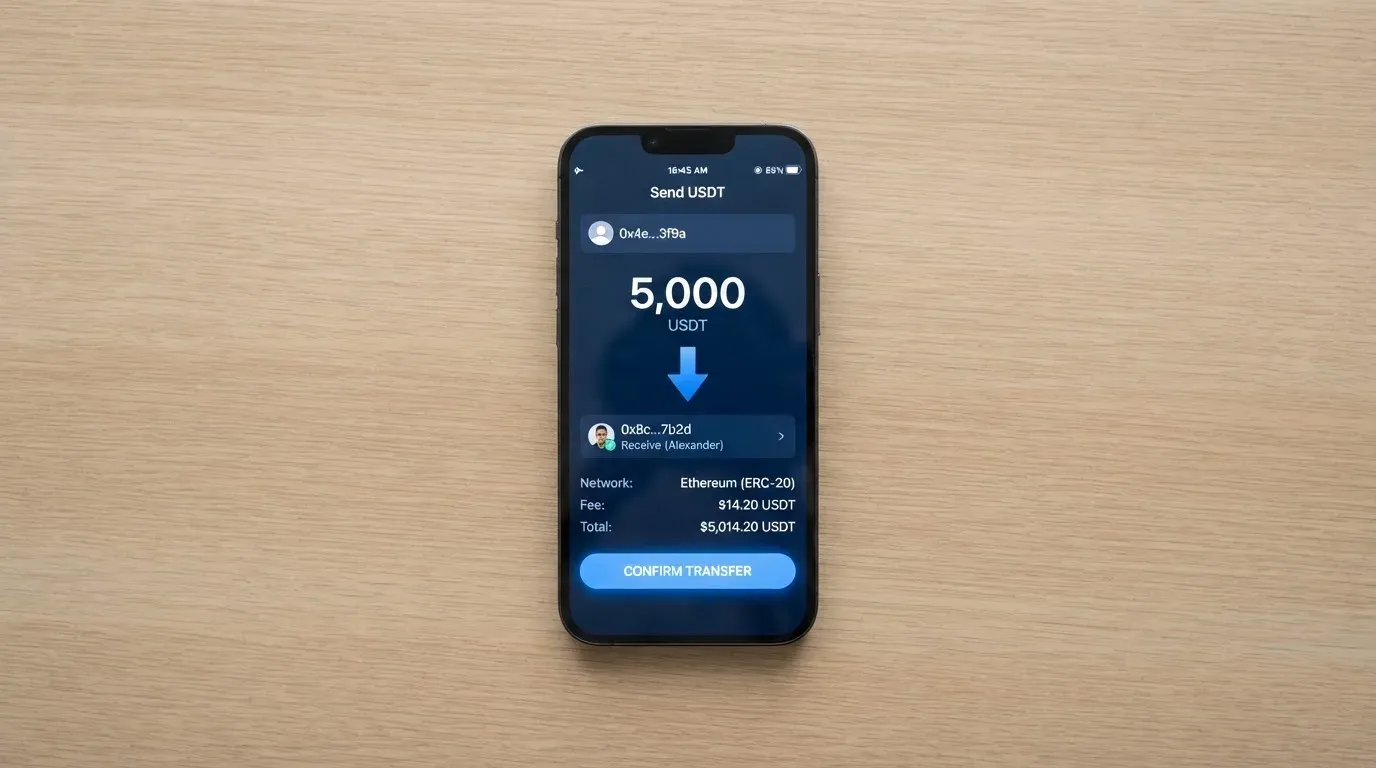
The minimum top-up is not listed as a number. The card tells you to read the minimum in the top-up amount input field, which is honest but means you find out at the moment you try.
Other mechanics worth knowing:
- Card-to-card loading costs 2.00 EUR + 1.99%, as above.
- Crypto deposited in a currency other than the card’s is “automatically exchanged at the system exchange rate” — which is the provider’s rate, not a market rate, and that phrasing is where I would press support for detail if currency conversion is central to your plan.
- Crypto purchases by card have monthly limits, with the amounts shown in the app.
- SEPA crypto transactions are capped at 14,500 EUR per day.
- On-chain network fees are charged by the blockchain, not by the card provider.
On the way out: transfers to SEPA, cards, e-wallets and crypto, processed “from 1 to 60 minutes”. Card transfers are only possible if the card was previously topped up. Closing the account costs 25.00 EUR for a personal account and 100.00 EUR for a business one, and what happens to the balance left on the account when it closes is not stated — that is a real question to ask before you ever close, not after.
Paying with it every day
This is where SharPay is strongest, and I want to give credit where the pages earn it. You can pay contactless. Google Pay and Apple Pay are both supported, and with Apple Pay in particular the card number is replaced by a device-specific number stored in the phone’s secure hardware, with a one-time security code on every payment — so adding the card to Apple Wallet is not just a convenience, it is a better way to use it than handing over the plastic. You can also make ATM withdrawals; the card page says so, though the fee page lists neither a fee nor an allowance for them, which is an omission I would want answered.
There is one tier only — no card plans to choose between — so what you get is what you get, and the pricing is per product rather than per plan.
The virtual card being live the moment you order is the feature I would emphasise most. If you need a Mastercard number for a subscription today, or you are waiting on a physical card to arrive, that instant availability is worth a lot on its own.
Two things you will not find. There is no cashback mentioned anywhere in the pages I read — rewards are not stated, so treat that as absent rather than as zero-and-therefore-fine. And some merchant categories are closed to you: the prohibited-activities list covers illegal gambling services, including illegal online casinos and sports betting, and adult content, among others. Expect declines at some merchants for reasons that have nothing to do with you.
Disputes work like this: a chargeback handling fee of 40 EUR, and if your account has been debited twice during a payment, the money is returned to your account automatically. A refund policy is linked from the pages but the time frames are not stated. The app is the SharPay Wallet app on Google Play and Apple App Store; the store ratings and the number of ratings were not shown in the text I read, and the homepage claims “15k +” users.
What can go wrong
The three real risks here are custody, screening and the fee arithmetic, in that order.
Your money is held by the provider. This is a custodial arrangement — the payment and e-money account sits with the provider, not with you. That means the private key or credentials are on their side, and you are trusting them in a way you would not with a wallet you control. The general point about this category is worth stating plainly: crypto transfers are typically irreversible, a stolen key has no built-in recovery because the network cannot freeze or return funds, and custodial platforms have a real record of it going badly wrong — Mt. Gox at around US$350 million reported stolen between 2011 and 2014, Coincheck at around US$400 million in 2018, and the Ronin Network at US$625 million in 2022. None of those was this card, and I am not suggesting SharPay is in that category. The point is that holding funds with a custodian carries counterparty and hack risk as a matter of structure.
What SharPay does offer on security: OTP or two-factor codes at login, the ability to block and unblock the card in the app, 3-D Secure 2.0 on online payments, and the possibility that they ask you for proof of funds. What it does not state is anything about safeguarding or insurance of funds — which matters more than it sounds, because safeguarded e-money is not the same as a bank deposit and may not sit under a deposit guarantee scheme.
Screening can stop you mid-life. The card can be blocked in the app by you, or by them. KYC is not a formality here: the questionnaire asks about turnover, source of funds, and PEP or US-person links, and Level 2 exists for a reason. If due diligence cannot be completed, the institution is expected to stop the transaction or relationship, and where necessary end the relationship — that is the rule that explains frozen accounts and closure requests in this category. So the realistic risk is not theft, it is a freeze or a refusal at a moment when you have money on the account, and the closure fee is 25.00 EUR for a personal account.
Programmes get wound down. Cards in this category do close. Visa terminated its global agreements with FTX on 13 November 2022 and the FTX US debit card was wound down by its issuer; WaveCrest, a Visa issuer that supplied crypto card brands, was suspended by Visa in Europe in 2018, closing all its Visa programmes. I found no dated events of that kind for SharPay, which is worth saying just as plainly. The pattern to understand is that a closure typically gives a notice period, then stops spending and loading, then asks you to withdraw remaining balances — and that the balance is the last thing to move. That is why the unstated balance-on-closure question matters.
Declines and holds. A merchant can look up the issuer identification number at the start of the card number and see which institution and country issued it, and may apply extra scrutiny when the issuer country differs from the billing address — which is why a card issued in one country can look foreign to a shop in another. Some merchants decline prepaid or foreign-issued cards for exactly that reason. Address verification, which compares the numeric parts of the billing address, is mainly offered in the US, Canada and the UK and is generally unavailable for foreign-issued cards, which can cause declines on their own. And a declined authorisation may leave a hold on funds that can remain for several days, typically up to seven.
Who you are dealing with. Worth knowing the structure before you sign up. GTM Exchange Ltd (Cyprus) designs and operates the sharpay website and app. The card is issued by UAB Walletto, Lithuania, under a Bank of Lithuania e-money licence no. 33. Payment services are provided by SPEKA Payments Corp., Canada, FINTRAC MSB M22046940. So the card side sits inside an EU e-money licence and the crypto side sits under Canadian money-services registration, with the crypto services described as outside the EU and not to EU residents.
Support, if you need it: phone +357 2503-09-49, email addresses on the page (obfuscated there), a website support widget, and social media on Facebook, X, Instagram and LinkedIn. The site runs in English, Ukrainian and German. Hours are not stated. The fact that Ukrainian and German are supported languages is itself a small signal about who the product is built for.
What to take instead
Three alternatives came up in my comparison set, and the honest summary is that each one wins on a different axis.
| SharPay | International Visa Card | UNi Card | Morse | |
|---|---|---|---|---|
| Score | 5.9 / 10 | 6.7 / 10 | 6.1 / 10 | 7.5 / 10 |
| Card | Mastercard debit, virtual immediate, physical ~15 working days | U.S.-issued Platinum Visa, virtual; physical “coming soon” | Multicurrency, Mastercard network; physical/virtual not stated | Fully virtual Visa prepaid debit |
| Card currency | EUR, spend in any | USD | Multicurrency | Spends in any currency |
| Setup / monthly | 10 EUR account, 1 EUR card, 3 EUR per month per card | $5 issuance, no maintenance fee; Pro $9.00/month, Max $19.00/month | No annual fee; issuance not stated | Not stated; cardholder agreement referenced |
| FX | 2.99% mark-up (1.00% on payments) | Visa rate + 2% FX fee | No foreign transaction fee | Zero FX fees or markups |
| Loading | 2.00 EUR + 1.99%; USDC by card 4% | Deposits of any kind free | Not stated | USDC, USDG, EURC via Solana free; other tokens carry a fee |
| Rewards | Not stated | Not stated | Up to 3% spend-to-earn | Not stated |
| Who can get it | Not restricted/prohibited countries; crypto not for EU residents | Not residents of a long restricted list; grey-list case by case | Not stated | 18+, resident in a supported country, over 140 countries; closed beta in some |
International Visa Card scores 6.7, above SharPay, and the reason is cost structure. It charges $5 to issue a virtual card and no maintenance fee, with a free Classic plan, and deposits of any kind are free — which is where SharPay’s 2.00 EUR + 1.99% really hurts by comparison. It pays in USD, and foreign currency costs the Visa exchange rate plus 2%, which is thinner than SharPay’s 2.99%. Its catch is access: the account and card are not available to residents or legal registrants of Belarus, mainland China, North Korea, Cuba, India, Iraq, Iran, Israel, Myanmar, Nepal, Nicaragua, Russia, Syria, Turkey, Ukraine, Venezuela and Vietnam, FATF grey-list countries are reviewed case by case with compliance approval, and purchases are blocked in North Korea, Cuba, Iran, Russia, Syria, Ukraine and Venezuela. Its card is virtual, with a physical card listed as “coming soon”.
UNi Card scores 6.1 — a little above SharPay, mostly because of its fee promise and its rewards. It is a multicurrency card on the Mastercard network that spends from the UNi.Global account balance, with no annual fee and no foreign transaction fee, assets converted at live OTC rates and “no hidden exchange fees”, plus spend-to-earn rewards of up to 3%. What it does not publish is who can get one, how you load it, or whether the card is physical or virtual — so I would be asking rather than assuming.
Morse scores 7.5, the highest of the four, and it earns that on the two axes SharPay is weakest on. Zero foreign exchange fees or markups at the real Visa rate, conversions on Morse at the real exchange rate with no markup, and paying with the card online and contactless is free. The Morse Wallet is self-custodial, which changes the risk profile described above. Deposits by debit card, stablecoin transfer and account details (USD, EUR, MXN, COP; BRL needs a Brazilian CPF) are supported, with USDC, USDG and EURC via Solana free and other tokens or blockchains carrying a fee. Eligibility is by residence, 18+, supported countries, over 140 for the app; it cannot serve customers subject to US sanctions (also UK, EU, UN), and a set of countries including Australia, Hong Kong SAR China, Japan, New Zealand, Singapore, Switzerland, Türkiye and the UK are closed beta needing an invite code, with the full list to be checked in the app.
If your priority is paying in another currency without a mark-up, Morse is the one I would look at first. If your priority is a stablecoin balance with a Mastercard in your phone and being able to load it cheaply, SharPay’s virtual card and Apple Pay support are real strengths — but you should go in knowing what loading costs.
Who I would recommend it to
I would recommend SharPay to a specific person, and I do not think that person is most people. You want a Mastercard that works the moment you order it, you want Apple Pay and Google Pay, you are based outside the EU and outside the restricted and prohibited countries, you hold euros or stablecoins, and you would rather not deal with an ordinary bank’s onboarding. If ordinary banking is genuinely difficult for you, this card’s Level 1 and Level 2 path with a passport, English bank statements and a video selfie is a comprehensible, well-documented process, and that is not nothing.
I would not recommend it if you live in the EU and the crypto side is the point, because the crypto services are not for EU residents. I would not recommend it if you travel and spend in foreign currency often, because the 2.99% mark-up is a floor rather than a promise. I would not recommend it if you plan to load the card repeatedly in small amounts from another card, because 2.00 EUR plus 1.99% on every load is the kind of fee that quietly becomes the largest thing you pay. And I would not recommend it as the place to hold a balance you cannot afford to lose access to, given the custodial structure, the 40 EUR chargeback fee, the 25.00 EUR closure fee and the silence on what happens to the balance when an account closes.
Ask support the three questions the public pages do not answer: what the total conversion cost is on a non-EUR purchase, what the ATM fee and allowance are, and what happens to the balance on closure. If the answers are good, this is a solid card at an uncompetitive price. If they are vague, the alternatives are waiting.
Frequently asked questions
What is the SharPay card?
It is a Mastercard debit card that spends from a balance you load yourself, in euros or in crypto. The card itself is issued by UAB Walletto, a Lithuanian e-money institution under Bank of Lithuania licence no. 33, and the payment services run through SPEKA Payments Corp in Canada. GTM Exchange Ltd, in Cyprus, designs and operates the website and app. You get a virtual card immediately after ordering and can order a plastic one.
How does the SharPay card work?
You load a balance, and the card spends that balance — the model is closer to a prepaid card than to a normal debit card, so it cannot overdraw. You load euros, or crypto such as USDT, USDC, BTC, ETH, XRP, LTC, BCH, and the card converts what you load into spendable currency. Buying in a currency other than EUR is possible; the FX mark-up on a personal card is 2.99%.
Is SharPay a bank?
No, it is not a bank, and the distinction matters for what happens to your money. The card comes from an electronic money institution, not a deposit-taking bank, and e-money funds must be safeguarded but are not bank deposits and may not be covered by a deposit guarantee scheme. The card’s own pages do not state what safeguarding or insurance arrangements apply, so that is a fair question to ask support.
Who owns SharPay?
Three companies, in three roles. GTM Exchange Ltd (Cyprus) designs and operates the website and app. UAB Walletto (Lithuania) issues the Flex Mastercard Debit card under Bank of Lithuania e-money licence no. 33. SPEKA Payments Corp (Canada) provides the payment and crypto services, registered as FINTRAC MSB M22046940. Knowing this split tells you who to ask about which problem.
Can I get the SharPay card in my country?
The rule is by residence: you must not be a resident of a restricted or prohibited country. The published prohibited list includes Russia and Belarus, plus Crimea, DNR, LNR, Kherson, Zaporizhzhia, Iran, Cuba and Syria. Separately, the crypto services are not offered to EU residents. The number of supported countries is not disclosed, so the app is the real test.
How do I apply for the SharPay card?
Register with phone, email and password, then verify. You need a full-page passport of good quality, English bank statements, a questionnaire on turnover, source of funds and any PEP or US-person links, and a video selfie. Level 2 verification is required for fiat accounts and cards and takes up to five days; document review runs from 1 to 72 hours. Then you order the card in the app.
Does SharPay require KYC?
Yes, and Level 2 of it, since Level 2 is what you need for a fiat account and a card. Level 1 follows the standard verification, Level 2 adds an extra check that takes up to five days. Cropped copies and non-passport documents are rejected, as is a video selfie with poor light, a hat, glasses or filters.
How do I top up the SharPay card?
You can load euros, or USDT, USDC, BTC, ETH, XRP, LTC, BCH, and also DAI and TUSD. Check the network in the app before sending, because the FAQ does not name networks and a transfer on the wrong network can be lost. XRP and Stellar need a memo or tag. Card-to-card loading costs 2.00 EUR plus 1.99%; USDC deposit by Mastercard or VISA costs 4%.
Is the SharPay card free?
No. Opening the payment account is 10 EUR, the crypto account is free, issuing the card is 1 EUR, and card service is 3.00 EUR per card per month. On top of that, loading from another card costs 2.00 EUR plus 1.99% each time. A replacement virtual card costs 1.00 EUR and chargeback handling costs 40 EUR. For an annually quiet card, that fixed block is the real price.
Is the SharPay card safe?
It is structured in the ordinary way for this category, which is not the same as being risk-free. You get OTP at login, card freeze and unfreeze in the app, 3-D Secure 2.0, and Apple Pay or Google Pay tokenisation on your phone. But the account is custodial, blockchain transfers cannot be reversed, a declined payment can leave a hold for up to seven days, and the pages say nothing about safeguarding or insurance. I would not keep a balance there that I could not replace.
App and neobank cards on the shortlist – cryptocardshortlist
Content created by the «cryptocardshortlist» team