
A USDC-only virtual Visa for the Americas that keeps costs low but locks you into one funding token
 Available in US
Fuse is a virtual Visa debit card funded by USDC stablecoin and issued under a US bank licence, aimed at people across the Americas who want to spend a stablecoin balance like a regular card. The headline is appealing: no issuance fee, no monthly fee, no foreign transaction fee. But the trade-offs are real: the card is virtual only, USDC is the only spendable token, ATM access is blocked, and the published daily limit sits at $2,000. If you sit inside its narrow corridor, the card works as advertised. If you don’t, the same restrictions become daily friction. The conditions in this review are current as of 2026-10-20.
Conditions are current as of October 28, 2026.
Verdict
Fuse earns 6.3 out of 10. It is a competent tool for a specific reader: someone in an eligible country who already holds USDC on Solana and wants a clean way to convert that balance into card spend in USD, with no monthly drag on the wallet. The card is less convincing for anyone who needs a physical card, an ATM, multi-token support, or a wider list of supported countries. Below is the breakdown by criterion, with the marks and a short reason for each.
| Criterion | Mark | Reason |
|---|---|---|
| Who can get it | 5/10 | Issued in 18 jurisdictions, all in the Americas, plus Ghana and Nigeria; New York and Alaska are excluded. |
| Cost | 9/10 | $0 to issue, $0 monthly, $0 inactivity, 0% FX; the only unstated cost is the crypto-to-fiat conversion fee. |
| Top-up options | 4/10 | USDC only, moved from a Main Account to a Card Account inside the app. Networks are not disclosed on the public pages. |
| Reliability and complaints | 8/10 | Issued by Lead Bank under a Visa U.S.A. licence, with Bridge Ventures LLC running the programme; limited public complaint data. |
| Everyday use | 4/10 | Virtual only, Apple Pay supported, Google Pay not mentioned, ATM access unavailable. |
The audience that fits this profile is straightforward: Americas residents funding a USD card with USDC. If you are outside the Americas, need a physical card, or want to spend tokens other than USDC, the same narrowness that gives Fuse its clean fee structure works against you.
Will they give you the card
Fuse is available as a residence-based product, not a citizenship-based one. The card is open to residents of 18 jurisdictions: the United States (excluding New York and Alaska), Argentina, Bolivia, Brazil, Colombia, Costa Rica, Dominican Republic, Ecuador, El Salvador, Ghana, Guatemala, Honduras, Mexico, Panama, Nigeria, Paraguay, Peru and Uruguay. If your country of residence is not on this list, the card is not available to you. The card’s public pages do not state whether citizenship affects eligibility, so if you live in one of those countries but hold a passport from somewhere else, that is worth confirming with support before you start the sign-up flow.
A few practical points flow from this geography. The list is heavily weighted to Latin America, with the US, Ghana and Nigeria as the only entries outside that region. If you live in Europe, the UK, most of Asia, or the rest of Africa, Fuse is not an option under the stated rules. The US exclusion of New York and Alaska is also worth flagging, because state-by-state restrictions of this kind are common in US-issued card programmes and are usually a function of state licensing rather than anything specific to the cardholder.
How to get it
You must be 18 or older and pass KYC, which the card runs through Bridge (its programme partner). The information collected at sign-up includes your name, address, date of birth and government ID number; further documents, for example a driver’s licence, may be requested at any point. The card’s pages do not state which documents count as proof of address, the typical processing time, or the specific reasons an application would be rejected, so it is worth having multiple ID documents ready before you begin.
The flow itself, as described in the card’s own materials, is: verify your identity in the Fuse app, then create the virtual card and move USDC from your Main Account to your Card Account. There is no physical card to wait for; the virtual card is the product, and you can add it to a mobile wallet once issued. As of the App Store listing read on 2026-10-20, the Fuse app is iPhone only (iOS 16.4 or later) and shows “not enough ratings” rather than a published score; Google Play was not checked for this review.
Fees: what it really costs
The headline cost profile of Fuse is one of its strongest points. Card issuance is $0, the monthly fee is $0.00, there is no annual fee and inactivity is $0. International transactions in non-USD currencies carry a 0% FX fee. There is no per-purchase transaction fee, and the support page says there are no top-up fees or card transaction fees, while still leaving room for “fees may apply” in the agreement.
The one cost the card does not publish is the crypto-to-fiat conversion fee. Because funding works by selling USDC against the spend currency, the price at which that conversion happens is a real cost even if no percentage is printed. A second, indirect cost is the network fee on any USDC transfer, which is charged by the blockchain rather than by Fuse; for a USDC transfer on a low-fee network this is small, but on a congested network it can matter.
| Fee or limit | Amount |
|---|---|
| Card issuance | $0 |
| Monthly fee | $0.00 |
| Annual fee | Not listed |
| Inactivity fee | $0 |
| FX / international transaction | 0% |
| Per-purchase fee | None listed |
| Crypto conversion fee | Not stated |
| ATM withdrawal | Not available |
| Cash reload | $0 (not applicable) |
| Daily spending limit | $2,000 (adjustable up to $2,000) |
| Per-transaction limit | $2,000 |
| Monthly limit | Not stated |
What this means in practice for three everyday payments:
- Buying lunch at a US café with USDC balance. The card is denominated in USD, so there is no FX fee; the merchant sees a domestic Visa transaction. The conversion from USDC to USD is the only potential cost, and it is not stated.
- Paying a hotel in Mexico from a USDC balance in a Fuse wallet. The transaction is processed in MXN; the 0% FX fee applies, and the only cost again is the conversion rate applied when USDC is sold to fund the spend.
- Withdrawing cash from an ATM in São Paulo. This is not possible: the card explicitly cannot be used at ATMs, and the agreement lists ATM withdrawal and balance inquiry as not applicable.
A last detail on the fee table: the default daily spending limit is $2,000, and the FAQ says it may increase after you have used the card for a while. The per-transaction limit is also $2,000, and the monthly limit is not stated, which is unusual and worth asking about if you expect to spend more than that in a calendar month.
Top up: how to fund the card
Top-up is a single path: USDC. You move USDC from your Main Account inside the Fuse app to your Card Account, and only USDC sitting in the Card Account can be spent. The card’s own pages describe the move as instant, with funds ready to spend immediately on arrival. There is no published minimum and no published top-up fee, although the agreement keeps the door open for fees to apply.
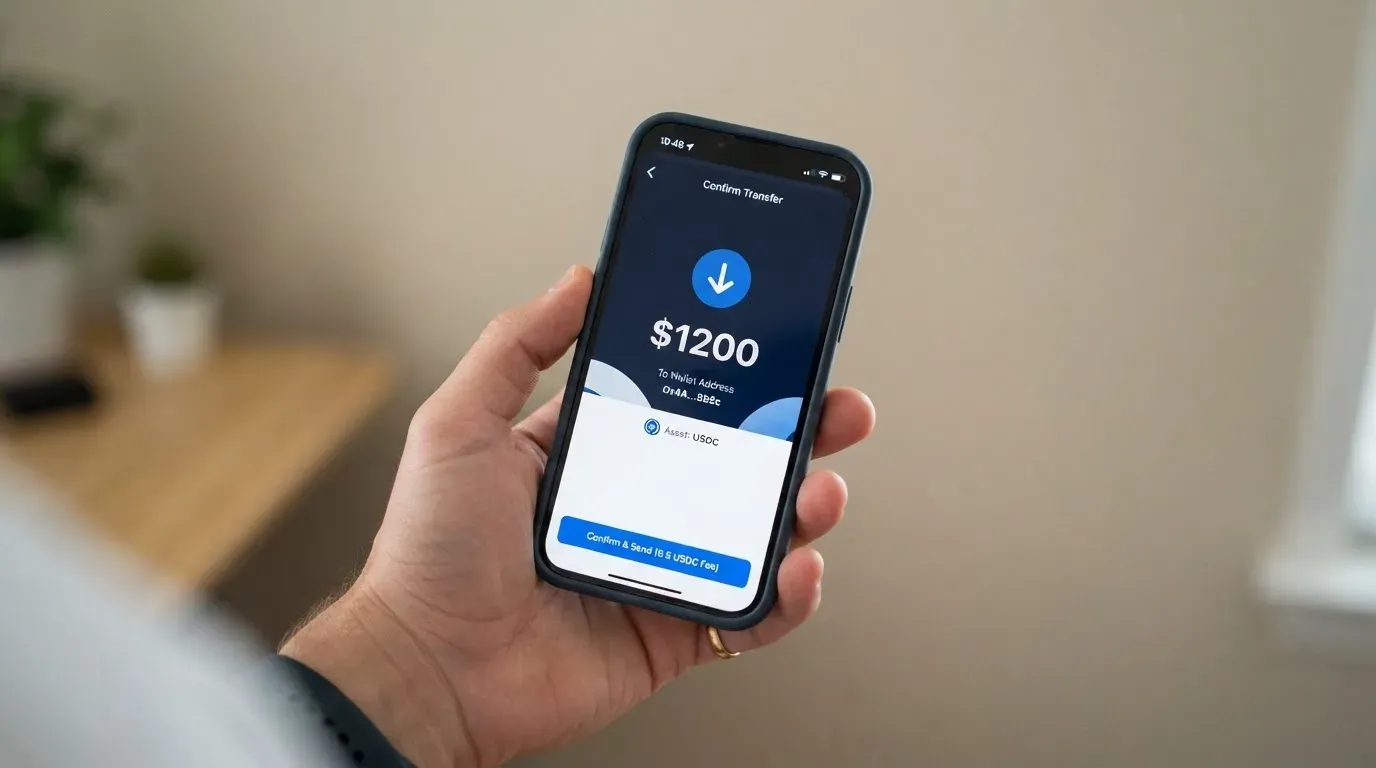
The card’s public pages do not disclose which networks the USDC transfer runs over, even though the wallet’s product positioning ties it to Solana. In practice that means the user has to know, or guess, which network to use, and sending USDC on a network the card does not support is a real risk because blockchain transfers are not reversible. A small practical tip worth repeating: always send a tiny test amount first if the receiving network is not explicitly stated, and confirm it lands in the Card Account before sending the full balance.
You can also move USDC back from the Card Account to the Main Account, but a 5-minute security time lock applies. On card closure, any remaining balance is returned to the Platform Provider wallet as a stablecoin, with no fee stated; the bank may refuse to return balances under $1.00, and closure may be blocked if a transaction is pending, a dispute is open, an amount is owed or a hold is in place.
One more angle: the card’s agreement notes that the Platform Provider or Program Manager may charge separate fees for the stablecoin sale that funds a purchase. That is a reminder that the on-page “no top-up fees” line describes Fuse’s own charges, not necessarily the spread on the conversion.
Paying with it every day
In-person, the virtual card works through Apple Pay. Google Pay is not mentioned on the card’s pages, so Android users are limited to using the card number directly at merchants that accept virtual cards or through tokenisation services that support them. The card is not blocked at any specific merchant category codes; the published restriction is that it cannot be used for illegal transactions or for cash back at point of sale, and the agreement reserves the right to block or cancel the card for suspected fraud.
There is no cashback or rewards programme stated. The card is positioned as a clean conduit for spending USDC, not as a way to earn back a percentage. For someone whose priority is “spend my USDC with the least friction and the least fee,” that is the right design choice; for someone who treats their card as a small income stream via rewards, it is a feature gap.
The dispute process is fairly detailed in the agreement. If you report unauthorised use within 2 business days your liability is capped at $50; after that the cap rises to up to $500. Errors have to be reported within 60 days. The bank aims to decide in 10 business days, with up to 45 days for the full process (credit issued within 10 business days if extended), and up to 90 days for point-of-sale, foreign and new-card errors. The outcome is communicated within 3 business days of the investigation ending. Stop-payments are not allowed on card purchases; merchant disputes go to the merchant first, and any refund is credited back to the wallet as a stablecoin. There is no provisional credit for goods-and-services disputes, which is a meaningful gap compared with credit-card-style protections. Pending amounts typically become available 24 hours after clearing.
A last note on the app: the App Store listing for Fuse shows iOS 16.4 or later, and the listing read on 2026-10-20 shows “not enough ratings” rather than a public average. An unofficial aggregator estimate puts the app at around 4.5 to 4.6 from roughly 35 ratings, but that is not confirmed by Apple and is not a substitute for reading recent reviews yourself.
What can go wrong
The risk picture for Fuse has three layers: company risk, user-experience risk and the risks that come with the underlying technology.
On the company side, the card is issued by Lead Bank, a Missouri state-chartered bank, under a Visa U.S.A. licence. Bridge Ventures LLC is the Program Manager, and Squads Labs Inc. is the Platform Provider (and is not a bank). That structure is normal for the category, but it means there are three entities between you and your money, and the Platform Provider in particular is a technology company rather than a regulated financial institution. The card agreement includes a binding arbitration clause with a class-action waiver, which limits your ability to join other cardholders in a dispute; that is common in US card programmes but worth knowing about.
On the user-experience side, the public complaint data is thin. The card does not have a Trustpilot page of its own, and there is no sizeable Reddit thread. What does exist is one App Store review about an account that was closed with about $600 of funds stuck, plus an X user who reported unanswered emails (per a third-party aggregator, without a date attached). The agreement’s line that the bank may refuse to return balances under $1.00 is small in dollar terms but tells you the kind of edge cases that can come up. Funds in transit during conversion are not FDIC insured, and there is no overdraft facility, so a failed top-up or a sharp move in USDC’s price is on you, not the bank.
On the technology side, two points stand out. First, USDC is a stablecoin rather than a true dollar, and although Circle states that USDC is redeemable 1:1 for USD and 100% backed by cash and cash equivalents, stablecoins have depegged in the past. Second, blockchain transfers are irreversible, so a USDC deposit sent to the wrong network, or to an address of a different network, can be lost or stranded pending manual support, with no guarantee of recovery. The card’s pages also do not publish the conversion fee, which means the rate at which your USDC is sold for USD at the moment of purchase is not something you can verify in advance.
What to take instead
Fuse is one option in a wider category of crypto-funded cards, and it is worth seeing how it stacks up against three peers with different design choices. The alternatives below are not ranked against Fuse; they are different products with different constraints, and the right choice depends on where you live, what tokens you hold and how you actually pay.
| Alternative | Score | Where it works | Funding | Card form | Key fees |
|---|---|---|---|---|---|
| TokenPocket (TP Card) | 5.8/10 | Visa debit in parts of Europe (Germany, France, Spain, Switzerland and others); Mastercard debit in Australia, Canada, Hong Kong, Japan, Taiwan, New Zealand, Singapore, South Korea, UK, others; Americas planned for Q2 2025 | Crypto deposits from the TokenPocket wallet on Arbitrum | Virtual (no physical mentioned) | 1% fee on crypto deposits (refunded later via rewards), FX not stated, NFT creation fee partly covered by TokenPocket |
| MetaMask Card | 7.1/10 | Sign-up open in 45 listed countries (e.g. Andorra, Argentina, Brazil, Canada, Mexico, Germany, France, Spain, Uruguay); US/UK sign-ups temporarily closed; other regions on a waitlist; proof of residency required | Spends directly from the connected wallet on Linea, Base, Monad or Solana; mUSD, wETH, EURe, GBPe, USDC, USDT named (nine tokens in total) | Virtual first, Metal pre-orderable in app; Mastercard; one card per user | Virtual free with no annual fee; Metal $199/year; “minimal fee” per transaction; no foreign transaction fee |
| KAST | 6.1/10 | Residence-based list shown at KYC (not published in full); ID/citizenship also matters; VPN does not bypass | USDT, USDC, PYUSD, RLUSD on Ethereum, Solana, Polygon, Arbitrum, TRON | Virtual and physical; up to 10 cards; Visa Platinum / Infinite metal / Infinite gold; Pengu, Solana, Bitcoin designs | Annual membership: Standard $0, Premium $1,000/year, Private $10,000/year; non-USD FX 0.5–1.75%; inactivity $1/month after 12 months; cashback 1.5–3% on tiered caps |
A few things stand out in that comparison. TokenPocket’s virtual-only structure and the fact that its Americas availability is still in the rollout stage make it a different proposition for non-European users. MetaMask Card is the most directly comparable in the “spend a token balance through a card” sense, with the advantage of multiple networks and tokens but the current restriction that US/UK sign-ups are temporarily closed. KAST is the most feature-rich of the three, with physical cards, multiple designs, multiple stablecoins and a tiered cashback structure, but it is also gated behind a $1,000 to $10,000 annual membership for the higher tiers and has a non-trivial inactivity fee after 12 months.
If you want a USDC-funded virtual card in the Americas, Fuse is the narrowest of the three in scope and the cheapest in headline cost. If you want a physical card, multi-token funding or a rewards programme, none of the three above is a direct swap, and the search moves outside this comparison.
Who I would recommend it to
I would recommend Fuse to a specific kind of reader, and I would steer a different kind away. The recommendation reads cleanly because the product is narrow.
You are a good fit if
- You live in one of the 18 supported jurisdictions, especially in Latin America, and you want a USD-denominated card without monthly drag.
- You already hold USDC and want a clean way to spend it at Visa merchants without converting to local fiat first.
- You are comfortable with a virtual card and use Apple Pay, or are happy to enter the card number at online checkout.
- You do not need ATM access, do not travel to countries where a foreign-issued card causes declines, and do not rely on a monthly limit above the $2,000 default.
You are not a good fit if
- You live in Europe, the UK, most of Asia or outside the supported list. The card is simply not available to you under its stated rules.
- You need a physical card. There is no physical card option on the card’s pages.
- You need to spend tokens other than USDC, or to fund from a bank account rather than from a crypto balance. Fuse is USDC-only.
- You need cash access. ATM withdrawals are explicitly unavailable.
- You want rewards or cashback. None is stated.
- You want the safety net of credit-card-style dispute protection. There is no provisional credit for goods-and-services disputes, and balances under $1.00 may not be returned on closure.
That is the shape of the recommendation. Fuse is a specialist tool: cheap, narrow, and a poor fit for anyone who needs even one of the features it leaves out.
Frequently asked questions
What is the Fuse card?
The Fuse card is a virtual Visa debit card denominated in USD, funded by USDC stablecoin held inside the Fuse app. It is issued by Lead Bank under a Visa U.S.A. licence, with Bridge Ventures LLC as the programme manager. There is no physical card.
How does the Fuse card work?
You keep a USDC balance in the Fuse app’s Main Account, move USDC into the Card Account, and the card spends that balance at Visa merchants. When you pay in a non-USD currency, the card adds a 0% FX fee on top of the conversion rate; the conversion rate itself is the one cost the card does not publish.
Is Fuse a bank?
No. Squads Labs Inc. is the Platform Provider and is not a bank. The card itself is issued by Lead Bank, a Missouri state-chartered bank, under a Visa licence, with Bridge Ventures LLC running the programme. The bank and the platform are separate entities.
Who owns Fuse?
Fuse is built by Squads Labs Inc., the Platform Provider named in the card agreement, with Bridge Ventures LLC as the Programme Manager and Lead Bank as the issuing bank. The card’s own pages do not give a fuller ownership or investor breakdown.
Is the Fuse card available in my country?
It depends on your country of residence, not your citizenship. The card is open to residents of the United States (excluding New York and Alaska), Argentina, Bolivia, Brazil, Colombia, Costa Rica, Dominican Republic, Ecuador, El Salvador, Ghana, Guatemala, Honduras, Mexico, Panama, Nigeria, Paraguay, Peru and Uruguay. If your country is not on that list, the card is not available to you under the stated rules.
How do I get the Fuse card?
Download the Fuse app on an iPhone running iOS 16.4 or later, complete KYC through Bridge with your name, address, date of birth and government ID number, and create the virtual card. You then move USDC from the Main Account to the Card Account to start spending.
Does the Fuse card require KYC?
Yes. KYC is mandatory and is run through Bridge. You must be at least 18 years old. The information collected includes your name, address, date of birth and government ID number; further documents such as a driver’s licence may be requested at any time. The card’s pages do not state the processing time or specific rejection reasons.
How do I top up the Fuse card?
Top-up is a USDC-only flow inside the Fuse app: move USDC from your Main Account to your Card Account. Funds are available immediately. The card’s pages do not publish the networks supported, and sending USDC on a network the card does not support can result in a loss because blockchain transfers are irreversible.
Is the Fuse card free?
Issuance is $0, the monthly fee is $0.00, there is no inactivity fee and the foreign transaction fee is 0%. The one cost the card does not publish is the crypto-to-fiat conversion fee that applies when USDC is sold to fund a purchase; the agreement also notes that the Platform Provider or Programme Manager may charge separate fees for stablecoin sales.
Is the Fuse card safe?
It carries the usual safeguards of the category (instant card freeze, PIN reset, daily spending limits up to $2,000, Apple Pay tokenisation) and is issued by a regulated US bank under a Visa licence. The trade-offs are that the agreement contains a binding arbitration clause with a class-action waiver, funds in transit during conversion are not FDIC insured, public complaint data is thin and there is no provisional credit for goods-and-services disputes. As with any USDC-funded product, the stability of USDC itself and the irreversibility of blockchain transfers are also part of the risk picture.
Wallet cards on the shortlist – cryptocardshortlist
Content created by the «cryptocardshortlist» team