
The BingX Visa card, explained for anyone holding USDT
 Available in US
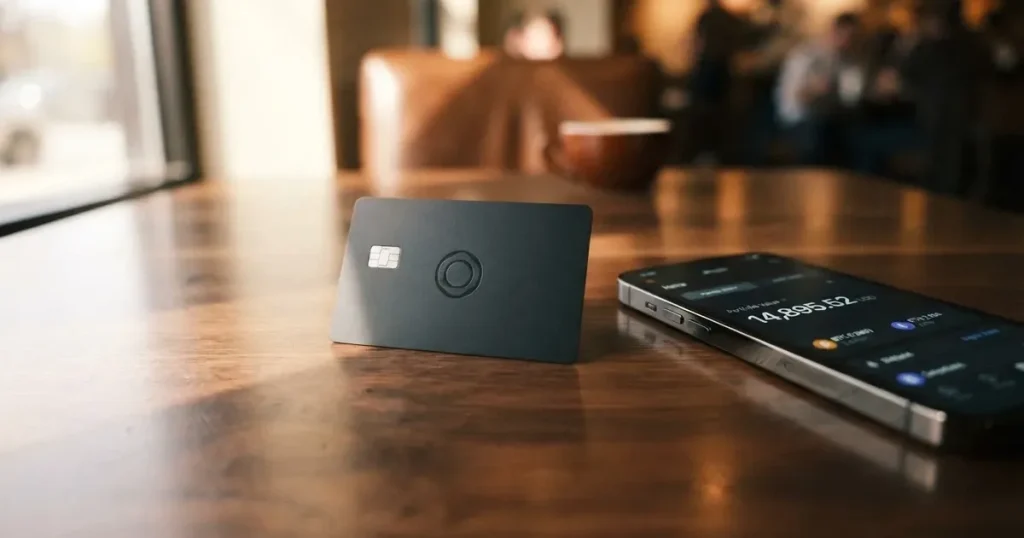
The BingX Visa debit card lets you spend USDT held in a BingX Funding Account through either a virtual card, issued instantly, or a metal card mailed out in 15 to 30 business days. It runs on the Visa network, settles in US dollars, and works with Apple Pay and Google Pay on both card types. Cashback rises with monthly spend rather than with exchange VIP status, topping out at 5% on the metal card, with a $150 monthly cap at the highest tier. That is a reasonable package on paper, but the rate sheet is thin, the card’s issuer is named only on a launch blog rather than in the card terms, and BingX’s overall reputation on independent review sites is poor. Read on for who the card suits, what it really costs to use, and where the rough edges are.
Conditions are current as of October 28, 2026.
Verdict
The BingX card scores 5.8 out of 10 in this review. The strengths are everyday usability: both a virtual and a metal Visa, mobile wallets on both, ATM access on the metal card, and cashback that is competitive at the upper tiers. The weaknesses are concentration: the card is funded only by USDT, the card-issuing partner is not named in the product terms, and BingX’s overall customer-feedback score is low. This is a card for someone who already keeps USDT on BingX and is comfortable taking on that counterparty exposure in exchange for a simple way to spend it.
| Criterion | Mark | Reason |
|---|---|---|
| Who can get it | 7 / 10 | Europe (EEA), APAC, LATAM and other selected regions; no country list published |
| Cost | 5 / 10 | Virtual card is free, no annual fee, metal card $180; first $200/month ATM free then 2%; purchase and FX rates not published |
| Top-up options | 4 / 10 | USDT only, drawn from the BingX Funding Account; other coins not supported |
| Reliability and complaints | 4 / 10 | Issuer partner not named in the card terms; BingX Trustpilot 1.5/5 from 766 reviews, with frozen-funds and restriction complaints |
| Everyday use | 9 / 10 | Virtual and metal Visa, Apple Pay and Google Pay on both, ATM access on the metal card |
| Total | 5.8 / 10 | A straightforward USDT-spending card for existing BingX users, held back by thin fee disclosure and weak overall reputation |
If you already hold USDT on BingX and want a simple way to spend it, this card is worth a look. If you do not, the funding limitation alone makes other cards easier to live with.
Who will they give you the card
The BingX card page lists Europe (EEA), APAC, LATAM and “other selected regions”, without publishing a country-by-country list. An older Euro Mastercard support page from BingX noted that KYC was unavailable in a number of countries including Cuba, Iran, Russia, Ukraine, Pakistan, Nigeria and mainland China, but that older programme is not the current Visa product. Because the supported list changes, the safest approach is to ask BingX support whether your country is included before you start an application.
The general eligibility rules are short: you must be at least 18 years old, live in a supported country, and hold a BingX account. Identity verification is required, and the documents you must provide depend on the rules of your country. The terms also note that physical cards are offered only to select customers, so the metal card is not guaranteed even if you meet every other condition.
Two practical points follow from this. First, if you live in or hold citizenship of a country under international sanctions, the card will not be available to you, regardless of where you currently reside. Second, if your country is on the borderline of “selected regions”, you may pass account-level KYC and still not be issued a card. It is worth confirming eligibility before you move funds or buy USDT specifically to load the card.
How to get it
The exact KYC process for the Visa card is not stated on BingX’s public pages, but the terms confirm that identity verification must meet local rules and that physical cards are offered only to select customers. The older Euro Mastercard programme used an automated review that usually completed within one working day, but that is not the current product.
Once your BingX account is verified and the card programme is available in your country, the application itself is short. You choose either the virtual card, issued instantly with no activation step, or the metal card, which is mailed to the address on your account and arrives in 15 to 30 business days. Shipping is free for both card types according to the current guide. There is no stated replacement cost, and no stated timeline for how long the application review itself takes.
What the terms do not tell you is which customers get a metal card. If you want the physical card, plan for the possibility of being offered only the virtual one and decide in advance whether that is acceptable.
What it really costs
The card’s headline cost story is friendly and the day-to-day story is thin, so it is worth separating the two.
| Fee or limit | Amount |
|---|---|
| Virtual card issuance | Free |
| Metal card issuance | $180 (non-VIP, non-agent users) |
| Annual fee | None |
| Conversion fee on purchases | Not stated (USDT converted at real-time rate) |
| FX fee on non-USD purchases | Not stated |
| ATM fee | Not stated on the official card page; per the guide, first $200/month free on the metal card, then 2% |
| Daily transaction limit | $10,000 |
| Monthly transaction limit | $30,000 |
| ATM daily limit (metal card) | $500 per day, 5 transactions |
| Shipping | Free |
| Inactivity or closure fee | Not stated |
The fees that hit ordinary payments are the ones the card does not publish. The card draws on USDT in your BingX Funding Account and converts it to US dollars at the real-time rate for the merchant settlement, but the spread or commission on that conversion is not disclosed. If you make a purchase in a currency other than US dollars, there is an automatic currency conversion on the Visa side and the cost of that conversion is also not stated. The earlier Euro Mastercard programme applied a 1% deposit fee, free inside the EEA and 2% (with a EUR 0.06 minimum) outside it, but that is the older product and not the current Visa card.
A coffee at a US café
You tap the card or pay with Apple Pay. BingX converts USDT to USD at the live rate and Visa settles the transaction in dollars. You pay the conversion spread, which is not disclosed, and that is it. If you have cashback at your tier, it is credited to the card.
A €30 train ticket bought in Europe
Visa converts the euros to dollars on the Visa side, then BingX converts USDT to dollars on its side. You sit between two conversion steps, and neither side publishes its rate. For a frequent traveller, that uncertainty is the largest practical cost on this card.
A $100 ATM withdrawal with the metal card
If it is your first $200 this month, the withdrawal is free apart from any ATM-owner surcharge. Anything above $200 in the same month costs 2% from BingX, and you have used up 1 of your 5 daily ATM transactions and $100 of your $500 daily ATM limit.
The general pattern: the fees that are published are reasonable, and the fees that are not published are the ones that will actually show up on everyday purchases. If predictable costs matter to you, that is a reason to keep looking.
How to top it up
Top-up is the card’s most limiting feature. The BingX card is funded by USDT only, drawn from your BingX Funding Account. No other coin is supported for now. If your balance is in BTC, ETH, or any other token, you have to convert it to USDT before you can load the card.
The flow, in practice, looks like this. You deposit USDT from an external wallet, or buy USDT through BingX’s Quick Buy or P2P service, and you make sure it sits in the Funding Account rather than the trading account. The card then draws on that balance at the moment of payment. The minimum top-up amount and the top-up fee for the Visa card are not stated. On-chain network fees for your deposit are paid to the blockchain, not to BingX, but they are still a cost you should factor in.
A few details are worth flagging here. First, transfers on a blockchain are irreversible, so a USDT deposit sent on a network the card does not support, or to an address of the wrong network, can be lost or need a manual support ticket with no guarantee of recovery. Second, if you hold Bitcoin or Ethereum and need to convert to USDT each time you want to spend, the conversion spread is a recurring cost, even when the card itself does not charge a top-up fee. Third, ending your participation in the card programme is done by contacting customer support and completing closure, verification, repayment or cancellation steps; no timeline or fee for balance return is published.
For someone who already earns, receives, or holds USDT on BingX, this funding model is genuinely convenient. For anyone else, the constant need to convert other assets into USDT makes the card more friction than it is worth.
Paying with it every day
The everyday experience is the strongest part of the BingX card. Both card types work with Apple Pay and Google Pay, so you can add the card to your phone’s wallet and tap to pay wherever contactless Visa is accepted. The metal card adds ATM access, in-store chip-and-PIN use, and a four-digit PIN set at activation. The virtual card is suited to online purchases, subscriptions, and mobile-wallet payments.
The card’s rewards structure is the other reason it works well as an everyday card. Cashback is paid in USDC (the launch blog describes USDC rewards) and is structured by tier rather than by exchange VIP level. The virtual card pays 2% to 3% a month and the metal card pays 3% to 5% a month, with the tier rising as your monthly spend increases. At the top tier, the monthly cap is $100 for the virtual card and $150 for the metal card. Eligible subscription services earn 20% back, counted within the same monthly cap. The exact tier thresholds and which subscriptions count as eligible are not stated in the public materials.
What is not stated is just as important. Cashback eligibility on individual merchant categories is not spelled out. A list of blocked merchant categories is not published, although the terms note that some merchants, countries or industries may decline for compliance reasons. The BingX app’s role in card management is mentioned but the details of what you can do inside it (freeze, limits, statements) are not described in the public materials.
If something goes wrong with a transaction, the terms ask you to report it as soon as you are aware of it. BingX will investigate and may credit your account “within a reasonable period”, with no specific day count. Refunds are not guaranteed and can be reversed. If the dispute is not resolved with BingX, the terms provide for 30 days of negotiation followed by SIAC arbitration. The card terms do not mention a Visa chargeback route, so it is not clear whether one is available.
What can go wrong
The card’s risks break into three groups: the card product itself, the underlying platform, and the regulatory environment.
The first group is the card. The issuer is not named on the BingX card page itself. The launch blog from July 2026 states that the BingX Visa Debit Card was launched “in partnership with Wirex” and describes Wirex’s role as Banking-as-a-Service and Visa principal membership. The card terms page, by contrast, refers only to “the applicable card issuer” operating under a Visa licence. If you want to know exactly who holds your card programme, you have to read the launch blog rather than the terms you would sign up under. Authorization holds on your card can last up to 30 days under the terms, so a hold on a hotel or car rental will reduce your available balance for a full month in some cases.
The second group is BingX itself. Trustpilot’s overall rating for BingX is 1.5 out of 5, marked “Bad”, from 766 reviews, with 64% one-star ratings. The themes in those reviews are restrictions and frozen funds blocking withdrawals, deductions for alleged promotion violations or “improper gains”, repeated identity and video verification, slow or generic support, and forced liquidations. None of the complaints we read were specifically about the card, but the platform that holds the USDT backing the card is the same platform that attracts those reviews. An aggregator report (rfp.wiki) puts the figure in a similar range, with conflicting numbers between 1.3 and 1.6 and notes that the rating has also been reported as unavailable after fake-review enforcement. The card perks and rewards are described positively in forums, which is a useful counterweight, but it does not offset the broader trust signal.
The third group is the regulatory and stability risk that affects any crypto card. Visa does not issue cards to consumers directly; it licenses issuers, and it can suspend a programme. The historical examples (FTX in November 2022, WaveCrest in 2018) show that card programmes can be wound down by the network, with a notice period, a stop on new loads, then a stop on spending, and finally a request to withdraw remaining balances. If a programme closes, the timeline for getting your remaining USDT out of BingX back to your own wallet will depend on the closure terms in force at the time.
Security-wise, the card offers BingX Shield Fund, 3-D Secure, two-factor authentication, end-to-end encryption, and instant transaction alerts. You can freeze a lost or stolen card from the Card Management screen in the BingX app and then contact support. These are standard safeguards, and they are listed in the launch materials rather than the terms, so the level of detail available is again thinner than the marketing.
The balance, in plain terms, is this. The card uses standard crypto-card security. The card-specific disclosures are thin, the issuer is named only in a blog post, and the platform behind the card has a low trust score. If any of those bother you, this is not the card to put a large balance behind.
What to take instead
If the BingX card’s funding limitations, fee opacity, or platform reputation rule it out for you, here is how three alternatives compare on the basics.
| Card | Score | Funding | Card type | Key cost feature | Cashback |
|---|---|---|---|---|---|
| BingX | 5.8 / 10 | USDT only | Visa virtual and metal, USD settlement | Virtual free, metal $180, ATM first $200/mo free | 2–5% by tier |
| Coinbase Card | 6.4 / 10 | US bank or paycheck, plus any crypto held on Coinbase (converted to USD at payment) | Visa prepaid, virtual or physical, USD | “Zero spending fees and no annual fees” with a conversion spread disclosed in the agreement | Optional rotating crypto rewards, US only |
| OKX | 6.2 / 10 | USDC or USDG in OKX Pay (other coins must be converted first) | Mastercard virtual, euro-denominated, via unnamed European licensed payment provider | No card or transaction fee; explainer puts conversion spread at 0.1% (vs 0.4% in launch release) | 2–10% on USDG purchases, monthly EUR caps by tier |
| Young Card | 5.7 / 10 | Not stated officially | Not stated officially | Not stated officially | Paid in YNG tokens, 0.1–3.6% by Club tier |
A few notes on the table. The Coinbase Card is available in all US states except Hawaii, with KYC under the USA PATRIOT Act. The OKX card is euro-denominated and aimed at the EEA plus Norway, with Iceland and Liechtenstein excluded; the explainer’s “entire EEA” framing conflicts with that list. The Young Card’s published materials do not state funding, card type, or cost in a way we could verify, which is itself a flag. If you are outside the US, your real comparison is probably between BingX and OKX. If you are in the US, Coinbase is the natural reference point. The Young Card is the option to investigate further if you specifically want a token-based rewards structure.
Who I would recommend it to
The BingX card is for you if you already keep a meaningful USDT balance on BingX, you want a low-friction way to spend it through a Visa card on your phone, and you are comfortable with the platform’s overall risk profile. The cashback structure is competitive at the upper tiers if your monthly spend is high enough, and Apple Pay plus Google Pay on both card types means you can use it almost anywhere you would use a normal debit card.
It is not for you if you hold your crypto on a self-custody wallet, if you want predictable per-transaction costs published in advance, if you need to fund the card with anything other than USDT, or if a named, regulated issuer is important to you. The same is true if you are in a country that is on the edge of “selected regions” and need a guarantee of eligibility before you start.
If you fall into the first group, apply for the virtual card first, load a small amount of USDT, and test a few real payments and a small ATM withdrawal if you have the metal card. If the experience matches what you need, scale up. If it does not, you have lost only the time it took to set up.
If you fall into the second group, the alternatives above are a better starting point. Coinbase gives you transparent cost disclosure in the US, OKX gives you a euro-denominated card with multi-coin conversion in the EEA, and a self-custody-linked card keeps your funds in your own wallet until the moment of payment.
Frequently asked questions
What is the BingX card?
The BingX card is a Visa debit card issued under a Visa licence by a partner named in BingX’s launch blog as Wirex, in a Banking-as-a-Service arrangement. It comes as a free virtual card, issued instantly, or a metal card that costs $180 and is mailed in 15 to 30 business days. Both cards settle in US dollars and work with Apple Pay and Google Pay.
How does the BingX card work?
You hold USDT in your BingX Funding Account. When you pay, BingX converts USDT to US dollars at the real-time rate and Visa settles the transaction. Cashback, if any, is credited to the card according to your spend tier. There is no separate fiat balance to manage.
Is BingX a bank?
No. BingX is a cryptocurrency exchange, and the card is a Visa debit card issued by a licensed partner, not by BingX itself. The card terms refer to “the applicable card issuer” rather than naming one on the public card page, while the launch blog identifies the issuer partner as Wirex.
Is the BingX card available in my country?
The card page lists Europe (EEA), APAC, LATAM and other selected regions, but does not publish a country list. An older Euro Mastercard support page excluded countries including Cuba, Iran, Russia, Ukraine, Pakistan, Nigeria and mainland China, though that is the older programme. Because the supported list changes, the safest step is to contact BingX support to confirm your country before you apply.
How do I apply for the BingX card?
You need a verified BingX account, to be at least 18, and to live in a supported country. The application itself is short: choose the virtual or metal card, complete identity verification to the standard your country requires, and, for the metal card, wait 15 to 30 business days for delivery. Physical cards are offered only to select customers.
Does the BingX card require KYC?
Yes. The terms require identity verification that meets local rules. The exact documents and processing time for the current Visa card are not stated on BingX’s public pages, though the older Euro Mastercard programme used an automated review that usually completed within one working day.
How do I top up the BingX card?
You fund the card by holding USDT in your BingX Funding Account. You can deposit USDT from an external wallet, buy USDT through Quick Buy, or buy it on the P2P market. The card then draws on that balance at payment. No other coin is supported, and the minimum top-up amount for the Visa card is not stated.
How do I add the BingX card to Apple Wallet or Google Pay?
Both the virtual and metal cards support Apple Pay and Google Pay. The standard process is to open the Wallet app on your phone, choose to add a card, and either scan the card details or enter them manually. The exact steps inside the BingX app are not described in the public materials.
Is the BingX card safe to use?
The card offers 3-D Secure, two-factor authentication, end-to-end encryption, instant transaction alerts, and the ability to freeze the card from the BingX app. The main risks are not card security but counterparty risk on BingX itself (Trustpilot 1.5/5, with frozen-funds complaints) and the fact that the card’s issuer is not named in the card terms, only in a launch blog.
Is the BingX card worth it?
It depends on your situation. If you already hold USDT on BingX and want a low-friction Visa to spend it, the card is competitive, especially with cashback at the upper tiers. If you want transparent per-transaction costs, multi-coin funding, a named issuer in the terms, or a platform with a stronger trust score, one of the alternatives above is a better fit.
Exchange cards on the shortlist – cryptocardshortlist
Content created by the «cryptocardshortlist» team