
A stablecoin-funded card for people who can't easily get a bank account — with more questions than answers about who actually issues it
 Available in US
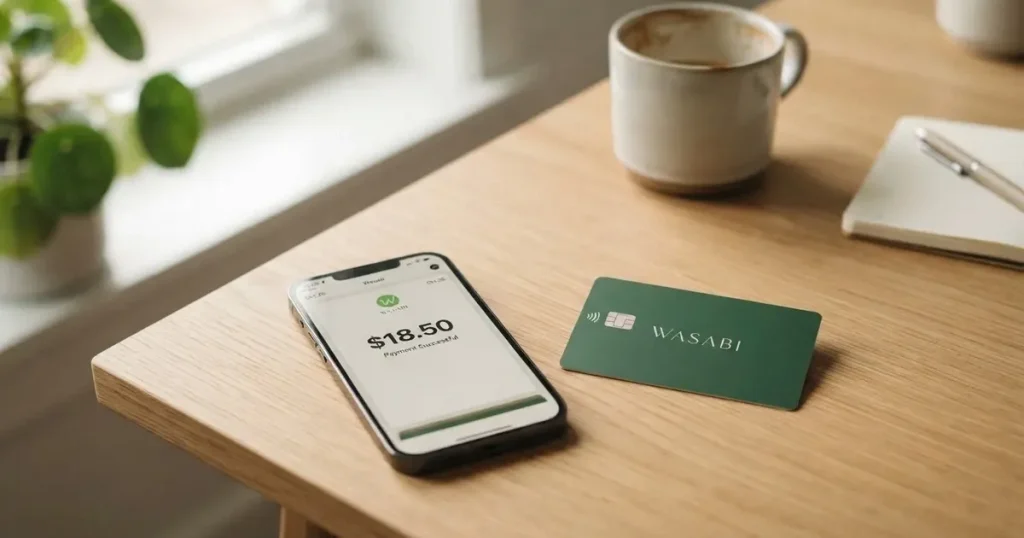
Wasabi is a payment card built around a stablecoin balance rather than a bank account. The product is run by Wasabi Ltd, which describes itself as a financial technology company — explicitly “not a bank or custodians” — and it leans on partner institutions for the actual card issuing and any OTC (over-the-counter) trading. The headline is appealing: a virtual or physical card, funded by stablecoins, that works in 200+ countries and regions, and Apple Pay binding for the virtual card. The details, though, are thin. Wasabi does not name its card issuer, does not publish fee amounts on the pages I read, and discloses almost nothing about monthly costs, conversion rates, or ATM allowances. The score below reflects that gap between a promising structure and a sparse fee schedule.
If you need a card and an ordinary bank account is hard to come by — a freelancer in a country with limited card access, a remote worker, someone rebuilding their financial setup after a move — Wasabi is structured for that picture. If you want to know what your coffee will cost, what an ATM withdrawal will cost, or what will happen if the programme changes hands, those answers aren’t easy to find.
Conditions are current as of October 28, 2026.
Verdict
Wasabi earns 6.4 / 10 in my review. That score is built from five criteria, each rated out of 10:
| Criterion | Mark | Why it lands there |
|---|---|---|
| Who can get it | 9 / 10 | 200+ countries and regions, with the usual “prohibited or sanctioned jurisdiction” carve-out |
| Cost | 5 / 10 | The terms list the kinds of fees that can apply but disclose no amounts, and no monthly fee is named |
| Top-up options | 6 / 10 | Stablecoin funding (“Spend with Stablecoin”); the supported coins and networks are not spelled out on the public pages |
| Reliability and complaints | 4 / 10 | No named issuer, no published licences, and a single public Trustpilot review complains of high setup fees and tight card restrictions |
| Everyday use | 8 / 10 | Virtual card with instant Apple Pay binding, physical card that can be added to Apple Pay, and worldwide ATM access |
Wasabi fits businesses and individual users who want a stablecoin-funded virtual and physical card and are comfortable accepting that several core terms will be communicated only after signup. It does not fit someone who needs to compare a published price list before applying, or who wants a clearly identified card issuer on the product page.
Who can get the Wasabi card
Wasabi is, on paper, unusually open. The starting position is 200+ countries and regions — that is a wide net, and there is no short public list of exclusions. The only territorial cut-out the terms give you is the standard one: you cannot be located in, or be a resident of, “any prohibited or sanctioned jurisdiction.” That phrasing matters because it is residence-based. The terms tie the rule to where you live, not (only) to your citizenship, but in practice sanctions screening is applied to multiple data points — your country of address, your nationality, your country of birth — so the practical effect is wider than the literal sentence.
The reason this score is so high is that the door is open by default. If your country is not on a sanctions list and you can complete identity verification, you can apply. The reason it isn’t a 10 is that the list of 200+ is not published, so the only way to know for certain whether your country is included is to go through the application itself.
How to sign up
Signing up is standard for the category, with a few details worth noting.
The terms require you to “successfully complete any required identity verification (KYC/KYB) procedures.” KYC stands for “know your customer” — the identity checks a regulated financial firm is required to run; KYB is the same idea for a business customer. The list of documents the provider says it may request is the usual one: a government-issued ID, proof of address, and a selfie for the individual identity check. For a corporate account, the requirement extends to registration documents and beneficial ownership — the natural persons who ultimately own or control the company. The minimum age is not stated on the pages I read; the category default in most jurisdictions is 18+. The terms warn that failure to complete verification can lead to suspension or termination of the account, which is the standard outcome across the industry.
The card itself comes in two forms: a stablecoin-linked virtual card and a stablecoin-linked physical card. The virtual card supports “instant binding” to Apple Pay. The card network and the card’s settlement currency are not stated on the public pages I read — starting data points to Visa or Mastercard and a USD balance, but Wasabi’s own pages do not confirm that. Delivery time for the physical card is also not stated. There is a KYC guide article in the help centre, but no public KYC tier structure (for example, “Tier 1 = ID, Tier 2 = address, Tier 3 = source of funds”) that I could find.
What it really costs: Wasabi card fees
This is where the review gets harder to write. The terms list the kinds of fees that can apply, and Wasabi confirms that currency conversion rates “may apply,” but the public pages do not give numbers. There is no published price for issuing the card, no disclosed monthly or annual fee, no conversion percentage, no FX markup, and no ATM allowance.

Here is what the fee schedule says, as published:
| Fee or limit | What Wasabi says |
|---|---|
| Card issuance | A fee “may apply”; amount not stated |
| Monthly fee | Not stated |
| Currency conversion | “Currency conversion rates may apply”; no figure |
| Foreign exchange (FX) | Fee type listed; no figure |
| Cross-border transaction | Fee type listed; no figure |
| ATM withdrawal | “Withdraw cash from millions of ATMs worldwide with competitive rates”; fee and allowance not stated |
| Chargeback handling | Fee type listed; no figure |
| Replacement card | Fee type listed; no figure |
| Virtual card spending limit | “Card limit up to 10,000 USD” |
| Physical card spending limit | “Flexible spending limits” (no value given) |
| Card currency | Not stated on the public pages read |
| Card tiers | Two types: virtual and physical; no tier structure |
What that means in everyday terms is that you will know the shape of a charge, but not its size, until the charge is on your statement. Three everyday payments will show how the categories can apply:
A coffee in the country where your card is denominated. If the merchant settles in the card’s own currency, you pay the face price plus any small fee Wasabi may apply for payment processing. The page does not name a percentage. In practice, this is the cheapest possible way to use the card.
A coffee abroad. If the merchant settles in a different currency, two line items can appear: the FX rate Wasabi applies (a “currency conversion” cost), and a cross-border transaction fee if the issuer treats the merchant’s country as cross-border. The terms name both as possible fees; neither has a number on the public pages.
A cash withdrawal at an ATM. The site says “competitive rates” and worldwide access. The ATM fee type is named in the terms, but the amount and any free allowance per month are not disclosed. Some issuers in this category waive a small monthly amount and charge a flat fee after that; some charge a percentage; some charge both. Wasabi does not say which model it follows.
The card currency is not stated on the pages I read, so I cannot tell you whether spending in your home currency is a conversion or a domestic payment. Site copy mentions sending money in 7+ currencies, which is about the Wasabi product in general, not specifically the card.
A note on the “up to 10,000 USD” virtual card limit. The wording is a ceiling, not a default. Your actual limit may be lower depending on verification level, jurisdiction, or account history.
How to top up the Wasabi card
Top-up is built around the “Spend with Stablecoin” product: the card spends a balance funded by stablecoins, which are crypto tokens designed to track a fiat currency such as the US dollar. The cards and networks that the system accepts are not stated on the pages I read. The starting data I have points to USDT on TRC20 and BEP20 — that is, Tether issued on the Tron network and on BNB Chain — but Wasabi does not confirm this in its public terms, and you should not send a top-up to a network you have not confirmed with support first.
Why this matters: a blockchain transfer is irreversible. If you send USDT on a network Wasabi does not support, or to an address that belongs to a different chain, the funds can be lost permanently or, at best, sit in support limbo with no guarantee of recovery. The help centre describes funds being “temporarily withheld pending investigation,” which is a polite way of saying your balance may be locked while the team reviews the deposit. That is normal for the category, but the absence of a published list of supported networks makes the Wasabi flow harder to plan for.
Withdrawal mechanics — sending crypto back out of the Wasabi ecosystem to your own wallet — are not stated on the pages I read.
A practical note on the underlying technology. Stablecoins are not, despite the name, guaranteed to hold their value. Two of the largest — USDT and USDC — together account for about 90% of stablecoin market capitalisation as of mid-2025, and both have, at different times, lost their peg briefly. USDC, for example, briefly traded below one US dollar in March 2023 during the US banking stress. Your card balance is exposed to that risk during the window between your top-up and your spend, and during any hold the provider may place while it reviews a transaction.
Paying with the Wasabi card every day
The everyday mechanics of the card are the strongest part of the package. The virtual card can be bound to Apple Pay immediately, which is genuinely useful if you need a working card number in minutes rather than days. The physical card can also be added to Apple Pay. The site is silent on Google Pay — it is not stated whether Wasabi supports Google Wallet or Samsung Wallet, so if your phone runs Android you may need to check with support before relying on mobile pay.
ATM access is global (“millions of ATMs worldwide”), subject to the fee structure described above.
Wasabi runs a cashback product (“Get Cashback on your card purchases”) and a referral programme, but the rate and the conditions are not stated on the public pages. There is a web app at app.wasabicard.com; I did not find a separate iOS or Android store listing in the pages I read, and the ratings are therefore not available to quote.
Disputes and refunds: Wasabi’s terms say that “refunds may take up to 30 business days to be reflected” in the account, and that chargebacks require supporting documentation with no guarantee of recovery. A chargeback is when your card issuer reverses a payment to settle a dispute — useful when a merchant won’t refund, but slow and uncertain.
Blocked merchant categories are not stated. In the wider category, gambling (MCC 7995 — the four-digit merchant category code casinos and bookmakers use) is commonly restricted by policy, but I did not see a published Wasabi block list.
What can go wrong
There are three areas I would watch before committing significant funds to a Wasabi card: the corporate structure, the fee schedule, and the public record so far.
Corporate structure. Wasabi Ltd describes itself as a financial technology company, “not a bank or custodians.” That wording is significant: it means the company’s own funds are not protected by a banking guarantee scheme, and Wasabi itself does not take custody of your assets in the way a bank takes custody of deposits. OTC trading and card issuing are “provided in partnership with licensed institutions or banks,” but the partner is not named on the public pages, and the licences are not named either. A “Licenses & Compliance” page exists at /en/licenses-compliance, but the relevant entity and regulator are not surfaced in the main flow. For a card product, that is a meaningful transparency gap. In the EU, an electronic money institution (EMI) — a regulated firm that can issue card-based e-money but cannot lend — must safeguard customer funds by segregating them in dedicated accounts or by insuring them, and those funds are not the same as bank deposits. I cannot confirm that any Wasabi partner holds an EMI licence, because the partner is not named.
The fee schedule. The terms list fee types, not fee amounts. That makes it difficult to compare the card to alternatives in any meaningful way, and it means the only way to know what a payment will cost is to make it and read the statement. If you are a business budgeting monthly card spend, this is a real obstacle.
The public record. The user-facing feedback I could find is thin. Trustpilot shows a TrustScore of 3 drawn from a single review, dated 8 July 2026, giving 1 star. The reviewer describes Wasabi as a product “aimed at businesses” with high setup fees (“$15,000 and up”) and cards that are “restricted” and of low quality. That is a single data point, and a single review is not a trend, but it is the entire public record I could verify. I did not find Reddit threads or other independent user reports. The lack of breadth, rather than any single complaint, is what pulled the reliability score down.
Security. Wasabi publishes a “Security by Design” page describing per-card fund isolation (the ability to create, delete, and isolate balances on a card-by-card basis) and describes custody as non-custodial — meaning Wasabi itself does not take control of your crypto; the funds sit with you, the user, and the card is just a window into the balance. Two-factor authentication is not stated on the public pages I read. For a card product, that is another item I would want confirmed before moving meaningful funds.
Support. Live chat, email (with a stated response time of “within 24 hours”), phone, and a Telegram channel at t.me/wasabicard_official. Languages supported and operating hours are not stated. A 24-hour email window is slow by the standards of mainstream neobanks, which often resolve simple issues in chat within minutes.
What to take instead
Wasabi is not the only stablecoin-funded card on the market, and the three alternatives below are useful comparators. They are not endorsements — the scores are taken from the same review framework — but they show what the wider category looks like.
| Card | Score | Who it’s for | Funding | Published fees |
|---|---|---|---|---|
| Wasabi | 6.4 / 10 | Businesses and individuals who want a stablecoin-funded card and don’t need a published price list | Stablecoin (“Spend with Stablecoin”); coins and networks not on public pages | Fee types listed, amounts not stated |
| CardFlow | 4.9 / 10 | Aimed at Nigeria and “Nigerians and global users”; virtual USD Mastercard created in about 3 minutes | Bitcoin, USDT, ETH, or Naira bank transfer | “Creating a virtual card is completely free”; other fees not stated |
| HyperCard | 4.7 / 10 | App Store says the card works in “more than 176 countries” (acceptance, not eligibility) | USDT, BTC, ETH in the app, converted to USD or EUR on the card | Not stated on the pages I read |
| Card.fi | 6.6 / 10 | Cards ship to “200+ countries” with sanctions carve-out; virtual and physical, including a metal (stainless steel) tier | 32 coins on 5 networks (Ethereum, Base, BNB Chain, Solana, Kaanch) | Virtual Classic $49 one-time, Virtual Premium $249; top-up 1.5% / 1%; FX 3.5% / 2.5%; cashback 0.8% to 2% |
The honest reading: Card.fi publishes what Wasabi does not — a price list, a list of supported coins and networks, and a clear fee schedule. CardFlow and HyperCard, like Wasabi, leave most of the fee detail unstated. The choice between them is mostly about which network of supported coins and which fee structure you can confirm before you apply.
Who I would recommend it to
I would point Wasabi at a fairly specific reader: someone who needs a stablecoin-funded virtual and physical card, is comfortable with crypto top-ups rather than bank transfers, and is not in a country where mainstream card access is straightforward. The 200+ country reach is the structural advantage here, and the Apple Pay binding for the virtual card is genuinely useful for fast onboarding.
I would steer away from Wasabi if any of the following is true:
- You need to see a fee schedule before you sign up. Wasabi does not publish amounts.
- You need a clearly identified card issuer and a named regulator on the product page. Wasabi does not name its issuer.
- You want Google Pay or Samsung Wallet support. Wasabi does not confirm it.
- You want a clear record of customer feedback. The public record I could find is a single Trustpilot review.
- You need a large virtual card limit. “Up to 10,000 USD” is the stated ceiling, with the “up to” doing meaningful work.
For a reader who needs the breadth but wants the transparency, Card.fi is the closer comparator in the table above. For a reader who only needs a virtual card and is happy with a Nigerian-centric product, CardFlow is free to create. For a reader who needs EUR or USD balance conversion in-app, HyperCard is the alternative on that axis.
The single most important thing to check before you top up is the network. Do not send stablecoins to a Wasabi address without confirming the supported network with the help centre or in-app first. The category default is that an unsupported network means lost funds.
Frequently asked questions
What is the Wasabi card?
The Wasabi card is a payment card issued by Wasabi Ltd through partner institutions. It is funded by a stablecoin balance rather than a bank account and comes as both a virtual card and a physical card. Wasabi describes itself as a financial technology company and not a bank.
How does the Wasabi card work?
You top up the card with stablecoins, then spend that balance wherever the card network is accepted. The virtual card supports instant Apple Pay binding, and the physical card can be added to Apple Pay as well. A cashback product and a referral programme are described on the site, but rates and conditions are not published.
Is Wasabi a bank?
No. Wasabi Ltd says explicitly that it is “not a bank or custodians.” Card issuing and any OTC trading are provided through licensed partner institutions or banks, but the partner is not named on the public pages I read.
Who owns Wasabi?
Wasabi is run by Wasabi Ltd. The ownership structure behind the company is not laid out on the public pages I could find, and the card issuer and regulator are not named on the product page.
Is the Wasabi card available in my country?
Starting data says the card is available in 200+ countries and regions. The exact list is not published, and the terms bar users who are located in, or residents of, any prohibited or sanctioned jurisdiction. The only reliable way to confirm eligibility is to go through the application and identity verification.
Does the Wasabi card require KYC?
Yes. The terms require successful completion of any required identity verification, which can include a government-issued ID, proof of address, and a selfie for individuals, plus registration documents and beneficial ownership information for businesses.
How do I top up the Wasabi card?
Through the “Spend with Stablecoin” product. The supported coins and networks are not stated on the public pages, so confirm the network with Wasabi support before sending any top-up. Blockchain transfers are irreversible, and a top-up to an unsupported network can be lost.
Is the Wasabi card free?
Wasabi does not publish its fee amounts on the pages I read. The terms list the kinds of fees that can apply — issuance, conversion, FX, cross-border, ATM, chargeback, replacement — but not the figures. A monthly fee is not named.
How do I add the Wasabi card to Apple Wallet?
The virtual card supports “instant binding” to Apple Pay, and the physical card can also be added to Apple Pay. The exact steps are completed in the Wasabi app or web app at app.wasabicard.com.
Is the Wasabi card safe?
Wasabi publishes a “Security by Design” page describing per-card fund isolation and non-custodial custody of crypto. Two-factor authentication is not stated on the public pages I read, and the card issuer and its regulator are not named, which makes an independent security assessment harder to complete from outside the company.
Virtual cards on the shortlist – cryptocardshortlist
Content created by the «cryptocardshortlist» team