
A virtual Visa funded by USDT, wrapped in a Telegram bot and a thin set of public facts
 Available in US
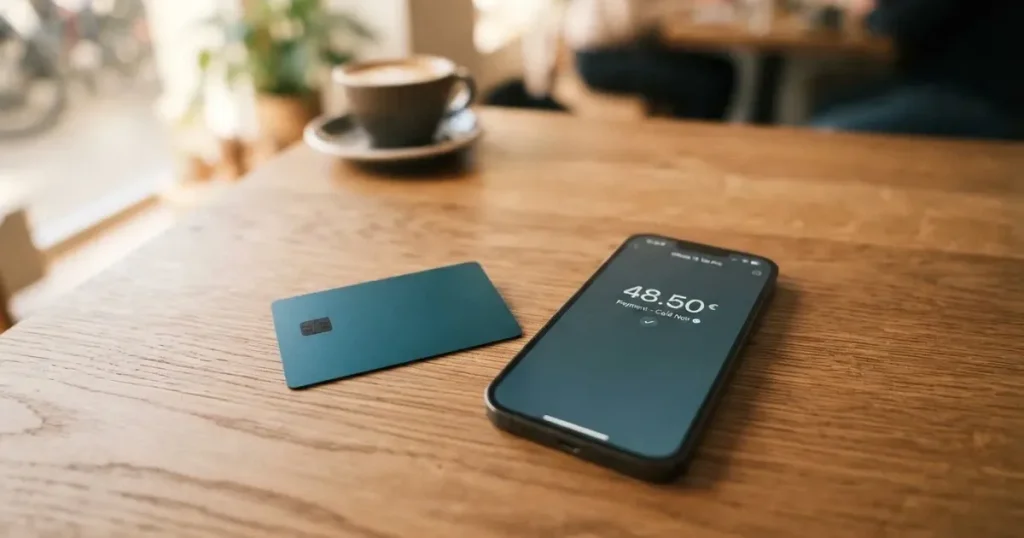
Balance Pay positions itself as a payment card for people who already hold crypto and want to spend it without first cashing out to a bank. The product that exists today is a virtual Visa issued through a Telegram bot, funded in USDT on three blockchains, with Apple Pay, Google Pay, and a physical card described as “coming soon.” That combination is genuinely useful for a narrow audience. It is also thin on public detail: no published country list, no published conversion or FX fees, no named issuing bank, and a promise that the full tariff and legal documents will appear later.
If you can live with that level of disclosure, the core mechanism is simple. If you cannot, this is not the product for you yet.
Conditions are current as of October 28, 2026.
Verdict
Balance Pay scores 5.7 out of 10 in my review. The strength is top-up flexibility for users who already hold USDT on TRON, Polygon, or Base. The weakness is everything that surrounds it: no published country list, no published conversion or FX fees, no named legal entity, no named issuer, no public tariff document, and no track record of user reviews to check. It is a fintech wrapper around a card programme, not a bank, and most of the answers a careful card shopper would normally look for are not yet in writing.

This card suits a specific reader: a Telegram user, comfortable with USDT, who wants a virtual Visa now, expects to top up on TRC-20, Polygon, or Base, and is willing to accept that the legal paperwork, full fee schedule, and physical card are still on the way. It does not suit a reader who needs to know up front whether their country is supported, who needs a published FX margin before they fund the card, who relies on Apple Pay or Google Pay today, or who wants a named regulated issuer behind the card.
| Criterion | Score | Why it matters |
|---|---|---|
| Who can get it | 7 / 10 | Country list and restrictions not published; interface in English and Russian |
| Cost | 6 / 10 | No monthly fee and free registration; conversion and FX fees not disclosed |
| Top-up options | 8 / 10 | USDT on TRON (TRC-20), Polygon, and Base; more networks “coming soon” |
| Reliability and complaints | 4 / 10 | Fintech, not a bank; no named entity, issuer, or tariff document; no reviews found |
| Everyday use | 3 / 10 | Virtual Visa only today; Apple Pay, Google Pay, and physical cards “coming soon” |
| Total | 5.7 / 10 |
Who they will issue the card to
The first thing I look for on any card product is the list of supported countries, because the country you live in, the country on your ID, and the country your card is billed from can all matter separately. Balance Pay does not publish this list. There is no table of accepted and excluded countries on the public pages I read, no statement of which nationalities are screened, and no description of which regions are restricted. The product is described as a fintech service available through a Telegram bot, with the interface available in English and Russian. If your situation depends on a specific country being on or off the list, the only reliable answer today is to ask support directly through the bot or at the email address listed on the site before you top up.
What this means for you: until Balance Pay publishes a country list, the country question is open. If you are in a jurisdiction where crypto card programmes are restricted or where local payment rules bite, the lack of a list is a reason to pause, not a reason to assume you are fine.
Age and address requirements follow the same pattern. The card pages do not state a minimum age, do not describe what proof of address is required, and do not name the KYC vendor that handles identity verification. The general industry baseline for prepaid and debit cards is 18+, and EU customer due diligence normally covers name, address, date of birth, nationality, and identity documents, with a sanctions check. None of that is spelled out for Balance Pay, so treat those norms as the working assumption rather than as a published rule.
How to sign up
The signup path is built around Telegram, not a mobile app. There is no native iOS or Android app for Balance Pay today; the entry point is the bot @balance_bot, paired with a web dashboard that is still described as a preview. That is unusual among crypto cards, where most competitors ship a standalone app with app-store ratings you can read. It also means your “app review” is whatever you can find by searching for balance.money or BalancePay, and as of writing I could not find a Trustpilot page or a meaningful body of user reviews for the brand.
Inside the bot, the published flow has four steps: open @balance_bot, pass KYC inside the bot in “a few minutes,” top up, and receive a virtual card. The exact documents the KYC step asks for, the name of the KYC provider, and the cases in which the step takes longer than a few minutes are not stated. If you have been through KYC for another crypto card, expect something in the same ballpark: a photo of an ID document, sometimes a selfie, and occasionally a proof of address.
Once KYC clears, the virtual card is issued instantly inside the bot, ready to be added to a checkout form. There is no physical card to wait for today, and there is no announced delivery window for the planned metal or plastic card, because Balance Pay has not published one. When the physical card does launch, the public pages say it will come with Visa Signature perks; “Signature” is a Visa tier, and what you actually get depends on the issuer’s programme, which is not yet named.
What this means for you: count on a Telegram-based signup and an in-bot KYC. Do not count on an app-store listing, a Trustpilot score, or a named regulated issuer until the company publishes those. If any of those are deal-breakers for you, the right move is to wait.
What Balance Pay really costs
This is the section where Balance Pay’s public information is thinnest, and the part of the review where I have to be the most explicit about what is and is not on the page.
Two things are stated clearly. Registration is free. There is no monthly fee. The Russian-language FAQ mentions the possibility of a one-time fee to issue the virtual card, but the amount is not named on the public pages, and it is not clear in which cases that fee is charged.
Everything else sits in gaps. The conversion fee between USDT and the currency the merchant charges you in is not published. The FX margin is not published. ATM withdrawal fees are not stated, and while the public pages do mention daily caps, no values are given for those caps. There is no published tier structure, no premium plan, and no cashback rate. The phrase “multi-currency spend” appears as a feature, with no list of currencies and no description of how the conversion is calculated. Balance Pay says the full tariffs and legal documents will appear later, which is a forward-looking statement, not a current fee schedule.
For comparison, the kind of fees that are usually published on a card like this include:
| Fee or limit | What Balance Pay publishes |
|---|---|
| Card issuance | May apply (amount not stated) |
| Monthly fee | None |
| Conversion (crypto to spend currency) | Not stated |
| FX margin | Not stated |
| ATM withdrawal | Not stated |
| Daily limit | Mentioned, value not given |
| Monthly limit | Not stated |
| Tiers (standard / premium) | None published |
What this means for you in practice: if you only spend on small, occasional purchases, the lack of a published FX margin may not feel like a problem on day one. If you transact in volume, or in a currency different from USDT, the absence of a published conversion fee is a real gap, because that fee is the part of the cost you cannot see until after the transaction. Three everyday payments illustrate where this matters.
A coffee at a local café priced in your home currency. If the merchant settles in USD and the card settles in USDT, the conversion happens once, with a fee that is not published. A coffee is small enough that a one or two percent surprise will not ruin your week, but it will set your real cost of using the card.
A subscription to a streaming service priced in euros or dollars. The same hidden conversion applies, but a subscription is recurring, so an undisclosed margin compounds. The fees for these recurring transactions are not published, so you cannot verify them against your balance.
A flight booked in a foreign currency on a travel site. This is the case where a hidden FX margin hurts the most. The ticket is hundreds of euros, the conversion is into your spend currency, and the merchant may add its own cross-border handling on top. Without a published margin, you cannot tell what part of the difference between today’s rate and yesterday’s rate is the card’s fee and what part is the market.
This is the part of the review where I would most like to tell you a number, and the part where I have to tell you that the number is not on the page.
Top up
Topping up the card is the part of the flow that is actually documented, and it is the clearest part of the product. The funding token is USDT, Tether’s US-dollar-pegged stablecoin. The supported networks are TRON (TRC-20), Polygon, and Base. More networks are described as “coming soon.”
Three things are worth knowing about that choice of networks. First, USDT on TRON is typically the cheapest way to move USDT, because Tron fees are paid via bandwidth and energy resources, often burning small amounts of TRX, rather than charging the volatile gas prices of Ethereum mainnet. Second, Polygon and Base are EVM-compatible layer-2 networks with their own, usually low, gas costs. Third, the fact that only three networks are supported today matters because USDT also exists on Ethereum, Solana, Avalanche, Arbitrum, and others; sending USDT on a network Balance Pay does not support risks the deposit being lost or stuck in manual recovery with no guarantee. Blockchain transfers are irreversible, so a wrong-network deposit is not a phone call you can undo; it is a recovery case with an unknown outcome.
The top-up flow does not list a top-up fee. Fiat on-ramps are handled by partner providers: Mercuryo for EU cards, and local providers for LatAm and APAC. The minimum top-up amount is not stated, and it is not stated who pays the network fee on the blockchain side. For a TRC-20 transfer, that fee is normally a fraction of a cent in TRX; for a Polygon or Base transfer, it is normally a fraction of a cent in the network’s native token. The relevant point is that the on-chain fee is set by the network, not by Balance Pay.
The reverse path is described in broad strokes. You can send USDT to external wallets, and partner routes are available to bank accounts, but the fees for those routes and the rules around any remaining balance when you close the card are not stated.
What this means for you: if your USDT is already on TRON, Polygon, or Base, the top-up path is short and predictable. If your USDT sits on Ethereum, Solana, or another chain, the realistic options are to bridge to a supported network first (incurring a bridging fee) or wait for “coming soon” networks to include yours. Either way, double-check the network selector in your wallet before you sign the transaction.
Paying with Balance Pay day to day
What the card actually does in your hand today is narrow. There is a virtual Visa. That virtual card can be used at any online merchant that accepts Visa, which is a long list. The published pages do not list which merchant categories are restricted, although they do mention that merchant category code rules apply. In practice, prepaid and crypto-funded cards are commonly blocked at gambling merchants, dating services, and some high-risk categories, but the specific blocklist for Balance Pay is not published.
Apple Pay and Google Pay are listed as “coming soon.” That matters more than it sounds, because the everyday experience of a virtual card is mostly an experience of typing the 16-digit number into a checkout form. Tokenised mobile wallets, where the card number is replaced by a device-specific number stored in the phone’s secure element and each payment uses a one-time code, are what make a card feel like a card in a physical shop. Until Apple Pay and Google Pay are live, the practical use of Balance Pay in a physical store is limited to merchants that let you pay by entering card details on a reader, which is a much smaller list than the list of merchants that take Visa online.
A metal or plastic physical card is planned. When that lands, Balance Pay says it will be a Visa Signature, which is a Visa tier that can include perks such as lounge access, travel insurance, and concierge service, depending on the issuer’s programme. The issuing bank is not named today, so the actual perk list is not yet knowable.
On the rewards side, Balance Pay mentions bonus points or stablecoin cashback when a referred friend activates their card. The amounts are not stated. There is no published cashback rate for spending, no staking tier, and no premium plan. The closest thing to a published incentive is the referral programme.
The control surface is the Telegram bot and the web dashboard preview. You can freeze and unfreeze the card, toggle security settings, and see real-time payment alerts. Disputes, chargebacks, and the rules for reversing a transaction are not described in the public pages, which is a real gap if you ever need to argue with a merchant about a charge. In the broader industry, chargeback rights vary: US debit card reversal rights come from Regulation E, credit card rights from Regulation Z, and prepaid-card coverage varies and should not be assumed. Without a published disputes policy, you have no way to know which regime applies.
What this means for you: today, Balance Pay works best as an online card funded by USDT on a supported network. It is not yet a “tap to pay” experience, and it does not yet have the published dispute framework you would expect from a card with a longer track record.
What can go wrong
I separate risk into three buckets for crypto cards: company risk, custody risk, and operational risk. All three apply to Balance Pay, and all three are amplified by the thin public disclosure.
Company risk. Balance Pay describes itself as a fintech company, not a bank. The legal entity, the country of registration, and the issuing bank are not named on the public pages. In a card programme, the issuer is the regulated institution that holds the card scheme licence, segregates customer funds, and is the entity you would deal with in a dispute. With a named issuer, you can look up a banking licence or an e-money licence and check the regulator’s register. With an unnamed issuer, you cannot do that check. The “full tariffs and legal documents will appear later” line is also worth reading carefully: the legal framework for the product is not yet in writing.
Custody risk. The card is a prepaid-style product: you load a balance, and the card spends that balance, so it cannot overdraw. That part is good. The less good part is that your USDT is converted and held by a custodian, and the safeguarding model is not stated. In the EU, electronic money institutions must safeguard customer funds, by segregating them in dedicated accounts or insuring them, and such funds are not the same as bank deposits and may not be covered by deposit guarantee schemes. None of that framework is confirmed for Balance Pay because the entity is not named. The industry’s track record on custodial failures is also worth keeping in mind: Mt. Gox in 2011 to 2014, Coincheck in 2018, Ronin in 2022, and the FTX collapse in 2022, which led Visa to terminate its global agreements with FTX in November 2022 and the FTX US debit card to be wound down. The pattern is not unique to crypto; it is a reminder that holding funds with a custodian is a counterparty decision, not a technical one.
Operational risk. No official incidents have been published, and I could not find user reports for balance.money or BalancePay in a search for reviews. That absence of signal is not the same as a positive signal, especially for a product that has not been on the market long enough to accumulate a critical mass of reviews. The support path is a “Contact support” shortcut inside the bot, plus the email address [email protected]; there is no phone number and no published support hours. Security features that are published are sensible: freeze and unfreeze, security toggles, real-time payment alerts. The custody model and the safeguarding approach are not stated.
There is also a regulatory horizon. In the EU, the markets-in-crypto-assets regulation (MiCA) took legal effect in June 2023, with the stablecoin rules applying from 30 June 2024 and the crypto-asset service provider rules from 30 December 2024; a transitional period runs until 1 July 2026 for providers already operating under national law. That timeline is a reason a newer product like Balance Pay may legitimately not have all its paperwork in place, and it is also a reason a customer should expect that paperwork to arrive during the life of their card.
What this means for you: the most important thing to check before you top up is whether your country’s name appears in the bot’s KYC step, and to keep the first top-up small. If the bot accepts your documents and issues a card, the second thing to check is whether the bot’s published tariff page has caught up with the actual charges you are seeing. Until both answers are yes, treat the card as a tool for small purchases, not a primary payment method.
What to take instead
The honest reading of Balance Pay is that it is one of several Telegram-native virtual cards funded by stablecoins, and the comparison is more useful than a verdict. Three alternatives are documented in my research: Azul Card, Telecard, and OnCards. Each is a virtual-only card aimed at a similar user, with different trade-offs.
| Card | Score | Card type | Cost | Top-up | Reward | Restrictions |
|---|---|---|---|---|---|---|
| Balance Pay | 5.7 / 10 | Virtual Visa (physical planned) | Free registration, no monthly fee; FX and conversion not published | USDT on TRON, Polygon, Base | Referral points or stablecoin cashback; amounts not stated | Country list not published |
| Azul Card | 5.3 / 10 | Virtual Mastercard | $20 one-time (refunded after $2,000 spend); $5 monthly | Crypto in Telegram, networks not listed | None stated; referral up to 40% of fees from referred users | Worldwide except Russia, Belarus, North Korea, Iran, Syria, Cuba, Sudan, Venezuela, Ukraine, Crimea, Donetsk, Luhansk, Zaporizhzhia, Kherson; restrictions apply regardless of nationality |
| Telecard | 6.1 / 10 | Virtual Mastercard | Standard $5 one-time, $99 minimum deposit (not a fee); VIP $49 setup, $19/month | USDT on TRC-20 or ERC-20, USDC on ERC-20, ETH, TRX; Polygon not supported | Fiorini points and cashback when friends spend; rate not specified | Usable in 150+ countries; bars users sanctioned by the US Government, including OFAC |
| OnCards | 4.6 / 10 | Virtual Mastercard or Visa (network not fixed) | Not stated | USDT BEP20 only | Not stated | Country list not stated |
A few things stand out when you walk through this table. First, every one of these cards is virtual only, and every one of them is thin on at least one important disclosure. Second, Azul Card is the only one in the set with a published country list, and the list is restrictive; if your country is on it, Azul Card is simply not an option. Third, Telecard has the highest score of the four, with a published cost structure (including a 1.5% conversion fee on non-USD payments and a 0.5 USDT gas fee per successful card transaction), a published deposit fee of 0%, and a published minimum deposit of $99, framed as not a fee because it stays in the wallet. Fourth, OnCards is the simplest in scope (USDT BEP20 only) and the most incomplete in disclosure (no fees, no rewards, no country list).
What this means for you: if you want a published fee schedule, Telecard is the strongest of the four. If you need a card that supports USDT on Polygon or Base specifically, Balance Pay is the only one of the four that does. If your country is one of the fifteen excluded by Azul Card, the choice narrows to the other three. None of the three is a clear upgrade on every dimension; the right pick depends on which disclosure you are least willing to live without.
Who I would recommend Balance Pay to
Putting it all together, I would recommend Balance Pay to a reader who fits the following profile: you already live inside Telegram, you already hold USDT on TRON, Polygon, or Base, you are looking for a virtual Visa to use at online merchants that accept Visa, you do not need Apple Pay or Google Pay today, you are comfortable with the fact that the country list, conversion fee, and FX margin are not yet published, and you can keep your balance on the card small enough that an undisclosed fee will not hurt. The referral programme is a nice extra if you have friends who would also top up a virtual card, but I would not size a balance on this card around unrewarded spending until the tariff page is published.
I would not recommend Balance Pay, yet, to a reader who needs any of the following: a named regulated issuer on the card, a published fee schedule, a country list that confirms eligibility, Apple Pay or Google Pay support, a physical card, a published dispute process, or a track record of user reviews you can read. For each of those needs, another card in the comparison table does the job better, and several mainstream non-crypto cards do it better still.
The product has a clear shape, and the shape is genuinely useful for a narrow audience. The paperwork is what is missing, and the paperwork is the part of a card programme that protects you when something goes wrong. Until that paperwork is in place, this is a card to try with a small balance, not a card to build a spending habit on.
Frequently asked questions
What is the Balance Pay card?
Balance Pay is a virtual Visa card issued through a Telegram bot, with metal and plastic physical cards planned. The card is funded by USDT, Tether’s US-dollar-pegged stablecoin, on the TRON, Polygon, and Base blockchains, and is aimed at crypto users who want to spend a stablecoin balance without first cashing out to a bank account.
How does the Balance Pay card work?
You sign up through the Telegram bot @balance_bot, complete a KYC step inside the bot, top up with USDT on a supported network, and receive a virtual card instantly. The card behaves like a prepaid Visa: the USDT is converted and held as a spend balance, and the card can only spend that balance, so it cannot overdraw.
Is Balance Pay a bank?
No. Balance Pay describes itself as a fintech company, not a bank. The legal entity, country of registration, and issuing bank are not named on the public pages, so the regulated institution behind the card programme is not yet identifiable in the public documentation.
Who owns Balance Pay?
The owner is not stated on the public pages I read. The product is operated from the balance.money domain with a Telegram bot at @balance_bot, but the company behind it, its registration country, and its investors are not disclosed in the materials available for this review.
Is the Balance Pay card available in my country?
Balance Pay does not publish a country list. The public pages do not state which nationalities or residents are supported, and they do not state which are restricted. The only reliable way to find out is to start the bot’s KYC step and see whether your documents are accepted, or to ask support directly before you top up.
Does the Balance Pay card require KYC?
Yes. KYC is performed inside the Telegram bot, and the company says it takes “a few minutes.” The KYC provider is not named, the documents required are not listed, and the cases in which the step takes longer are not described. Treat the general industry baseline (photo ID, sometimes a selfie, sometimes proof of address) as the working assumption.
How do I top up the Balance Pay card?
You send USDT to the card’s deposit address on TRON (TRC-20), Polygon, or Base. The top-up flow does not list a top-up fee. The minimum top-up amount is not stated, and it is not stated who pays the network fee on the blockchain side. Sending USDT on a network Balance Pay does not support risks a deposit that is hard to recover.
Is the Balance Pay card free?
Registration is free and there is no monthly fee. The Russian-language FAQ mentions the possibility of a one-time fee to issue the virtual card, with the amount not named. The conversion fee between USDT and the spend currency, and the FX margin, are not published on the public pages.
How do I add the Balance Pay card to Apple Wallet or Google Pay?
You cannot, yet. Apple Pay and Google Pay are listed as “coming soon” on the public pages. Until they launch, Balance Pay is best used for online card entry rather than tap-to-pay in physical stores, and the physical card itself is also listed as planned rather than available.
Is the Balance Pay card safe?
The published safety features are sensible: freeze and unfreeze, security toggles, and real-time payment alerts. The unresolved safety questions are upstream of those features: the legal entity is not named, the issuer is not named, the custody model is not stated, and the safeguarding approach is not described. Treat the card as a tool for small balances until those questions are answered in writing.
Virtual cards on the shortlist – cryptocardshortlist
Content created by the «cryptocardshortlist» team