
A rand card you load with crypto, and it is not available to you unless you are in South Africa
 Available in US
The Spendl card is a rand-denominated payment card that South African users fund with crypto or with ordinary fiat. That single sentence hides most of what you need to know. This card ships across South Africa and nowhere else, it converts twelve crypto assets into ZAR before you spend, and your rand balance sits in a pooled account at a partner institution rather than at a bank in Spendl’s own name. If you are in South Africa and you hold crypto you would rather spend like ordinary money, this is a real product with a real licence and real limits. If you are anywhere else, everything below is background reading and nothing on this page applies to you.
The conditions described here are current as of October 28, 2026.
The verdict: 5.0 out of 10, and the score is mostly about geography
I score the Spendl card 5.0 out of 10. That number is not a shrug. It is a card that does one thing, does it inside one country, and asks you to trust a custodial structure for the money sitting on it. The breakdown below shows where the marks come from, because a single score tells you nothing useful on its own.
| Criterion | Mark | Why, in my words |
|---|---|---|
| Who can get it | 2 / 10 | South Africa only. Residents and foreign nationals with valid KYC, but the store says it ships across South Africa, which is a hard wall for everyone else. |
| Cost | 3 / 10 | R99.00 for the card, R100.00 to replace it, R25.00 monthly on the tiers that list it, R45.00 plus 1.56% on international purchases, and R12.50 plus R2.50 per R100 at a local ATM. |
| Top-up options | 7 / 10 | Twelve assets convert to ZAR — BTC, ETH, USDT, USDC, SOL, AVAX, BNB, LINK, TRX, XRP, DOGE, SHIB — and you can also fund with plain fiat. Networks are not named, which is the part that should worry you before your first transfer. |
| Reliability and complaints | 8 / 10 | Light Fusion (Pty) Ltd trading as Spendl Technologies, FSP No. 53757, described as an FSCA-exempt Crypto Asset Service Provider, working with the partner Payaccsys. The issuing bank is not named. I found no complaints, which is also what you would expect from a young product nobody has written about yet. |
| Everyday use | 7 / 10 | Virtual and physical card on every plan, ATMs available. Apple Pay and Google Pay are not disclosed, and the app is a progressive web app with no App Store or Google Play listing. |
| Total | 5.0 / 10 | A competent South African product that is unavailable to most of the world and quietly narrow even inside its own market. |
The headline of this review is the 2 out of 10 on eligibility, and I want to be direct about why. When a reviewer hands you a crypto card and the first question — can I even get it — resolves to “if you live in South Africa”, the review is mostly about telling you whether to bother. So: who it suits is a South African resident, or a foreign national legally in South Africa, who holds crypto and wants to spend rand in the ordinary way without a traditional bank relationship. Who it does not suit is anyone outside South Africa, anyone who wants their crypto to stay self-custodied until the moment of payment, and anyone for whom the monthly fee on a card that only spends a loaded balance feels like paying rent on an empty flat.
There is one more audience note that shapes everything. This is a card for people funding a rand card with crypto. That is not the same problem as a card for people who want to hold dollars abroad, and the comparison section later in this page is going to make that distinction concrete rather than theoretical.
Will they give you the card
Short answer: if you are in South Africa and your documents line up, probably yes. If you are not, no amount of good paperwork will help, because the product only exists inside one country’s borders.
The store states the card ships across South Africa. Residents and foreign nationals are both accepted, but the application form asks for your nationality and your country of residence separately, which tells you the decision is made on residence and nationality as two distinct questions rather than on citizenship alone. That distinction matters more than it sounds: sanctions screening and issuer risk policy are commonly applied to citizenship and country of birth as well as to your address, so a non-South African passport does not guarantee a straightforward approval.
There are three plans, and they differ by verification level rather than by feature set. Every plan includes a virtual and a physical card, digital asset funding, vouchers and remittance, all at the same card price.
| Plan | Verification level | Stated monthly spend limit | Note |
|---|---|---|---|
| Smart | KYC 2 | R25,000 | The entry tier |
| Savvy | KYC 3 | R100,000 | Listed as “Coming Soon” |
| Guru | KYC 4 | R500,000 | Listed as the “Popular Plan” |
Here is something that should make you pause before you assume you know which plan you are signing up for. Spendl’s own pages disagree with themselves. The Smart plan’s KYC guide lists “No SA Nationals”, while the card plans page describes Smart as being for foreign nationals and non-RSA users, Savvy for both RSA and foreign nationals, and Guru for RSA users. So the same site tells two different stories about who each tier is for. I am not going to guess which is current. If you are a South African national and you are trying to work out whether you start on Smart, ask Spendl directly, in writing, and keep the answer.
One more thing falls in this section and it is not small. For Guru, foreign nationals need a passport, a work permit and proof of residence. That is a heavier stack than the resident path, and it is the tier with the R500,000 monthly spend limit. Budget for paperwork.
How to get it
The process is: sign up in the app, complete your KYC, then order the physical card from the shop for R99.00, one card per order. Upgrading from a wallet-only account to wallet plus card requires an extra KYC step, so if you start out only wanting the wallet you will be going through verification twice.
On documents, here is the full list as the card states it:
- Identity: a South African ID Smart Card, photographed front and back, or a passport information page.
- Proof of residence: a utility bill, bank statement, municipal rates account or signed lease.
- The proof must show your full name and your physical street address.
- It must not be older than 3 months.
- No PO Box addresses.
- Upload limit 10 MB.
The minimum age is not stated. The application does collect a date of birth, which is how they will find out.
On timing, Spendl says most verifications complete within minutes, with some taking up to 24 hours, and you get an email notification either way. They also publish the reasons verification gets refused, and the list is worth reading twice because every item on it is avoidable and every item on it ends in a longer delay. A name mismatch between your ID and your proof of address. Blurry, cropped or incomplete images. Proof of residence older than 3 months or in another person’s name. A PO Box. And inaccurate information, which the card warns may lead to permanent suspension — that is not a soft warning, so read what you type.
When it comes to the card itself, you get both a virtual and a physical card on every plan, and it is loaded in rand. The card is meant to work anywhere a supported networked card is accepted; Spendl’s official pages do not name the network. Its terms describe it as “a major payment Network”, disclosed on the website, which is a category of answer rather than an answer. I did find one third-party report calling it a Visa debit card, but that came from a technology news site whose page I did not open and which showed no month, so treat it as unofficial and unconfirmed by the card. If the network matters to you — and it should, because it determines where the card works and how disputes are handled — ask Spendl before you order.
Delivery time and cost are not stated. A replacement card costs R100.00, and the terms say replacements typically take 5 to 10 business days. If you are outside a major city, factor that delay into your planning; five to ten business days with no stated delivery fee is a better deal than many cards manage, but it is still a window where you have no physical card.
What it really costs, including Fees
Fees are where this card gets marked down. Let me put the whole published schedule in front of you first, then walk through three ordinary payments so you can see which lines actually fire.
| Fee or limit | Amount |
|---|---|
| Card price | R99.00 per card |
| Replacement card | R100.00 |
| Monthly fee | R25.00, listed for Savvy and Guru; the Smart fee is not listed |
| Crypto conversion | “A small transparent fee may apply” — amount not published, shown before you confirm |
| International POS payment | R45.00 plus 1.56% of the transaction value |
| International POS decline | R17.50 |
| Local ATM withdrawal | R12.50 plus R2.50 per R100 or part thereof |
| Local balance enquiry | R6.75 |
| International ATM withdrawal | R100.00 |
| International balance enquiry | R12.00 |
| International ATM decline | R20.00 |
| Daily POS limit | R20,000.00 Savvy / R100,000.00 Guru |
| Daily cash ATM limit | R5,000.00 Savvy / R10,000.00 Guru |
| Daily POS purchase with cash | R5,000.00 Savvy / R10,000.00 Guru |
| Maximum daily spend | R25,000.00 Savvy / R100,000.00 Guru |
| Per-transaction ATM | R2,000.00 on both |
| Per-transaction POS | R10,000.00 Savvy / R50,000.00 Guru |
| Maximum monthly spend | R25,000.00 Savvy / R500,000.00 Guru |
| Maximum monthly balance | R25,000.00 Savvy / R500,000.00 Guru |
| Deposits per month | R25,000.00 Savvy / R500,000.00 Guru |
| EFT per month | R20,000.00 Savvy / R50,000.00 Guru |
| Smart plan spend limit | R25,000 per month (KYC 2) |
| Free ATM allowance | Not stated |
Now the three everyday payments, because a fee table does not tell you what a purchase costs.
A coffee in rand, say R60, paid at a South African shop. No conversion fee if the balance is already in rand. No FX fee, because the transaction is domestic. No ATM charge, because it is not a cash withdrawal. The only thing that may have happened earlier is the crypto conversion, and if you funded with crypto that is where the unstated fee sits. This is the cheapest path, and it is the path the card is built for.
The same card used on an online subscription priced in dollars, billed through a merchant outside South Africa, triggers the international POS fee: R45.00 plus 1.56% of the transaction value, on top of whatever rate the merchant’s own pricing applied. On a small recurring subscription the flat R45.00 dominates and the percentage barely registers. On a large one the percentage becomes the story. Either way, an international online payment is materially more expensive than a domestic one, and the card does not hide that.
A cash withdrawal from a South African ATM costs R12.50 plus R2.50 per R100 or part thereof. That per-R100-or-part-of-it wording is worth reading twice, because it means a R150 withdrawal pays three R2.50 increments, not one and a half. Cash is the most expensive routine thing you can do with this card, and the free allowance is not stated anywhere I could find, so I would not plan around there being one. If you need rand in hand, factor roughly R12.50 plus R2.50 per R100 or part thereof into whether it is worth it.
Two things about the monthly fee. It is listed at R25.00 for Savvy and Guru, but not for Smart — the plans page says the monthly price is the same across plans without giving an amount, which is a claim I cannot verify against a number. And a monthly fee on a prepaid-style card that can only spend a loaded balance has a specific character: you pay it whether or not you used the card that month. If you top up occasionally and the balance sits below R25.00, you are paying to hold a balance that will never cover the fee.
One more cost that is not in the table because it is not a Spendl fee at all: on-chain network fees for your deposit are charged by the blockchain, not by the card provider. That is category behaviour across every crypto card, but it lands on your statement when you send, and Spendl does not publish who pays it.
How to Top up the card
Twelve assets convert to ZAR, and that list is the strongest single feature on this page: BTC, ETH, USDT, USDC, SOL, AVAX, BNB, LINK, TRX, XRP, DOGE and SHIB. You can also fund with plain fiat, which matters more than it first appears — it means the card works as an ordinary prepaid card even on a month when you do not touch your crypto.
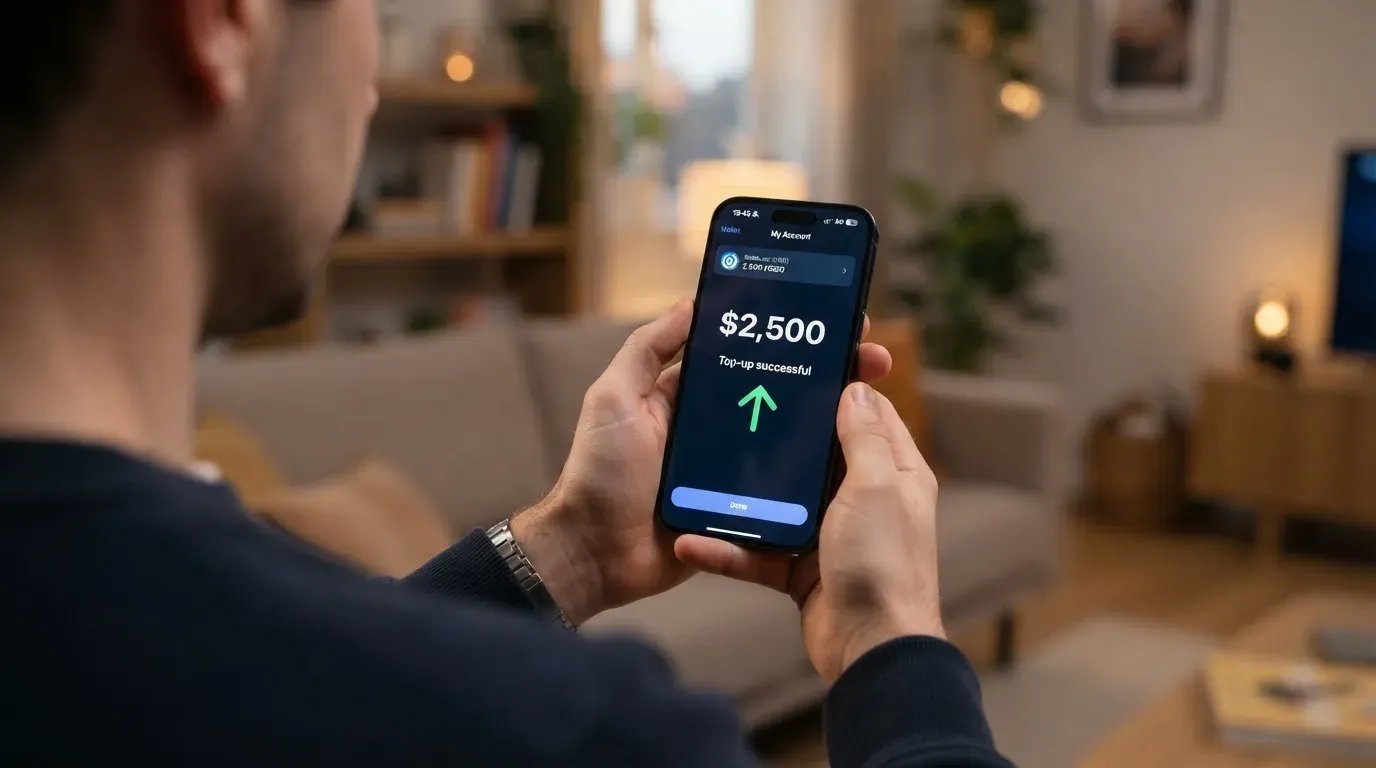
The mechanism matters more than the list. Your crypto is converted to rand, and then the card is loaded from the Spendl Wallet. There is no direct spend from a crypto balance. Every payment you make is a payment from rand you already paid to convert. That is the prepaid model, and it is why the card cannot overdraw, but it also means you cannot hold a crypto position on the card and let it move with the market.
Minimum crypto top-up is R10 or the asset minimum, whichever is higher. The asset minimums are published per coin: BTC 0.000008, ETH 0.0002, USDC 0.6, USDT 0.6, SOL 0.003, XRP 0.8, AVAX 0.03, BNB 0.0008, DOGE 3, LINK 0.04, TRX 2, and none listed for SHIB. Networks are not named, and who pays the network fee is not stated. I want to underline that, because blockchain transfers are irreversible. A deposit sent on a network Spendl does not support, or to an address belonging to a different network, can be lost outright or need manual recovery with no guarantee attached. Before your first transfer, get the network and the address from Spendl in writing, and check them twice. If you hold USDC and are considering the Tron route, note that Circle stopped supporting USDC on Tron in February 2024, so USDC over TRC20 is not a native option and the coin you would need there is USDT.
Fiat funding has more ways in than most crypto cards: card, PayShap, RTC, EFT, cash at participating tills, and Zapper QR. The deposit fees are published and they are not trivial:
| Deposit route | Fee |
|---|---|
| Receive from the card issuer | R1.20 |
| Receive from an outside source | R2.75 |
| Instant deposit | R12.00 |
| SWIFT deposit | R55.00 |
The spread on that table is stark. Moving rand from your own Spendl card costs R1.20. Moving it in via SWIFT costs R55.00. Forty-six times more, for what is often the same amount of money.
Money coming out is far more restricted, and this is the part I would read twice if the card is on your shortlist. You cannot send crypto to third-party wallets. You cannot convert ZAR back to crypto. ZAR leaves only by EFT, to a named, compliant bank account. If the purpose of a crypto card for you is moving value between places, this one cannot do it in either direction. On closure, the residual balance is generally returned within 30 days, less fees, holdbacks and anything owed to Spendl, and sanctions or anti-money-laundering holds can delay that.
Paying with it every day
Everyday use is where this card is more ordinary than you might expect, and also where two gaps start to show.
The card is loaded in rand, and international transactions are allowed on both Savvy and Guru, with the international POS fee applying. Multi-currency balances are not stated, so do not assume you can hold dollars and euros separately on this card. South African street shops, tills and online merchants are the intended environment.
What is not there matters. Apple Pay and Google Pay are not stated anywhere in the terms or documentation I read. That is not the same as “not supported” — it may simply be undocumented — but you should plan on tapping the physical card rather than your phone, and if phone payments are a requirement, ask. Merchant category blocks are also not stated, so I cannot tell you whether gambling, adult content or fuel are restricted, which in practice means you will find out at the till.
On the software side, the app is a progressive web app at app.spendl.money. There is no App Store or Google Play listing, which means there are no store ratings to read — and no independent public reviews to look at either, which feeds directly into the next section. Read on 2026-10-21.
If something goes wrong with a payment, the dispute route runs through Spendl’s Programme Partner under the card network’s rules. You are expected to notify Spendl promptly with evidence, typically within 30 to 60 days of the transaction posting. Two things to note here. First, that window is real — a dispute filed late is a dispute lost. Second, chargeback abuse is treated seriously: it can bring higher fees, a reserve, a restriction on your card, or termination.
Rewards are worth a sentence and not more. No cashback is stated. What Spendl offers is XP and points tied to levels, streaks and a leaderboard, with no monetary value stated anywhere. If you are weighing this card against one with genuine cashback, this is not that card, and the rewards system appears to be about engagement rather than money back.
What can go wrong
This is the section where the 5.0 lives. Three risks matter, and I would rank them in this order.
The first is custody, and the card is unusually plain about it. ZAR balances are held in a pooled client account at the Programme Partner, and Spendl states plainly that these are not deposits at a registered bank in Spendl’s name, with no statutory deposit insurance. Spendl also states that it is not a custodian of standalone crypto holdings. What this means in practice: your rand is not covered by a deposit guarantee scheme the way a bank deposit would be. It is held at a partner. If you are comfortable with that, fine — it is how most prepaid cards work. If you are not, this is a reason to close the tab and find something else. And to be fair to Spendl, publishing that sentence plainly is better than most providers do; the risk is in the structure, not in the disclosure.
The second is the counterparty chain above you. The card is issued and processed by a licensed third-party payment Programme Partner, and the bank is not named. Card programmes get suspended — WaveCrest, a Visa issuer that supplied several crypto card brands, was suspended by Visa in Europe in 2018 and all its Visa programmes were closed; Visa terminated its global agreements with FTX on 13 November 2022 and the FTX US debit card was wound down by its issuer. These are not predictions about Spendl. They are the base rate. When a programme closes, the pattern is a notice period, then loading and spending stop, then you are asked to withdraw your balance — and any ZAR you have left comes out by EFT to a named compliant account, or within 30 days of closure minus fees, holdbacks and amounts owed, subject to sanctions holds.
The third is the network detail, which I have flagged twice because it is the one that loses money fastest. Networks for the twelve supported assets are not listed. Blockchain transfers are irreversible. A deposit on the wrong network or to the wrong address can be gone, or can need manual recovery with no guarantee. Spendl’s own framing is that the crypto is not censorship-proof either, since stablecoin issuers disable tokens in wallets on sanctions lists and have frozen funds tied to illicit activity.
On the company’s background, so you know who you are trusting: Light Fusion (Pty) Ltd trading as Spendl Technologies, registration 2023/154151/07, Cape Town, South Africa, FSP No. 53757, FIC ID 74993, described as an FSCA-exempt Crypto Asset Service Provider. The partner is Payaccsys Services (Pty) Ltd, a Registered SO & TPPP with FIC ID 69498.
On complaints, the honest answer is that I found none — and that is not the same as a clean record. No incidents are published in the documentation I read, and a single search for reviews surfaced no Trustpilot page and no Reddit threads, on 2026-10-21. No complaints detail is published anywhere. For a young South African product with no app store listing, that is what you would expect: not a red flag, but not an endorsement either. You are not choosing between a product with a bad history and one with a good history. You are choosing between a young product and a young product.
Finally, two smaller operational things. The card can be blocked on request and there is a fraud hotline on 011 207 1600. Two-factor authentication and an in-app freeze are not mentioned anywhere I looked, which is odd for a financial app in 2026 and worth asking about. Support is at [email protected] with standard hours of 08:00 to 17:00 South African time, Monday to Friday — though those hours are stated for business support, and card support hours are not stated.
What to take instead
If you are not in South Africa, the Spendl card is simply off the table and you should read the alternatives as a different conversation. Here is how the three cards I looked at compare, and then I will tell you which one fits which kind of reader.
| Card | Score | Card type | Card cost | International / FX fees | Funding |
|---|---|---|---|---|---|
| Spendl | 5.0 / 10 | Physical and virtual, rand-denominated, South Africa only | R99.00, R25.00 monthly on the tiers that list it | R45.00 plus 1.56% on international POS | 12 crypto assets to ZAR, plus fiat |
| International Visa Card | 6.7 / 10 | Virtual, U.S.-issued Platinum Visa, pays in USD; physical “Coming soon” | $5 one-time virtual, no maintenance fee; plans Classic free, Pro $9.00/month, Max $19.00/month | Visa exchange rate plus 2% FX fee; USD use free on all plans | USDC or USDT at 1:1, plus USD, EUR, SEPA, SWIFT, FedNow |
| UNi Card | 6.1 / 10 | Multicurrency, Mastercard network, spends from the UNi.Global account balance | No annual fee; issuance fee not stated | No foreign transaction fee; conversion at live OTC rates | Not stated |
| Morse | 7.5 / 10 | Fully virtual Visa prepaid debit, spends from the balance in any currency | Issuance and monthly fee not stated | Zero foreign exchange fees or markups, real-time Visa rate | Debit card, stablecoin transfer, Account Details; self-custodial wallet |
The International Visa Card is the one for a reader who is outside South Africa and wants a dollar card. Its eligibility is by residence or registration, not citizenship, and it is not available to residents or legal registrants of Belarus, mainland China, North Korea, Cuba, India, Iraq, Iran, Israel, Myanmar, Nepal, Nicaragua, Russia, Syria, Turkey, Ukraine, Venezuela and Vietnam, with FATF grey-list countries reviewed case by case with compliance approval. Purchases are blocked in North Korea, Cuba, Iran, Russia, Syria, Ukraine and Venezuela. Its virtual card costs $5 once with no maintenance fee, card use in USD is free on all plans, deposits of any kind carry no fee, and foreign currency costs the Visa exchange rate plus a 2% FX fee. No cashback is stated. Note that its physical card is listed as “Coming soon”, so if you need plastic, that is a wait.
Morse scores highest of the four at 7.5 out of 10, and it earns that partly on fees and partly on custody. Its card is “fully virtual for now” — a Visa prepaid debit spending from the Morse Balance in any currency — with “zero foreign exchange fees or markups” at the real-time Visa rate, conversions at the real exchange rate with no markup, and card payment online and contactless free. Its wallet is self-custodial, which is the structural advantage over Spendl: the funds stay in your own wallet. Eligibility is by residence, not citizenship, and you must be at least 18 and resident in a supported country, with the app available in over 140 countries and local add and withdraw in over 70. It cannot serve customers subject to United States sanctions, and it also follows UK, EU and UN sanctions. A list of closed-beta countries needing an invite code includes American Samoa, Australia, Cape Verde, Guernsey, Hong Kong SAR China, Isle of Man, Japan, Jersey, New Zealand, Serbia, Singapore, Switzerland, Thailand, Türkiye, the United Kingdom and Western Sahara. The card is available only in certain countries and the list is not published on the card page, so you check the app. Fees: issuance and monthly not stated, the card page says fees may apply and points you to the Cardholder Agreement.
UNi Card is the multicurrency middle option: a Mastercard network card spending from the UNi.Global account balance, with no annual fee and no foreign transaction fee, conversion at live over-the-counter rates and no hidden exchange fees, plus “Spend-to-Earn” rewards of up to 3%. Its eligibility and funding details are not stated, and whether a physical card exists is not stated.
The honest summary of this table: Spendl is the only one of the four that is a rand card for South Africans, and that is simultaneously its reason to exist and its ceiling. If you are a South African, your comparison is not really against these three — it is against your own bank’s card. If you are not, and you are reading this page because you found the name somewhere, stop here and start with one of the other three.
Who I would recommend it to
I would recommend the Spendl card to four kinds of person, and to nobody else.
First, a South African resident — or a foreign national with valid KYC living there — who holds crypto and is tired of the friction of moving it. If your problem is “I have crypto, I need rand, and the exchange-to-bank route is slow and expensive”, this card does that in one step, from twelve assets, with ATM access and a physical card when you want one.
Second, someone who wants a rand card as a secondary instrument rather than a primary bank account. The limits make this obvious: R25,000 monthly on Smart, R100,000 on Savvy, R500,000 on Guru. Those are not the numbers of a card meant to run a household. They are the numbers of a card that holds a spending float.
Third, someone who has read the custody disclosure and accepted it knowingly. The pooled client account, the unnamed issuing bank, the fact that Spendl is not a custodian of standalone crypto — if you can hold that comfortably, the rest of the card is competently built and honestly documented.
Fourth, someone who values the wallet and vouchers and remittance on top of the card. Those features are listed on every plan and are not the reason most people arrive, but they are real.
And here is who I would not recommend it to, plainly. Not to anyone outside South Africa, because the product does not reach them. Not to anyone who wants to move crypto to a third-party wallet, or to convert rand back into crypto, because the card does neither — ZAR leaves only by EFT to a named compliant bank account. Not to anyone whose crypto position must stay self-custodied until the moment of payment, because Spendl converts first and spends rand second. Not to anyone for whom an unnamed monthly fee on Smart matters, because the Smart fee is not listed. And not to anyone who reads “no complaints found” as “no problems”.
If you are in South Africa with crypto to spend and you accept the custodial structure, this card is worth an afternoon of your time. The score is 5.0 out of 10 because the eligibility mark is 2 and the cost mark is 3, and neither of those is about the quality of the product. It is about where the product exists and what it charges to exist there.
Frequently asked questions
What is the Spendl card?
The Spendl card is a rand-denominated payment card available in South Africa, funded either with fiat or with crypto. Twelve assets — from BTC and ETH to stablecoins, SOL, AVAX, BNB, LINK, TRX, XRP, DOGE and SHIB — convert to ZAR, and the rand balance then pays for purchases and ATM withdrawals like an ordinary prepaid card. Both a virtual and a physical card come with every plan. It is not a bank account, and it does not hold crypto on the card itself.
How does the Spendl card work?
Your crypto is converted to rand first, and the card is then loaded from the Spendl Wallet. Every payment you make comes from rand you have already converted, so the card cannot overdraw. There is no direct spend from a crypto balance, and no way to hold a crypto position on the card that moves with the market. ZAR leaves the account only by EFT to a named, compliant bank account — you cannot convert back to crypto or send crypto to third-party wallets.
Is Spendl a bank?
No. Spendl is Light Fusion (Pty) Ltd trading as Spendl Technologies, registration 2023/154151/07 in Cape Town, FSP No. 53757, FIC ID 74993, and describes itself as an FSCA-exempt Crypto Asset Service Provider. Its partner is Payaccsys Services (Pty) Ltd. The card is issued and processed by a licensed third-party Programme Partner, and the issuing bank is not named.
Who owns Spendl?
Light Fusion (Pty) Ltd trading as Spendl Technologies owns and operates the brand, with registration 2023/154151/07 and an FSP number of 53757. The Programme Partner that issues and processes the card is a separate licensed third party, and the bank behind it is not named in Spendl’s public terms. ZAR balances sit in a pooled client account at that partner rather than at a registered bank in Spendl’s own name.
Is the Spendl card available in my country?
Only in South Africa, as far as Spendl’s public pages say. The store states the card ships across South Africa. Within South Africa, residents and foreign nationals with valid KYC are both accepted, though Spendl’s own pages disagree about which nationality each plan suits — ask before you choose a tier. Guru applicants who are foreign nationals need a passport, a work permit and proof of residence.
How do I apply for the Spendl card?
Sign up in the app, complete KYC, then order the card in the shop for R99.00, one card per order. Upgrading from wallet-only to wallet plus card needs a second KYC step. Most verifications finish within minutes and some take up to 24 hours. Bring a South African ID Smart Card or passport, plus proof of address under 3 months old showing your full name and street address, no PO Box, under 10 MB.
What does the Spendl card cost?
R99.00 per card and R100.00 for a replacement. The monthly fee is R25.00 on Savvy and Guru, and the Smart fee is not listed. International purchases cost R45.00 plus 1.56%. A local ATM withdrawal is R12.50 plus R2.50 per R100 or part thereof, so a R150 withdrawal pays three increments. Crypto conversion carries a small transparent fee that is shown before you confirm but not published.
How do I top up the Spendl card?
With crypto — twelve assets convert to ZAR, from a minimum of R10 or the asset minimum, whichever is higher — or with fiat by card, PayShap, RTC, EFT, cash at participating tills or Zapper QR. Deposit fees range from R1.20 to receive from the card issuer and R2.75 from an outside source, to R12.00 instant and R55.00 by SWIFT. Check the network before sending, because transfers are irreversible.
Is the Spendl card safe?
It is custodial by design, and Spendl says so plainly: ZAR balances are held in a pooled client account at the Programme Partner, are not deposits at a registered bank in Spendl’s name, and carry no statutory deposit insurance. No complaints were published in the documentation and none surfaced in review searches, which for a young product with no app store listing means no track record rather than a clean one. The card can be blocked on request; the fraud hotline is 011 207 1600.
Is the Spendl card worth it?
In South Africa, if you hold crypto and want to spend rand without a bank relationship, probably yes — twelve assets convert in one step and the limits suit a spending float. Outside South Africa, it is not an option at all. And it is not worth it for moving crypto, for holding crypto on the card, or for anyone who needs their money insured as a bank deposit would be. My score for it is 5.0 out of 10.
App and neobank cards on the shortlist – cryptocardshortlist
Content created by the «cryptocardshortlist» team