
A crypto card that spends from your own wallet — reviewed on the details that matter
 Available in US
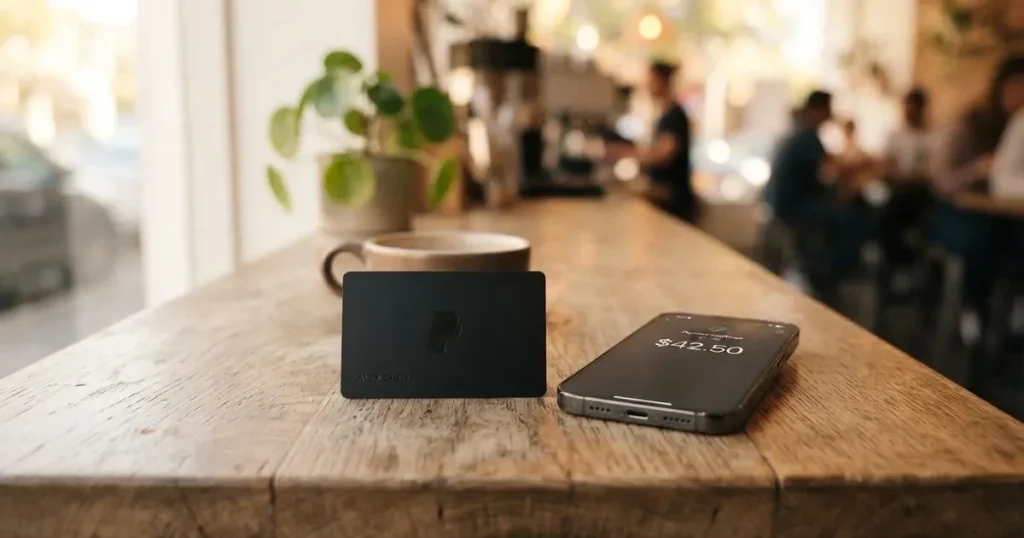
The PayitFast card turns crypto you already hold into an ordinary Visa payment. You connect a self-custody wallet — MetaMask, Trust Wallet, Binance Wallet or another — and the card draws on that balance when you pay. There is no exchange account in the middle holding your money, and no bank application for a card that assumes you already have a compliant account somewhere else. That is the appeal, and it is a real one for anyone who has tried to open an ordinary bank card and run into a wall.
Conditions are current as of October 28, 2026.
I scored it 6.9 out of 10. That is not a dismissive number and it is not an endorsement. It reflects a card with good fundamentals — a clear regulatory identity, a self-custody model, and cashback paid in USDT — sitting underneath a layer of public documentation that is thinner than it should be. The card’s own pages do not state its fees, its spending limits, its card currency, or which countries it actually serves. If you are deciding whether to rely on this card for anything important, those gaps matter more than the score.
Who it suits: people who already hold stablecoins or crypto in a wallet they control, who want to spend it without moving it to a custodian first, and who are comfortable losing a few percent on the way in exchange for that control. Who it does not suit: anyone who needs to know the exact cost of a payment before they make it, anyone who needs a card in a specific country with certainty, or anyone who wants a physical card in the post next week.
The conditions described here are current as of October 2026.
The score in detail
| Criterion | Mark | Why |
|---|---|---|
| Who can get it | 8 / 10 | Officially “varies by jurisdiction”; unofficial sources say 189 countries, but the card publishes no country list |
| Cost | 4 / 10 | Officially not disclosed; unofficial sources mention a 3% annual fee and 2.2% on non-USD transactions |
| Top-up options | 8 / 10 | Self-custody wallets (MetaMask, Trust Wallet, Binance Wallet); stablecoins, USDT, Bitcoin, Ethereum; networks not named |
| Reliability and complaints | 8 / 10 | Silverleaf E-Money Services Ltd., FINTRAC MSB registration M23026009, supervised by the Bank of Canada under the RPAA; unofficial: issuer Third National Bank; no complaints found |
| Everyday use | 7 / 10 | Virtual Visa, Apple Pay and Google Wallet, ATM mentioned without conditions; physical card only by waitlist |
| Total | 6.9 / 10 |
The audience note is worth stating plainly: this card is built for self-custody users who want up to 10% back in USDT. If that is you, the marks are mostly generous. If you are looking for a cheap everyday debit card, the cost mark tells you this is not that.
Will they give you the card
The card says availability “varies by jurisdiction and is subject to regulatory approval”. Certain countries may be temporarily unavailable. And the important part, which almost nobody mentions in passing reviews: if your country is missing from the verification list, onboarding is unavailable there — not restricted, unavailable. There is no published country list on the pages I read. Unofficial sources, notably DefiLlama, put the reach at 189 countries, but that is not confirmed by the card and you should treat it as a hint, not a guarantee. The honest position is that you cannot tell from public information whether you qualify until you open the app and look.
That is a real friction point, and it is worth being honest about what it means for you. “Varies by jurisdiction” leaves the door open for a country you are in to be switched off without notice, and for the verification list to change between the day you check and the day you need the card. If you are in a jurisdiction where ordinary banking is already awkward, this is one more thing that can stop working without warning.
The company behind the card is Silverleaf E-Money Services Ltd., trading as PayitFast, incorporated in British Columbia, Canada. It holds FINTRAC MSB registration M23026009 and is supervised by the Bank of Canada under the Retail Payment Activities and Associated Activities Regulations. That is a real regulatory footprint, not a shell. The issuing bank is not stated officially; unofficial sources name Third National Bank. Whether the card is issued through a named bank matters for chargebacks and for what happens to funds if the programme ends, and you cannot confirm that from the card’s own pages.
How to get it
Identity verification happens in the app. Documents are rejected if they are expired, damaged, unclear, mismatched, or from an unsupported country. What is not stated: the accepted document types, whether proof of address is needed, and any age requirement. That is a meaningful gap — many people fail at this step by guessing which document will work. Support cannot manually approve or override a rejected document, so if your scan comes back rejected you are back to square one with no appeal route.
What you get is a Visa. The virtual card is the default; a physical card exists but is waitlist only, with no details given about the waitlist length or how you join it. The card currency is not stated. Note what that means in practice: the currency question is not a technicality when non-USD transactions are where the extra fee sits.
In this category, prepaid and debit cards are generally available to adults 18 and over, and some issuers set higher limits. The card does not state its own age rule.
Fees and what a payment really costs
Here is the honest part of this review, and the reason the cost mark is 4 out of 10. The card’s public pages, as I read them, do not state issuance cost, monthly fee, conversion fee, foreign-exchange fee, ATM fee, or any spending limit. That is not stated. It means the number you would most want — what does a payment cost — is precisely the number the card does not publish.
What unofficial sources report: a 3% annual fee and a 2.2% charge on non-USD transactions, both from DefiLlama in October 2026, which also noted that the pricing page differed from the card agreement. An earlier check of the card’s own files recorded a 0.75% crypto conversion fee per transaction. Take these as leads to verify in the app, not as figures to plan around.
| Fee or limit | What the card states |
|---|---|
| Issuance | not stated |
| Monthly fee | not stated |
| Crypto conversion | not stated officially; an earlier check of card files recorded 0.75% per transaction |
| Foreign exchange / non-USD | not stated officially; unofficial: 2.2% on non-USD transactions |
| ATM | “withdraw at any contactless ATM”; fee and allowance not stated |
| Daily and monthly limits | not stated |
| Annual fee | not stated officially; unofficial: 3% |
Two or three everyday payments, and which fees would apply:
A coffee, local currency, in your home country. If the payment is in USD or in the card currency, the only fee you would be exposed to is the conversion fee, unofficial 0.75%, plus whatever network cost sits in the transfer of crypto to the card balance. No FX fee. On-chain network fees — gas or bandwidth — are charged by the blockchain, not by the card provider, so they are a real cost of funding but not a card charge.
A subscription billed in a currency you do not use. This is where the unofficial 2.2% non-USD fee bites, and where Address Verification Service can cause a decline: AVS compares the numeric parts of the billing address you type with issuer records, it is mainly offered in the US, Canada and the UK, and it is generally unavailable for foreign-issued cards. Some merchants decline prepaid or foreign-issued cards outright, because the BIN lookup reveals the card type and the issuer country.
A cash withdrawal at a contactless ATM. The page says “withdraw at any contactless ATM” and then says nothing about the fee or the allowance. You are spending real money to find out. A declined authorisation can also leave a hold on your funds that stays for several days, typically up to 7.
Master Terms and Elite Terms exist. What is inside those tiers was not retrieved, so I cannot tell you whether a paid tier would improve any of the above. That is exactly the kind of question a fee table should answer.
How to top up
This is where the card is strongest, and it is a genuinely simple flow: you send crypto to the card, the card converts it, and the balance becomes spendable. The funding side accepts self-custody wallets — MetaMask, Trust Wallet, Binance Wallet or any other — and accepts stablecoins, USDT, Bitcoin and Ethereum. What is not stated is which networks. That omission is the one real hazard here.
Blockchain transfers are irreversible. A deposit sent on a network the card provider does not support, or to an address belonging to a different network, can be lost, or need manual support recovery with no guarantee. ERC-20 fees are paid only in ETH, so a wallet holding USDT and no ETH cannot send. Tron prices fees through bandwidth and energy, often burning TRX. Circle stopped supporting USDC on Tron in February 2024, so “USDC over TRC20” is not a native option. Given that PayitFast does not name its supported networks, you would be finding this out by trial, and a wrong guess is expensive in the way only irreversible transfers are.
If a deposit does not arrive, it is handled through support, with the TXID. That is the recovery path, and it is manual.
Paying with it every day
Add the card to Apple Pay or Google Wallet. Blocked categories are not stated — and categories matter, because a merchant category code is a four-digit number classifying a business, MCC 7995 covers gambling, and many issuers block that on specific cards by policy rather than by law, with the blocked list varying by issuer. Whether PayitFast blocks it is not something I can tell you.
The rewards are the reason self-custody users gravitate here. “Up to 10% back on eligible transactions”, paid in USDT to the PayitFast wallet, immediately. Two things to understand about that. It depends on which eligible asset you spend — so the percentage is not a flat discount on everything. And the eligible transactions are undefined in the card’s own materials. Cashback is non-withdrawable: it is usable on eligible card transactions only, not taken out as cash.
Apple Pay replaces the card number with a device-specific Device Account Number stored in the Secure Element, never on Apple’s servers, and each payment uses a one-time dynamic security code. The issuer can still restrict a tokenised number, for example blocking it on phone or website use.
Apps: iOS (App Store ID 6764277245), Android (co.payitfast.app) and a web app at app.payitfast.com. Ratings were not retrievable on 2026-10-21 — the store pages did not load — so I have no user rating to quote. Whether there is a formal dispute process is not stated.
What can go wrong
The card’s own position is that cards can be restricted for repeated declines, unusual activity, or compliance review. That is standard, but it means your spending can stop for reasons that are not yours and are not disclosed. The self-custody model cuts one way here too: because your wallet is linked as collateral, the card’s restriction decisions are tied directly to the wallet you hold. Whether 2FA or an instant freeze exists is not stated, though those are the standard safeguards in this category.
Withdrawals may be pending for compliance, Travel Rule, network congestion, or large-amount review. Promotional credits, referral rewards, cashback and bonus funds are non-withdrawable.
The systemic risk is worth naming even though it is not specific to PayitFast. Custodial platforms have a history: Mt. Gox (about US$350 million reported stolen 2011-2014), Coincheck (about US$400 million, 2018), Ronin Network (US$625 million, 2022). Programme closures typically give a notice period, then stop spending and loading, then ask users to withdraw remaining balances. Visa terminated its global agreements with FTX on 13 November 2022 and the FTX US debit card was wound down. WaveCrest, a Visa issuer that supplied crypto card brands, was suspended by Visa in Europe in 2018, closing all WaveCrest-issued Visa programmes. None of this predicts PayitFast will fail; it tells you what to ask if it ever looks shaky.
I found no user complaints, and no Trustpilot page for PayitFast. That is a genuinely neutral finding, not a clean bill of health — a young card with no complaints may simply not have been around long enough, or may not have the volume, to generate them. Where complaints are usually found, the card’s details are not stated, so I cannot give you a picture of how disputes are handled.
Support is a Telegram bot (t.me/payitfastbot) and an email Support Team. Product news — Local QR Payments, Send Money, Business — is marked “Soon”, which tells you this is an early-stage product.
What to take instead
I looked at three alternatives in the same category and scored them on the same basis. PayitFast at 6.9 sits between MetaMask at 7.1 and KAST at 6.1, with TokenPocket at 5.8.
MetaMask (7.1 / 10) is the closest competitor and the one to look at first. Sign-up is open in 45 listed countries and territories; other regions join a waitlist; proof of residency is required; US and UK sign-ups are temporarily closed per the FAQ. It is a Mastercard, virtual first and instant, with a Metal card you can pre-order after approval at $199/year; the virtual card is free with no annual or maintenance fee. Fees are “minimal” with no additional MetaMask fees and no foreign transaction fee, Mastercard rate used. Networks are named — Linea, Base, Monad, Solana — which removes the single biggest hazard on PayitFast. Cashback is 1% on Virtual, and on Metal a headline 3% capped at the first $10,000 spent then 1%. Its weakness: your funds move into a Money Account, so it is not the pure self-custody model.
KAST (6.1 / 10) is the transparent-fee option. Availability is residence-based and the country list is shown at KYC rather than published, and citizenship matters independently: living in a supported country with only an ID from a restricted region can still leave you ineligible. Cards are Visa across Standard, Premium and Private tiers — but Premium is 1,000 USD/year and Private 10,000 USD/year, with an inactivity fee of 1 USD/month after 12 months. What makes it interesting is the fee line: stablecoin top-up 0%, USD spend 0%, transaction fee 0%, Apple/Google Pay 0%, non-USD FX 0.5%–1.75%, 0.10 USD on non-USD transactions under 25 USD, 0.50 USD for a declined payment from insufficient balance. Cashback runs 1.5% to 3% USD on tiered monthly spend caps.
TokenPocket (5.8 / 10) splits Visa debit for a list of European countries and territories with Mastercard debit for Australia, Canada, Hong Kong, Japan, Taiwan, New Zealand, Singapore, South Korea and the UK, running on Arbitrum, with virtual Fiat24 cards. Fees are simple — an NFT creation fee partly covered, “a small portion” your share, and otherwise no additional fees — but a 1% fee on depositing cryptocurrency, to be refunded later via rewards. No cashback stated directly. Its geography is the narrowest of the three.
| PayitFast | MetaMask | KAST | TokenPocket | |
|---|---|---|---|---|
| Score | 6.9 / 10 | 7.1 / 10 | 6.1 / 10 | 5.8 / 10 |
| Card network | Visa | Mastercard | Visa | Visa / Mastercard |
| Card currency | not stated | not stated | USD (balances 1:1, 0% spread) | EUR24 and USD24 |
| Where | varies by jurisdiction, no list | 45 listed countries, waitlist elsewhere | residence list shown at KYC | Europe; Australia, Canada, HK, Japan, Taiwan, NZ, Singapore, South Korea, UK |
| Named networks | not stated | Linea, Base, Monad, Solana | USDT/USDC on Ethereum, Solana, Polygon, Arbitrum, TRON | Arbitrum |
| Annual fee | not stated (unofficial 3%) | Virtual free; Metal $199 | 0 / 1,000 / 10,000 USD by tier | small NFT creation share, otherwise none |
| Non-USD fee | not stated (unofficial 2.2%) | no FX fee, Mastercard rate | 0.5%–1.75% | not stated |
| Cashback | up to 10% USDT, non-withdrawable | 1% Virtual; 3% Metal to first $10,000 | 1.5% / 2% / 3% USD by tier | none stated; 1% deposit fee refunded via rewards |
Who I would recommend it to
I would recommend PayitFast to someone who already keeps stablecoins in a wallet they control, who has a metered approach to spending — coins, small everyday amounts — and who treats the card as one tool among several rather than their only access to money. For that person, spending directly from a self-custody wallet without a custodial intermediary is a real improvement, the USDT cashback is a genuine sweetener, and the regulatory identity behind it — a FINTRAC-registered MSB supervised by the Bank of Canada under the RPAA — is more reassuring than an unknown issuer.
I would not recommend it as a first crypto card, and not to anyone who needs certainty about cost. The cost mark is 4 out of 10 for a reason: the card does not publish its fees, its limits, its card currency, or its supported networks. You would be budgeting and topping up on assumptions drawn from third-party sites rather than terms you have read. If your country is not on the verification list, you cannot onboard at all, and there is no published list to check against.
If you want the same self-custody logic with named networks and no foreign-exchange fee, MetaMask scores higher and tells you more before you commit. If you want every fee spelled out in advance, KAST publishes the most complete fee table in this group. Both trade away something PayitFast holds. That is the trade, and now you know what it is.
Frequently asked questions
What is PayitFast card?
PayitFast is a Visa payment card that spends directly from crypto in your self-custody wallet, not a custodial exchange account. You connect a wallet such as MetaMask or Trust Wallet, and the card draws on that balance when you pay. Silverleaf E-Money Services Ltd. operates it, holding FINTRAC MSB registration M23026009.
How does PayitFast card work?
You verify your identity in the app, receive a virtual Visa, and fund it by sending crypto to the card. It behaves like an ordinary Visa, working with Apple Pay and Google Wallet. PayitFast offers up to 10% back in USDT on eligible transactions, paid immediately to your wallet but usable only on eligible card purchases.
Is PayitFast a bank?
No. PayitFast is an e-money and card programme, not a bank. The operator, Silverleaf E-Money Services Ltd., is FINTRAC-registered and supervised by the Bank of Canada. The official issuer is not stated, though unofficial sources mention Third National Bank. E-money funds are not the same as bank deposits.
Who owns PayitFast?
PayitFast is the trading name of Silverleaf E-Money Services Ltd., a company incorporated in British Columbia, Canada. It is registered as a money services business with FINTRAC under number M23026009. I found no user complaints or Trustpilot page, a neutral finding rather than an endorsement. Because the card is young, it may not yet have the volume to generate established user feedback.
Is PayitFast card available in my country?
Availability varies by jurisdiction and is subject to regulatory approval. If your country is missing from the verification list, onboarding is unavailable. No country list is published; unofficial sources cite 189 countries, but the card does not confirm this. The only reliable check is to open the app and look.
Does PayitFast card require KYC?
Yes. Verification happens in the app. Documents are rejected if expired, damaged, unclear, mismatched, or from an unsupported country — and support cannot override rejections. The card does not state accepted document types, proof-of-address requirements, or age rules, so expect to determine those by trial as you go through the sign-up process.
Is PayitFast card free?
The card’s public pages do not state issuance, monthly, or annual fees. Unofficial sources report a 3% annual fee, and earlier checks noted a 0.75% crypto conversion fee. Because nothing official was published, treat these as leads to verify in the app rather than fixed figures for your budgeting.
How much does it cost to pay with PayitFast?
That depends on your location and funding. At home, you may face the 0.75% conversion fee (unofficial) plus blockchain network costs. Non-USD transactions may incur a 2.2% fee. ATM withdrawals carry unstated fees. None of these figures come from official terms, so ensure you have clarity in the app before spending.
Is PayitFast card safe?
The card is built on a regulatory identity, not reputation. Against that, the self-custody model means key loss, phishing, and malware are your sole responsibility. Blockchain transfers are irreversible, and cards can be restricted for unusual activity or compliance review. Whether 2FA or instant freezing exists is not officially stated by the provider.
Is PayitFast card worth it?
For someone already holding stablecoins who wants to spend without a custodian in between, the control justifies it, and the USDT cashback is a sweetener. For a first card, I would look elsewhere for transparency and named networks. Always check your country’s availability and real fees before committing anything meaningful.
Wallet cards on the shortlist – cryptocardshortlist
Content created by the «cryptocardshortlist» team