
The card that gives you a Swiss IBAN — and asks you to pay for the privilege
 Available in US
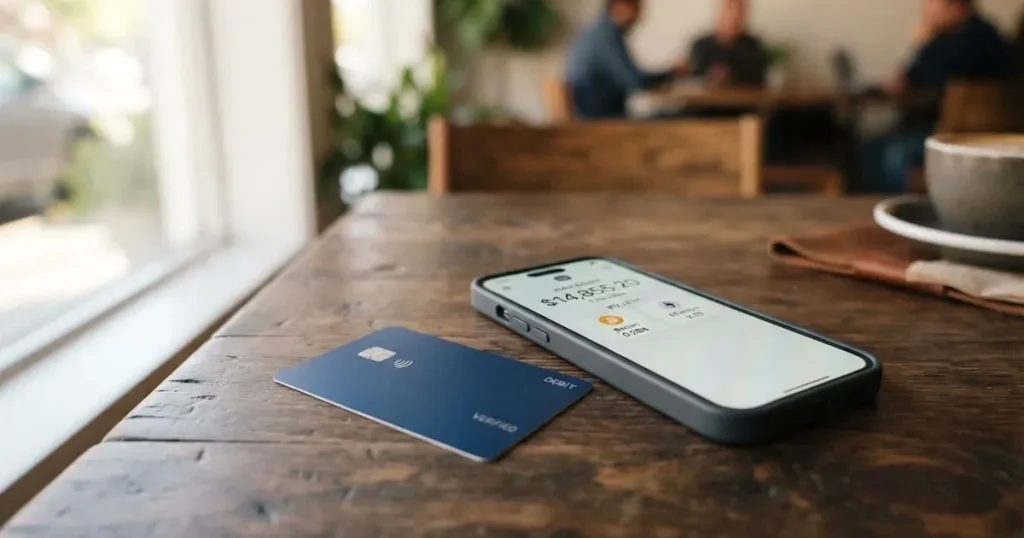
The M2 card is not a free travel card. It is a subscription product: you pay a monthly, quarterly or yearly fee in USDT and, in return, get a Mastercard debit card attached to a Swiss IBAN account that you can fund with USDC. That combination — a card that many people cannot otherwise get, an account number in Switzerland, and a price that is transparent enough to calculate before you sign up — is the whole pitch. On my scoring, M2 comes out at 6.9 / 10: a strong everyday-use score dragged down by gaps in what the public pages actually disclose. It suits the person who wants a Swiss IBAN account with a USDC-funded card and who is comfortable paying a flat monthly fee. It does not suit someone hunting for a free card, someone who needs transparent foreign-exchange costs, or anyone who requires a published figure for the conversion fee, cash withdrawals or daily limits.
The conditions described here are current as of October 28, 2026.
The score, and who M2 suits
Here is the breakdown, criterion by criterion, exactly as I scored it.
| Criterion | Score | Why |
|---|---|---|
| Who can get it | 8 / 10 | Open in “over 150 jurisdictions” — most of the EU, the UK, Switzerland, much of Asia-Pacific, Latin America, Africa and the Middle East; the United States and sanctioned regions are not supported |
| Cost | 5 / 10 | The subscription is cheap in dollar terms (10 USDT a month) but it is mandatory, and the size of the currency conversion is not disclosed despite the “no hidden FX spreads” claim |
| Top-up options | 6 / 10 | USDC on BNB Smart Chain and Mantle, Ethereum “soon”, converted into seven fiat currencies — a real option, but limited to one token and two chains today |
| Reliability and complaints | 7 / 10 | Funds sit in a Swiss IBAN at regulated institutions with 1:1 reserve backing, but the issuing entity and its licence are not named |
| Everyday use | 9 / 10 | Virtual Mastercard instantly, physical card optional, and it works in Apple Pay, Google Pay, Alipay and WeChat Pay |
| Total | 6.9 / 10 | A good card attached to a Swiss account, held back by disclosure gaps and a mandatory subscription |
Read that table as I read it. The two ends of it do the talking. The 9 for everyday use is real: a virtual card in your phone within minutes, plus the four mobile wallets people actually reach for, is more than most crypto cards offer. The 5 for cost is not about the subscription being expensive — 10 USDT a month is genuinely small — it is about what the subscription buys you and what it does not. You pay a flat fee every month, and what you are not shown is the conversion cost when you spend, or the fee at a cash machine. “All fees are transparent and shown before confirmation. No hidden FX spreads” is a promise about disclosure, but the conversion fee figure itself is not stated anywhere on the public pages. For someone budgeting carefully, an unquantified fee is the hardest kind of fee to plan around.
The 7 for reliability rests on a genuinely reassuring structure — the money is described as being in your own Swiss IBAN account at regulated institutions, backed 1:1 — with one persistent unanswered question: who issues the card and under whose licence? The company describes itself as a “Swiss-regulated debit card and IBAN account” running on Matchain, marked “Live on Mainnet”, but the issuer and licence name are not stated. That matters more than it sounds. A card programme sits with three parties: the network that routes it, the licensed institution that issues it, and the brand that markets it. Knowing which of those is actually regulated, and by whom, is how you judge who is responsible when something goes wrong.
Will they give you the card
Mostly yes, and this is M2’s genuine strength — but read the list properly rather than skimming “150”.
Eligibility spans “over 150 jurisdictions”. That covers most EU countries, the United Kingdom and Switzerland. In Asia-Pacific it includes China (Mainland), Hong Kong, Taiwan, Japan, Singapore, Korea and the UAE. In Latin America: Brazil, Argentina, Mexico and Chile. In Africa: Nigeria, Kenya, Rwanda and Ghana. In the Middle East: the UAE, Qatar and Saudi Arabia.
Two exclusions matter. The United States is not supported — not a nuance, simply not. Neither are sanctioned regions.
One condition catches people out: Chinese mainland users need a passport. That is a specific requirement attached to one jurisdiction, and if you are a mainland resident with only a national ID card, the passport requirement is the detail to check before you start.
Where this sits against the alternatives, M2’s reach is broad. Compare the International Visa Card, whose account and card are not available to residents or legal registrants of Belarus, mainland China, North Korea, Cuba, India, Iraq, Iran, Israel, Myanmar, Nepal, Nicaragua, Russia, Syria, Turkey, Ukraine, Venezuela or Vietnam, with FATF grey-list countries reviewed case by case with compliance approval — and where the rule is by residence or registration, not citizenship. That is a longer blocklist than M2’s, but it also blocks jurisdictions M2 accepts. Neither approach is obviously better; they are different philosophies about who to admit.
How to get it
The sign-up path is short, and the identity check is fast — genuinely fast, not “fast for KYC”. There is a single verification level, run through MatchID: you present a passport or valid ID and a selfie. The card states an average of two minutes. One level only — there is no tiered upgrade path here.
The sequence is: sign up, complete the MatchID verification, choose a subscription plan, then deposit. That ordering matters. You do not deposit before you are verified, and you do not get access until the subscription is paid. The subscription is what unlocks full access; it is not an optional add-on on top of a free account.
On the card itself: it is a Mastercard debit card tied to a Swiss IBAN account. The virtual card is issued instantly. A physical card is optional and ships after activation — the delivery time is not stated on the public pages, so if you need a physical card for a trip with a date on it, plan for the virtual one and check the shipping terms yourself rather than assuming.
What it really costs: Fees, subscriptions and the numbers that are missing
The subscription is the fixed, knowable part. The variable part is where the disclosure thins out. Here is what the card actually states.

| Fee or limit | What the card says |
|---|---|
| Subscription, monthly | 10 USDT (5 USDT when paid in token, 50% discount) |
| Subscription, quarterly | 25.5 USDT (15 USDT when paid in token) |
| Subscription, yearly | 84 USDT (60 USDT when paid in token) |
| Monthly fee, separate | None beyond the subscription — there is a single card, not a tiered plan |
| Conversion fee | Not stated. “No hidden FX spreads” is claimed; the size of the conversion is not published |
| Foreign exchange | Exchange between 7 fiat currencies “with competitive rates”; the rate or spread figure is not stated |
| Cash withdrawals (ATM) | Not stated |
| Daily limit | Not stated |
| Monthly limit | Not stated |
| Top-up fees and minimums | Not stated |
| Withdrawal fees | Not stated |
Read the token prices carefully. Paying in USDT on the network unlocks a 50% discount: 5 USDT monthly instead of 10, 15 quarterly instead of 25.5, 60 yearly instead of 84. What that subscription covers, per the card: banking infrastructure, compliance, custody, card issuance and rewards. So it is not a usage fee in the way a bank’s monthly fee is — it is closer to the price of a bundled account.
Two everyday payments, and which fees bite.
A subscription renewal in USDT. This is the payment you already know the price of. Every month 10 USDT leaves your balance, or 5 USDT if you are on the token rate. No conversion is involved because you are paying in the token you already hold. This is the payment M2 prices most clearly.
A card purchase in a currency your balance is not in. Say your balance sits in EUR and you buy something priced in USD. Your subscription does not change; on top of it, your money is converted. The card says fees are “transparent and shown before confirmation” and that there are “no hidden FX spreads”, and that you exchange between 7 fiat currencies at “competitive rates”. What it does not publish is the conversion fee as a number. So the practical answer to “what will this cost me?” is: the shown rate at confirmation, plus a conversion component whose size the public pages do not disclose. If you are the kind of person who needs that figure in advance to decide whether to buy, this is a real limitation, and it is why cost scored 5 rather than 7.
A cash withdrawal. The card’s public pages do not state the ATM fee, and they do not state daily or monthly limits. Both are things you should confirm before relying on the card as your only access to cash — the alternative may well be that the IBAN account is the sensible route for withdrawals, and the card is for spending.
One more currency detail, because it has bitten people before: balances are held in EUR, CHF, USD, CNH, JPY, SGD and HKD — seven currencies. An earlier check listed RMB rather than CNH. CNH is the offshore renminbi and RMB is the mainland one; the currency the account is actually denominated in is worth confirming before you fund it.
How to Top up: USDC in, fiat balance out
Funding is the narrowest part of the offer and the part you should read most carefully, because sending crypto to the wrong network is one of the few genuinely irreversible mistakes available here.
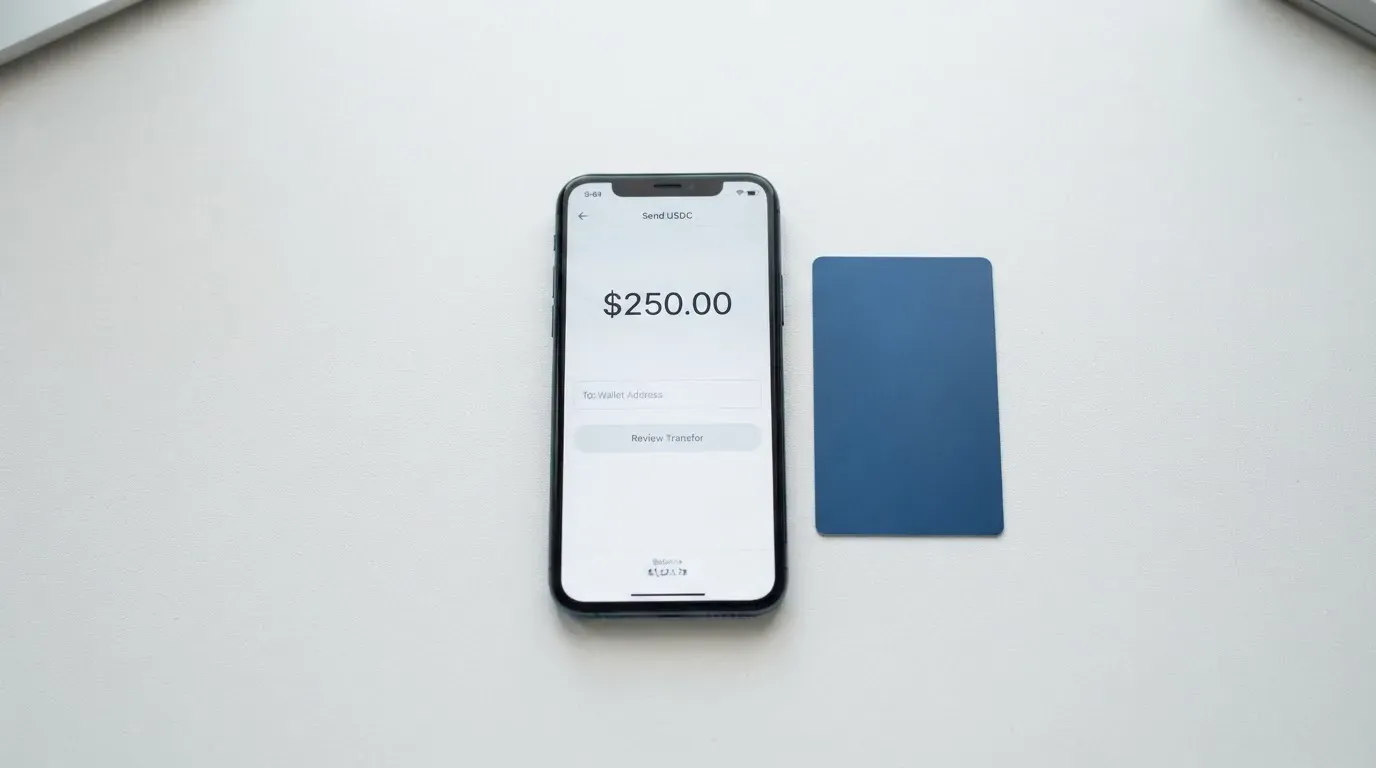
You deposit USDC, and today the supported networks are BNB Smart Chain and Mantle, with Ethereum described as “soon”. That is the entire list. Not “USDC and USDT”, not “any token” — one stablecoin on two chains, with a third to come.
Once the USDC arrives, it is converted into your balance in EUR, CHF, USD, CNH, JPY, SGD or HKD. The card does not state the top-up fees or minimums, so neither can I give you a number for the cost of loading.
A word on why network choice is not a technicality. A stablecoin like USDC exists at different addresses on different chains, and a transfer sent on a network the provider does not support can be lost, or need manual support recovery with no guarantee. Blockchain transfers do not reverse the way a card payment does. If you fund M2, read the network name on screen twice.
There is also the question of what the stablecoin itself is. USDC is Circle’s dollar-pegged token, which Circle says is redeemable 1:1 for USD and fully backed by cash and cash equivalents, mostly in an SEC-registered government money market fund, with monthly reserve attestations. It is also worth holding onto the fact that “stablecoin” is a description of intent, not a guarantee: stablecoins have depegged before, and can again. Circle supports USDC natively on 38 networks as of 16 September 2026 — Ethereum, Solana, Base, Polygon PoS, Avalanche, Arbitrum and Stellar among them, which is a reminder that M2’s two-chain support is narrower than the token’s own reach.
Getting money back out: the card says your balance is yours, held in your IBAN account, and can be withdrawn according to banking rules. That framing is the reassuring part — the money is not described as locked inside a crypto programme. The part it does not give you is the withdrawal fee.
Paying with it every day
This is where M2 scores highest, and the reason is unglamorous: the card works in the places people actually pay. It is a Mastercard debit, so it is accepted wherever Mastercard is accepted. The virtual card is instant, so you can add it to your phone the same day. It works with Apple Pay, Google Pay, Alipay and WeChat Pay — that last pair matters if you are in or travelling through Asia, because those two are how a lot of everyday spending happens there rather than at a card terminal.
Rewards are small and structural rather than generous. Spending earns 0.1% “consumption rewards” from spending inside your own referral network, and the network deepens the more people you bring in: invite one person and you get three generations of referral, invite three and you get five, invite five and you get ten. There is also referral cashback and “Partner Cashback” with partner projects. Read that as a reason to invite people you genuinely would invite anyway, not as a returns engine — 0.1% is 0.1%.
Two things the public pages do not tell you, which I would want to know before this became my daily card. The blocked categories are not stated — and this is not a small omission, because card issuers routinely block whole merchant categories by policy, most famously gambling (MCC 7995), and the list varies by issuer. If some spending matters to you, that is worth confirming. And the dispute and chargeback process is not stated: what happens when a payment goes wrong, how long it takes, whether it is handled at all. Under EU rules, if due diligence cannot be completed, the institution is required to refrain from the transaction or the relationship, which is the general reason accounts get frozen pending documents; a prepaid or foreign-issued card can also be declined at the till because the BIN lookup shows the card type and issuer country. None of that is a reason to reject M2, but it is a reason to keep a second payment method.
What can go wrong
M2 describes a reassuring safety story, and parts of it are unusually well put. Funds are held in your own Swiss IBAN account at regulated institutions with 1:1 reserve backing. The card goes further than most: even if Matchain stops operating, it says your funds remain accessible through the regulated bank. That is the right thing to say, and it is the right structure — the money’s claim is against the bank account, not against the crypto brand.
But two words in that paragraph deserve a second read. Insurance, the card says, “depends on jurisdiction and account structure”. That is a genuine caveat, not a reassurance. And the 1:1 reserve claim describes what backs the balances; it is not the same as a deposit guarantee scheme. In the EU, electronic money institutions must safeguard customer funds by segregating them or insuring them, and those funds are not bank deposits and may not be covered by a deposit guarantee scheme. Read “regulated institutions, 1:1” as “not a bank deposit”, and read “depends on jurisdiction and account structure” as “ask what your protection is where you are”.
The unresolved item is the one I keep coming back to: who issues the card. The company presents itself as a Swiss-regulated debit card and IBAN account on Matchain, but the issuer and licence name are not stated. Card programmes fail, and they fail in a specific shape — notice, then spending and loading stop, then you are asked to withdraw what is left. Visa terminated its global agreements with FTX on 13 November 2022 and the FTX US debit card was wound down; WaveCrest, a Visa issuer that supplied several crypto card brands, was suspended by Visa in Europe in 2018 and all its programmes closed. One 2026 closure reported by a secondary source ended new loads on 8 July 2026 and spending on 8 August 2026 — a single unconfirmed source, but the shape matches. An unnamed issuer is not proof of a problem. It is the absence of an answer to the question you would want answered before you leave a balance sitting there.
Two smaller practical risks. On-chain transfers are irreversible, so the wrong network is the wrong network. And declined authorisations can leave a hold on your funds that stays for several days, typically up to 7 — a small payment that fails can quietly tie up money for a week.
On complaints: I found none, which is either good news or an absence of evidence, and at this card’s size it is more honestly the second. I could not find any statement about the complaints process itself either, so if something goes wrong you would be working from the same thin disclosure. Support is by email at [email protected], a “Get Help” form and X at @m2card_io; hours and languages are not stated. Do not send a support email from an address you have not verified on the card’s own pages.
What to take instead
I scored three alternatives against the same criteria. The comparison is not about finding a perfect card — there isn’t one in this category — it is about which gaps matter less to you.
| Card | Score | Card type | Cost model | What it does better | What it does worse |
|---|---|---|---|---|---|
| M2 | 6.9 / 10 | Mastercard debit + Swiss IBAN | Subscription 10 USDT monthly, 84 yearly; token payment halves it | Broad reach (150+ jurisdictions); Apple Pay, Google Pay, Alipay, WeChat Pay; funds in a Swiss IBAN with 1:1 backing | Conversion fee, ATM fee and limits not stated; issuer unnamed; one token on two chains |
| Morse | 7.5 / 10 | Virtual Visa prepaid, spends in any currency from a self-custodial wallet | Issuance and monthly fee not stated; “Fees may apply. See Cardholder Agreement” | “Zero foreign exchange fees or markups” at the real-time Visa rate; card use online and contactless is free; USDC, USDG and EURC free on Solana | Fully virtual only; closed-beta invite code for Switzerland, Singapore, Japan, the UK and others; serves no one under US/UK/EU/UN sanctions |
| International Visa Card | 6.7 / 10 | US-issued Platinum Visa, virtual, pays in USD | $5 one-time issuance, no maintenance; free Classic, Pro $9/month, Max $19/month | Cheapest structure — 2% FX fee is published; deposits of any kind free | Long blocklist by residence or registration; physical card “coming soon”; USD-only spending |
| UNi Card | 6.1 / 10 | Multicurrency Mastercard spending from the UNi.Global balance | “No annual fee”; issuance fee not stated | “No annual fee or foreign transaction fee”; “no hidden exchange fees”; up to 3% spend-to-earn rewards | Eligibility not stated; physical/virtual not stated; top-up not stated |
A few patterns worth naming as you read that table.
Cost structure splits three ways. M2 charges a subscription, which is predictable and payable in crypto at half price but non-zero. The International Visa Card charges a flat 2% FX fee plus optional $9 or $19 plans, which is transparent and zero if you never spend abroad — its card use in USD is free on every plan and deposits of any kind carry no fee. Morse and UNi both promise no FX markup at the real interbank rate, which sounds best and is the claim that pays off most when you actually travel. If you spend in one currency only, the free-tier options win. If you spend across several, the honest-rate cards win. M2’s subscription is the odd one out: you pay for access regardless of how much you convert.
Morse is the strongest of the four at 7.5. Its zero-markup, real-time Visa rate is a better answer for a traveller than M2’s undisclosed conversion. Its self-custodial wallet keeps the crypto in your hands until payment rather than with a custodian — though that transfers the risk to you, since a lost seed phrase, typically 12 to 24 words, restores nothing and anyone holding it can spend the balance. Its reach is also narrower than M2’s: the app works in over 140 countries with local add and withdraw in over 70, but the card is available only in certain countries, the list is not published on the card page, and a set of jurisdictions including Switzerland, Singapore, Japan, Australia, the United Kingdom and New Zealand is in closed beta behind an invite code.
UNi is the rewards outlier at up to 3% spend-to-earn, against M2’s 0.1% — but the disclosure around it is thinner still, with eligibility, top-up and card format all unstated.
The International Visa Card’s blocklist is the widest of the four, and its rule is about residence or registration rather than citizenship, so a citizen of an excluded country living elsewhere may be treated differently from a resident. Note too that it blocks India, Israel, Turkey and Vietnam, which M2 accepts.
My honest comparison: if your priority is a specific published number before you spend, the International Visa Card and Morse both give you more than M2 does. If your priority is simply being able to get a card at all from where you are, and getting a Swiss IBAN with it, M2 is in a different league.
Who I would recommend it to
To someone who wants a Swiss IBAN account funded with USDC and a card attached to it, and who is comfortable with a flat monthly fee. That is the audience M2 is built for, and if you are in it, the card delivers: a virtual Mastercard immediately, four major mobile wallets, a balance in one of seven currencies, and money held at regulated institutions with 1:1 backing rather than inside a crypto programme. The 50% token discount makes the subscription close to symbolic if you were going to hold USDT anyway.
To someone who mostly spends in one currency and has a plan for FX costs. The International Visa Card or UNi will tell you more about what a transaction costs before you commit, and UNi’s 3% rewards are a step up from 0.1%.
Not to someone whose budget depends on knowing the conversion fee, the ATM fee, or the daily limit in advance. Those three numbers are not published. If the absence of those figures would make you nervous, listen to that feeling.
Not to someone in the United States or a sanctioned region, and note the passport requirement if you are a mainland China resident.
Not as your only card. Not because M2 is unsafe — the Swiss IBAN structure is genuinely reassuring — but because the blocked merchant categories, the dispute process, the withdrawal fee and the ATM fee are all unstated. For travel, in particular, cash withdrawal is the question that gets asked at the airport, and it is the one M2’s public pages leave blank.
Not to someone who wants to hold USDC on a self-custody basis. M2 is custodial by design: your balance sits in an IBAN account and the card spends it.
Frequently asked questions
What is the M2 card?
M2 is a Mastercard debit card attached to a Swiss IBAN account, offered on a subscription. You pay a monthly, quarterly or yearly fee in USDT, verify your identity through MatchID, and then fund the account with USDC deposited on BNB Smart Chain or Mantle. The virtual card is available immediately, a physical card is optional. In short: a prepaid-style crypto card whose distinguishing feature is the Swiss account behind it.
Is M2 a bank?
Not as far as its own public pages go. M2 describes itself as a “Swiss-regulated debit card and IBAN account” running on Matchain, but it does not name the issuing bank or the licence, and the entity name behind the card is not stated. Your money is described as sitting in your own IBAN at regulated institutions with 1:1 reserve backing — but note that safeguarded e-money funds are not the same as bank deposits and may not sit under a deposit guarantee scheme.
How much does the M2 card cost?
The subscription is 10 USDT monthly, 25.5 USDT quarterly or 84 USDT yearly, and paying in token halves each of those: 5, 15 and 60 USDT. That covers banking infrastructure, compliance, custody, card issuance and rewards. There is no separate monthly maintenance fee and no tiered plan — one card. What the public pages do not publish is the conversion fee, the ATM fee, or the daily and monthly limits.
Can I convert between currencies without a hidden spread?
The card states that all fees are transparent and shown before confirmation, with “no hidden FX spreads”, and that you exchange between seven fiat currencies — EUR, CHF, USD, CNH, JPY, SGD and HKD — at competitive rates. The honest reading: you will see the rate before you confirm, but the size of the conversion fee is not stated, so if you need that number in advance, this card will not give it to you.
Does the M2 card require KYC?
Yes, and there is only one level. You verify through MatchID with a passport or valid ID plus a selfie. You then choose a subscription plan and deposit — the paid subscription is what unlocks full access, not a free tier. Nothing can be deposited before verification is complete.
How do I top up the M2 card?
You send USDC to the address the app gives you, on either BNB Smart Chain or Mantle, with Ethereum described as coming soon. The USDC is then converted into your balance in one of seven fiat currencies. Network choice is the thing to get right: blockchain transfers are irreversible, and USDC sent on an unsupported network or to an address belonging to a different chain can be lost or need manual recovery with no guarantee.
What currencies and top-up limits does M2 support?
Balances are held in EUR, CHF, USD, CNH, JPY, SGD and HKD. An earlier version of the card’s information listed RMB rather than CNH, so it is worth confirming which currency your account is actually denominated in before funding it. The card does not publish top-up fees, minimum deposit amounts, daily limits or monthly limits — those are numbers you will have to ask for rather than read.
Is the M2 card safe to use for everyday payments?
The structure is genuinely reassuring: funds are held in your own Swiss IBAN account at regulated institutions with 1:1 reserve backing, and the card says that even if Matchain stopped operating, your funds would remain accessible through the regulated bank. The gaps are elsewhere — the issuer and licence are not named, blocked merchant categories are not published, and insurance “depends on jurisdiction and account structure”. Keep a second payment method and do not leave your full balance sitting there.
Can I use the M2 card in Apple Pay, Google Pay, Alipay and WeChat Pay?
Yes, all four are supported with the virtual card, and because the virtual card is issued instantly you can set it up the same day you are verified. The two Chinese wallets are the notable ones for everyday spending in Asia, where wallet payment often replaces the card terminal. Note that your card details are tokenised inside your device rather than stored on the phone maker’s servers, with a one-time security code per payment.
Where can I get the M2 card and who is left out?
Open in “over 150 jurisdictions” — most EU countries, the UK and Switzerland, Asia-Pacific including China (Mainland), Hong Kong, Taiwan, Japan, Singapore and Korea, Latin America including Brazil, Argentina, Mexico and Chile, Africa including Nigeria, Kenya, Rwanda and Ghana, and the Middle East including the UAE, Qatar and Saudi Arabia. Not available in the United States or sanctioned regions, and mainland China residents need a passport.
App and neobank cards on the shortlist – cryptocardshortlist
Content created by the «cryptocardshortlist» team