
Anodos review: your crypto is the collateral, not the balance
 Available in US
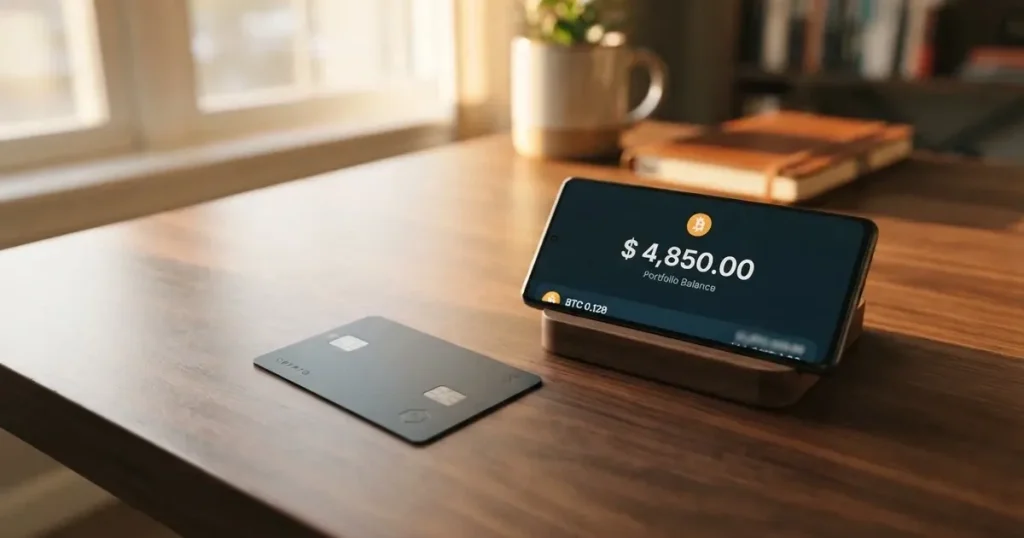
Most crypto payment cards work the same way: you convert something into a fiat or stablecoin balance, load it, and the card spends that balance. Anodos takes a different route. You lock crypto as collateral in a wallet you control, and the card gets a spending limit equal to that collateral. Nothing is sold, nothing is converted into a stored balance, and if the market moves against you, the position can be liquidated. That design is genuinely useful for some people and genuinely unsuitable for others, and which one you are decides most of this review.
I scored it 7.2 out of 10. The number is not flattering enough to hide the sharp edges, and not low enough to dismiss it, because the edges here are mostly the direct consequence of the idea rather than sloppiness.
The conditions described below are current as of October 28, 2026.
Verdict: 7.2 out of 10, and who it is actually for
Anodos suits the holder who already keeps crypto in their own wallet, on their own terms, and wants to spend it without triggering a sale every time they buy groceries. If that is you, the collateral model is the strongest thing on offer in this category, because non-custodial means Anodos and its issuer never take possession of your coins — the terms say so in as many words.
It does not suit anyone who wants a simple prepaid card, anyone who needs to spend more than a few thousand dollars a month, anyone who needs cash from ATMs with any regularity, or anyone living in one of the seventeen countries where cards cannot be issued to residents.
| Criterion | Mark | Why |
|---|---|---|
| Who can get it | 9 / 10 | Available in 150+ countries with a few exceptions; closed to residents of 17 countries including Russia, Belarus, China, India, Turkey, Ukraine |
| Cost | 7 / 10 | Free tier at $0, first virtual card free, FX 1.50%, ATM $1.00 + 1.75%; Pro $9.99/mo, Elite $29.99/mo |
| Top-up options | 6 / 10 | No top-ups by design — collateral locked in your own wallet on Ethereum, Polygon, Optimism, Arbitrum; coins not listed |
| Reliability and complaints | 6 / 10 | Anodos Labs Inc. is not a bank, issuer is Third National, Visa licence; no complaints found |
| Everyday use | 7 / 10 | Physical or virtual card, ATM limited to $5,000/mo on Free; Apple Pay and Google Pay not disclosed |
| Total | 7.2 / 10 | A well-built card for one specific kind of user, held back by an unfinished document and an undisclosed coin list |
Two things move that number most. The upside is reach: 150+ countries with a card that runs on Visa rails and never holds your collateral. The downside is that the fee schedule is generous but the disclosure is thin, and a document that still contains a bracketed placeholder is a document that was not finished being reviewed.
Who will they actually issue the card to
The card is currently available in 150+ countries, with a few exceptions. The exceptions are listed by residence, and they are long: residents of Belarus, China (Mainland), Cuba, India, Iran, Iraq, Israel, Myanmar, Nepal, Nicaragua, North Korea, Russia, Syria, Turkey, Ukraine, Venezuela and Vietnam cannot be issued cards. Chinese and Hong Kong passports are not eligible. Nigeria, Sri Lanka and South Africa are possible but only with “enhanced review + explicit approval”, which in practice means you may simply be refused.
Spending is also blocked in Cuba, Iran, North Korea, Russia, Syria, Ukraine and Venezuela, which is a different list from the issuance one and slightly shorter. That distinction matters if you travel: a card issued in a permitted country can still be declined in a country where cards simply are not issued.
Russia gets called out specifically in the card’s own terms: cards cannot be issued to residents, and cannot be used for spending there. Belarus is named for issuance. I would not read these as starting points for workarounds — they are statements about who the issuer will contract with, and the surrounding law in each of those countries is separate from anything the card says.
One more condition worth reading twice: the terms require users to attest they are not US citizens, because the international programme is for people outside the United States. A separate US programme exists in 30 US states. So “is the Anodos card available in my country” has two answers depending on where you live and what passport you hold, and both answers have to be true.
How to get it
The card terms describe no KYC process. That is not a euphemism for an easy one — it means the public terms simply do not say what identity checks are run or how far they go, so you cannot plan around a known standard. What the terms do say is that you must provide “true, correct, and complete” information. Age is not stated. Personal, family or household use only — no business accounts through this card.
The actual sequence is short. You link a wallet, lock collateral in it, and that sets your spending limit. Physical or virtual cards are available, issued under licence from Visa. Foreign-currency transactions are converted to USD by the card network, which is the single most important operational fact about using this card abroad and I return to it in the cost section.
What is not stated is as notable as what is. Delivery times are not listed, and neither are replacement terms — the fee schedule has no line for a lost card, which for a physical product is a real gap. KYC levels, if any exist, are not described.
What it really costs: Fees, tiers and the arithmetic of a purchase
Three tiers, and the differences between them are narrow. The monthly fee is the headline; the FX rate is what you will actually feel.
| Fee or limit | Free | Pro | Elite |
|---|---|---|---|
| Monthly fee | $0 | $9.99 | $29.99 |
| Annual alternative | $0 | $99.90 | $299.90 |
| First virtual card | Free | Free | Free |
| Extra virtual card | $20 | $10 | $10 |
| Card FX / international fee | 1.50% | 1.25% | 1.00% |
| Currency exchange (non-card) | 1.00% | 0.75% | 0.50% |
| ATM fee | $1.00 + 1.75% | $1.00 + 1.00% | $1.00 + 0.75% |
| ATM monthly limit | $5,000 | $10,000 | $15,000 |
| Spending limit | Collateral value | Collateral value | Collateral value |
The account-level fee is $0 on Free, $9.99/mo or $99.90/yr on Pro, and $29.99/mo or $299.90/yr on Elite. First virtual card included free on all three; extras cost $20 on Free and $10 on Pro and Elite. Interest is 0% APR on purchases currently, late payment is “Up to $40”, and a returned payment is $29.00.
Now three everyday payments, because fees work differently depending on what you buy.
A coffee abroad, say $5 in a local currency. The card network converts the transaction to USD, then the international fee applies: 1.50% on Free, which is 7.5 cents. Rounding aside, your total cost of the coffee is $5.07 on the free tier and $5.05 on Elite. This is the case where the tier choice barely matters.
A $200 online purchase in a non-USD currency is where the FX fee earns its place in the table: 1.50% is $3.00 on Free, $2.50 on Pro, $2.00 on Elite. Pro’s $9.99 monthly fee is recovered by this single purchase and then some — which is the arithmetic that makes Pro sensible for anyone actually travelling on this card.
Withdrawal from an ATM costs $1.00 plus 1.75% on Free, so a $200 cash withdrawal is $4.50 in fees. Here is the catch: the same terms also state “Cash advances and balance transfers are not available”. Those two statements sit in one document and pull against each other. If cash is not actually a feature you need, the contradiction costs you nothing — but if it is, you must ask support before you rely on it.
The limit structure is the part most people will feel first. Your spending limit equals your collateral value — $100 of collateral supports a $100 limit, across all cards — and those limits are “dynamic and may be modified at any time”, including reduction to $0. Daily limits are not stated. So the limit is not a number you set and keep; it is a number the issuer can move.
How to top it up: you don’t, and that is the design
There is no top-up function here, and asking for one is asking for a different kind of card. This is a collateral model. The funds that back your limit are crypto you already hold, locked in a wallet that stays yours.
The supported blockchains are Ethereum, Polygon, Optimism and Arbitrum — written “Arbitrium” in the terms, a small typo that tells you these documents were written quickly — or others the issuer adds later. The coins accepted are not listed. That is a genuine gap, and it is the first thing I would ask: if the token you hold is not on an unnamed internal list, the card is irrelevant to you no matter how good the rest is.
Because there are no top-ups, there is no deposit fee in the fee schedule — nothing to charge. What you do pay is gas: gas fees on liquidation are paid from the collateral itself, not billed to you separately. In a bad week, that is a cost taken from the position that was already losing value.
Withdrawing is the one question the model answers cleanly. Not applicable to a collateral card: the collateral stays in your wallet. And on termination, the card must be surrendered or destroyed, while repayment obligations survive — closing the relationship does not close the debt.
Paying with it every day
Physical or virtual, on Visa, and foreign-currency purchases convert to USD through the network. That conversion is where the friction sits, and it is worth remembering that the network does the conversion and the issuer adds its own percentage on top; you are paying for two things, not one.
Apple Pay and Google Pay are not stated. I would read that as unknown rather than unsupported — the absence of a line in a document that does not describe its own app platforms proves very little — but for anyone who pays by phone constantly, this is a question to put to support in writing before you commit.
The app is described as the place to send, save and invest. Platforms are not stated and store ratings were not found, so I cannot tell you what it feels like to use or how well it is maintained.
Some transactions are treated differently. Cash-like transactions — crypto purchases, gambling, money transfers — may be restricted. This is standard: the merchant category code is a four-digit number classifying a business, and codes such as the one covering casinos, betting and lotteries get blocked by issuer policy rather than law, with the blocked list differing between issuers. If any of your spending depends on those categories, check before you rely on the card.
Rewards are not stated in the card terms. No cashback, no points, nothing claimed. A card that is this inexpensive on paper is not trying to compete on perks.
Disputes follow a normal path: try the merchant first, then report to the issuer no more than 60 days after the disputed charge is posted on your periodic statement. Two caveats the terms spell out — pending disputed charges may still be due, and card network rules apply on top. If you are disputing a crypto-funded purchase, the chargeback machinery still works; the question of how the disputed amount is reconciled against locked collateral is not something the terms explain.
What can go wrong
Start with the company, because it is not what people assume. Anodos Labs Inc. is the technology provider and says plainly that it is “not a bank, credit union, or money services business”. The issuer is Third National. The card runs under a Visa licence. The terms are governed by Puerto Rico law, and they commit you to binding AAA arbitration in New York — if you have a dispute, you are not going to be in a local court.
The document is also incomplete in parts. In a contract, an unfilled bracket is a small thing that makes everything around it slightly less certain: it means a party to the arrangement was not finalised at the time of writing, or was not named. Combined with the missing coin list, the unstated delivery terms and the ATM contradiction, it tells me these terms are maintained rather than reviewed.
On security, the good news is genuine and the terms state it directly: Anodos and the issuer “will not, in any circumstance, be holding custody of your Collateral”. You grant a security interest — a lien — over it. Non-custodial does not mean consequence-free. You carry sole responsibility for key loss, phishing and clipboard malware that swaps a copied address. Blockchain transfers are irreversible, so a deposit sent on the wrong network can be lost or need manual support recovery with no guarantee.
The liquidation mechanic is the thing to understand before you fund anything. If payment is not made “within one (1) calendar day”, or if the collateral value falls below your outstanding charges, a liquidation event is triggered — and gas comes out of the collateral. The account may be suspended or cancelled “in our sole discretion”. One calendar day is a short runway: it means a card payment that fails to clear can start unwinding your position almost immediately.
Two-factor authentication and in-app card freeze are not stated. Those are the two controls most people assume exist by default, and their absence from the documentation is worth a direct question.
Complaints: there are no official records of incidents or user complaints. The company has a thin online footprint, which cuts both ways: less exposure to disaster, but also less public track record to judge.
The country availability page was last updated on 26 September 2026, which is recent. Support is by email at [email protected] and by phone on +1 (307) 683-5768, with official pages on X, Discord, LinkedIn, Facebook, YouTube, Instagram and TikTok. Languages and hours are not stated.
One piece of category context, since a card programme can be closed rather than merely declined: card programmes typically give notice, then stop spending and loading, then ask users to withdraw remaining balances. WaveCrest, a Visa issuer that supplied several crypto card brands, was suspended by Visa in Europe in 2018 and all its Visa programmes were closed. Visa terminated its global agreements with FTX on 13 November 2022 and the FTX US debit card was wound down. These are the failure modes a crypto card can suffer that a bank card cannot.
What to take instead
Three alternatives came up in my comparison, and they sit on different axes. One is barely a card yet; one is priced for volume; one is a rewards play.
| Anodos | Sponge | Xplace | ether.fi | |
|---|---|---|---|---|
| Score | 7.2 / 10 | 4.9 / 10 | 7.7 / 10 | 6.7 / 10 |
| Model | Collateral, non-custodial | USDC moved from wallet | Cash mode or Credit mode | Collateral in a Safe, or Direct Pay |
| Country reach | 150+ countries, 17 closed | No country list published | Not available in all jurisdictions | Listed jurisdictions only, plus 31 US states |
| Card | Physical or virtual, Visa | Virtual, Visa | Virtual instant, physical Silver live | Virtual and physical, Visa |
| Fees | FX 1.50% down to 1.00% | Not stated | 0% FX on Platinum, others not stated | FX 0.5% Core to none at top tiers |
| Rewards | Not stated | Not stated | Cashback 0.5%–2% by tier | ETHFI cashback, tiered caps |
Sponge is the weakest of the group at 4.9 out of 10, and it is weak on disclosure rather than design. No country list on the card pages, no costs, no fees, no rewards stated. The mechanism is USDC collateral moved from the Sponge wallet with a card fund command, with base as the example chain. If you are comparing cards and one of them will not tell you what it charges, that is your answer.
Xplace scores 7.7 and targets a different wallet: spendthrift, not saver. It offers Cash mode, which spends a stablecoin balance, and Credit mode, which borrows against holdings with no origination fee. Pricing is annual — Basic free, Silver $99/year, Gold $249/year, Platinum $999/year — with 0% FX on Platinum. Funding is on Solana, accepting BTC (cbBTC), ETH (wETH), SOL, JitoSOL, USDC, USDT and xStocks. Credit-mode cashback runs 0.5% to 2% by tier, paid in USDC at settlement. Worth it if you spend in volume and want the fee to disappear; not worth it if you want the first card free.
ether.fi scores 6.7 and is the most rule-bound. It issues only in listed jurisdictions — Andorra, Argentina, Australia, Austria, Brazil, Canada, Cyprus, Czech Republic, France, Germany, Hong Kong, Hungary, Italy, Japan, Mexico, Poland, Portugal, Singapore, Spain, Switzerland, UAE, UK, plus 31 US states — with Belgium and Ireland eligible without physical delivery, and the terms are blunt: if your jurisdiction is not listed, you cannot apply. FX runs 0.5% on Core, 0.25% on Luxe, none on Pinnacle and VIP, with EUR purchases at 0%. Its cashback is the most elaborate in the group, paid in ETHFI locked for seven days, tiered by monthly spend caps. The free virtual card is the catch: the first one costs $10 in regional-pricing countries including Mexico, Nigeria, South Africa, the Philippines and Thailand. ATM withdrawals are blocked in North Korea, Iran and Myanmar.
The honest summary: if your collateral is non-custodial and your country is broad, Anodos wins. If you want annual-fee economics on heavy spend, Xplace is stronger. If you want rewards, ether.fi pays more. If you want answers to basic questions, Sponge is not ready.
Who I would recommend it to
I would recommend this card to one person in particular: someone who already holds crypto in a self-custody wallet, has no access to an ordinary bank card in their country of residence, and spends from that balance monthly rather than weekly. For them, Anodos does something no prepaid crypto card does — it puts a Visa number against assets that never leave their control, at zero account cost, in a country list 150 entries long.
I would not recommend it to someone whose income is in fiat and whose crypto is speculative. The liquidation rule bites hardest exactly when it matters most: a market fall reduces your limit and can trigger unwinding of your position, on a one-calendar-day clock, with gas paid from the collateral. That is a different risk profile from losing money on an investment, and it deserves to be understood as one before you fund the card.
The short checklist before you deposit anything: confirm your token and network are supported — the coin list is not published, so this is an email to support, not a page to read. Ask what happens to ATM access, given the contradiction in the terms. Ask how liquidation is calculated and what grace period applies in practice. And if the Free tier’s 1.50% FX is your main cost, run one realistic month of purchases through Pro’s arithmetic before deciding.
Frequently asked questions
What is the Anodos card?
Anodos is a Visa payment card that draws on crypto you already hold, rather than on a stored balance. You lock crypto as collateral in a wallet you control, and the card gets a spending limit equal to that collateral — $100 of collateral supports a $100 limit. Nothing is sold to make a purchase and nothing is converted into a prepaid balance. Physical and virtual cards are both offered, issued under licence from Visa.
How does Anodos card work in practice?
You link a wallet, lock collateral in it, and that collateral sets your spending limit. The card then spends against that limit the way any Visa card spends against an account. Foreign-currency transactions are converted to USD by the card network, and your tier’s international fee applies on top. The collateral stays in your wallet throughout — Anodos and the issuer say they never hold custody of it, and you grant them a security interest over it instead.
Is Anodos a bank?
No, and the card’s own terms say so: Anodos Labs Inc. is “not a bank, credit union, or money services business”. It is the technology provider. The issuer is Third National, and the card runs under a Visa licence. So the money side of the relationship is with the issuer, not with Anodos. The terms are governed by Puerto Rico law and provide for binding AAA arbitration in New York.
Which countries can I get the card in?
Currently 150+ countries, with exceptions. Cards cannot be issued to residents of Belarus, China (Mainland), Cuba, India, Iran, Iraq, Israel, Myanmar, Nepal, Nicaragua, North Korea, Russia, Syria, Turkey, Ukraine, Venezuela or Vietnam. Chinese and Hong Kong passports are not eligible, and Nigeria, Sri Lanka and South Africa need enhanced review plus explicit approval. Spending is separately blocked in Cuba, Iran, North Korea, Russia, Syria, Ukraine and Venezuela.
Does Anodos card require KYC?
The card terms describe no KYC process, so the public documentation does not tell you what identity checks apply or how deep they go. What is stated is that you must provide “true, correct, and complete” information, that age is not specified, and that the card is for personal, family or household use only. The international programme also requires you to attest that you are not a US citizen.
How do I top up the Anodos card?
You do not, and that is the design rather than an omission. This is a collateral card: there are no top-ups, so there is no deposit fee in the fee schedule. Supported blockchains are Ethereum, Polygon, Optimism and Arbitrum, or others the issuer adds — though the terms do not list which coins are accepted, which is the first thing to confirm by email. Gas fees on liquidation are paid from the collateral itself.
What does it cost to use the card day to day?
On the free tier the account fee is $0 and the first virtual card is free, but the card FX and international fee is 1.50%, currency exchange outside the card is 1.00%, and ATM withdrawals cost $1.00 plus 1.75%. Pro costs $9.99/month with FX at 1.25%, and Elite $29.99/month with FX at 1.00%. Interest is 0% APR on purchases currently; late payment is up to $40 and a returned payment is $29.00.
Can I use Anodos card at Apple Pay or Google Pay?
The terms do not say either way. Apple Pay and Google Pay support is not stated in the card documentation, and the app’s platforms are not stated either. I would treat this as unknown rather than unsupported, since the documents are silent on much beyond fees and limits. If paying by phone is how you spend daily, ask support directly before committing — and keep the physical card as the fallback until you have tested it.
Is Anodos card safe?
The custody answer is the strong one: the terms state that Anodos and the issuer “will not, in any circumstance, be holding custody of your Collateral”. The risk is on your side of that trade. You are responsible for key loss, phishing and malicious software that swaps copied addresses, and blockchain transfers are irreversible. If a payment is not made within one calendar day, or collateral value falls below outstanding charges, a liquidation event is triggered, with gas taken from the collateral.
Is the Anodos card worth it?
For the person it was built for — holding crypto in their own wallet, no ordinary card available, spending from it monthly — yes, and the free tier costs nothing to try. Against that, the coin list is not published, ATM terms contradict themselves, two-factor authentication and in-app freeze are not stated. I would fund it modestly, test the payments you actually make, and scale up only once those questions are answered.
Credit and cashback cards on the shortlist – cryptocardshortlist
Content created by the «cryptocardshortlist» team