
A crypto card built for creators, not for everyday spending
 Available in US
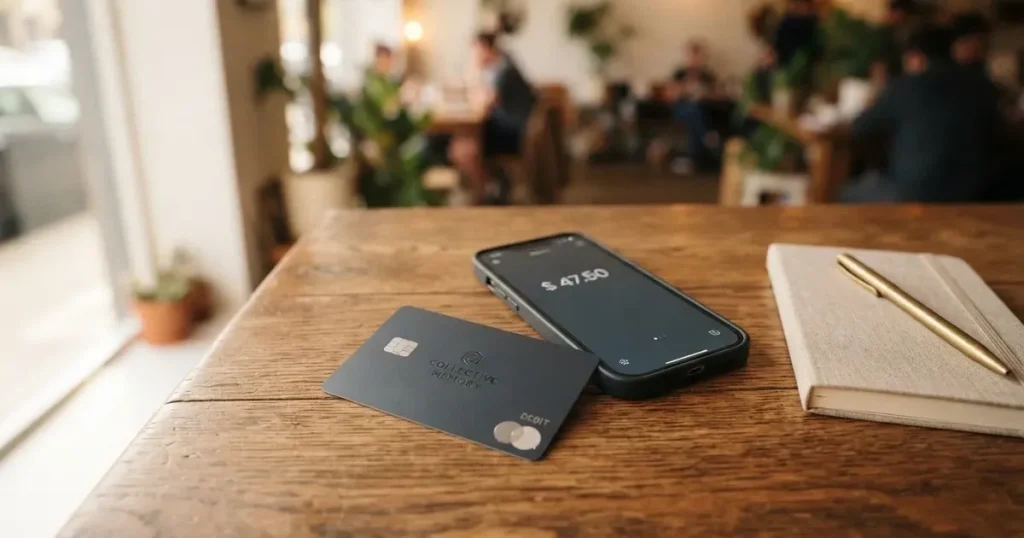
The Collective Memory card promises something quite specific: turn your ATTN token earnings into everyday spending without going through an exchange. That promise is real, and for a creator already earning ATTN the card makes sense. But outside that narrow circle, it runs into the same walls as every other new crypto card: no published fees, no confirmed limits, no named issuing bank, and a top-up route that goes one way only. I checked the card’s public announcements and documentation as of the conditions line below, and this is what I found. My score for it is 6.1 out of 10 — perfectly usable if you are already earning ATTN, frustrating if you are not.
Conditions are current as of October 28, 2026.
Verdict: 6.1 out of 10, and only for a specific person
The card does what it says for its intended user and does little else. The core problem is not that Collective Memory built a bad card — it is that almost everything a cardholder needs to know is missing from the public pages. No pricing figures. No daily spending limits. No named issuer or licence. The card’s strongest argument is its simplicity: your ATTN converts to USDC at the point of sale and the purchase goes through, with no prefunding step. Its weakest is that it only works one way.
Who it suits: creators who earn ATTN from staking their content and want to spend those earnings directly, without selling tokens on an exchange and waiting through banking hours. If you are in an eligible country and your income already arrives in ATTN, this card removes a genuine friction.
Who it does not suit: anyone looking for a general-purpose spending card, anyone who needs to add money from an external wallet or bank, anyone who wants cashback, and anyone who needs to know what a purchase costs before they make it. If you hold ordinary currency and want to spend it, this is not the card.
| Criterion | Mark | Reason |
|---|---|---|
| Who can get it | 7 / 10 | A long country list across North America, Europe, Asia, Latin America and the Middle East, including Georgia, Kazakhstan, Turkey, United Arab Emirates, Ukraine |
| Cost | 5 / 10 | No figures published; the release promises “transparent pricing and competitive FX rates” without numbers |
| Top-up options | 4 / 10 | Only the ATTN balance: Liquid ATTN converts to USDC and is spent immediately; no external-wallet deposits |
| Reliability and complaints | 7 / 10 | Runs on Wirex Banking-as-a-Service; Wirex describes itself as a principal Visa and Mastercard member; issuer and licences not disclosed; no complaints found |
| Everyday use | 7 / 10 | Virtual and physical cards, Apple Pay and Google Pay; ATM details not disclosed |
| Total | 6.1 / 10 |
The middle of that table matters. Every “not stated” is a real gap a cardholder would hit on day one, not a technicality.
Will they give you the card?
A wide list, but the basis of eligibility is unclear.
Eligible: United States; Andorra, Austria, Belgium, Bulgaria, Croatia, Cyprus, Czech Republic, Denmark, Estonia, Finland, France, Germany, Gibraltar, Greece, Hungary, Iceland, Ireland, Italy, Latvia, Lithuania, Luxembourg, Malta, Monaco, Montenegro, Netherlands, Norway, Poland, Portugal, Romania, Slovakia, Slovenia, Spain, Sweden, Switzerland, United Kingdom; Australia, Hong Kong, Indonesia, Malaysia, Philippines, Singapore, Taiwan, Thailand, Vietnam; Argentina, Brazil, Chile, Colombia, Ecuador, Mexico, Peru; Azerbaijan, Bahrain, El Salvador, Georgia, Ghana, Guernsey, Isle of Man, Israel, Japan, Jersey, Kazakhstan, Kenya, Macao, Moldova, Nigeria, Oman, Panama, Saudi Arabia, South Africa, South Korea, Turkey, Uganda, Ukraine, United Arab Emirates, Uzbekistan.
Russia and Belarus are not on the list. Whether eligibility runs on citizenship or residence is not stated — and that distinction matters. If you live in an eligible country but hold a passport from a restricted region, some providers will still decline you. Others treat address alone as sufficient. You will only find out by applying.
If your country is missing from that list, you are not eligible and there is no waiting period that will change that.
How to get it
The path is straightforward; the paperwork is the question.
Collective Memory announced the Wirex partnership on 2026-02-11, with the EU and UK launch planned from March 2026 behind a waitlist. By May 2026 the card was rolling out across eligible countries, with new withdrawal terms taking effect from May 18 that year.
As for verification: the identity-check requirements are not stated in the documentation I read. That is unusual. Most card providers spell out what they need — passport, proof of address, selfie — and what tier of verification you are signing up for. Here you get nothing. Expect to provide some form of government ID and a selfie, because the underlying issuer almost certainly requires it, but do not treat my expectation as a description of their process.
The card itself is offered in virtual and physical debit forms, per the February 2026 release. The card network is not stated and neither is the card currency. Delivery timelines are not stated either — how long the physical card takes to arrive is simply not on the public pages.
The app is available at collectivememory.ai/get-app. Store ratings I did not check, so I cannot tell you what other users say about it.
What it really costs: fees
This is the section where the card is most silent, and it is the section you should read most carefully.
The release says “transparent pricing and competitive FX rates”. There are no figures anywhere behind that sentence. Issuance cost: not stated. Monthly fee: not stated. Conversion fee: not stated. FX rate markup: not stated. ATM withdrawal fees: not stated. Daily and monthly spending limits: not stated. Whether there are card tiers with different pricing: not stated for the card.
| Fee or limit | What the card publishes |
|---|---|
| Issuance fee | Not stated |
| Monthly fee | Not stated |
| Conversion fee (ATTN to USDC) | Not stated |
| Foreign exchange rate | “Competitive”, no figure |
| ATM withdrawal | Not stated |
| Daily spending limit | Not stated |
| Monthly spending limit | Not stated |
| Card tiers | Not stated for the card |
What this means in practice: you cannot calculate what a purchase costs before you make it. You will find out the effective rate after the fact, from your balance. For small purchases where you already hold the balance in USDC after conversion, the cost to you may be minimal. For larger or cross-currency purchases, you have no way to preview the number.
Two everyday payments, to show where this bites:
A coffee in euros. If your ATTN converted to USDC and your card spends a USDC balance, the euro purchase involves a currency conversion whose markup you cannot see. The charge goes through; you just cannot predict the rate.
An online purchase in dollars. If your balance is already in USDC, the conversion step has already happened at the point of sale, so the cost depends entirely on the ATTN-to-USDC rate at that moment — again, undisclosed.
A card that says its pricing is transparent but shows no numbers is asking for trust rather than earning it. Compare that attitude to a provider that publishes a full fee table.
How to top it up
This is the card’s defining constraint, and it is the reason its score on top-ups is the lowest in the table above.
The funding model works like this: Liquid ATTN is converted to USDC and used immediately through the card. The release describes conversion happening at the point of sale with no prefunding step. You do not load the card; you spend from what your tokens are worth.
When you withdraw, the split is 50/50 between Liquid and Savings ATTN, and only the Liquid half is usable. So half of a withdrawal is stranded in the Savings side, out of reach for spending. Withdrawal cycles also shortened from 30 to 14 days, effective May 18, 2026 — better than before, still slow.
This is not a deposit card. It is funded from ATTN earnings, not from a bank balance. The release mentions EUR and USD IBAN accounts, but fees on those are not stated and their role in funding the card is unclear.
The off-ramp — getting your money out to local currency — works like this: ATTN swaps to USDC in the app wallet and you send it to an external provider for local currency. The in-app off-ramp is marked “coming soon”, which means as of now you depend on a third party for cashing out.
The practical question for you: can you add money to this card from outside? The answer is no. There is no external-wallet deposit, no bank transfer route into the card balance. Your spending is capped at whatever your ATTN holdings convert to at the moment of purchase. If you are not an ATTN earner, this card is functionally closed to you.
Paying with it every day
Solid basics, with a few blanks.
Apple Pay and Google Pay are supported, per the release, so you can pay by phone at a counter without touching plastic. Whether any merchant categories are blocked — gambling is the one crypto card issuers most commonly restrict — is not stated.
There is no card cashback stated. This is not an oversight in the sense of a missing perk; it is a structural feature. The reward here is not a percentage back on your spending but the ATTN tokens you earn from staking your content. If you are not a creator on the platform, there is no reward mechanism at all.
Dispute handling — what happens when a charge is wrong, when goods never arrive — is not stated. Chargeback rights also depend on the card’s status as prepaid versus debit, which is not disclosed.
So: virtual and physical cards, tap-to-pay on both major mobile wallets, no cashback, no disclosed blocked categories, no disclosed dispute process.
What can go wrong
Three risks, one of them structural.
The one-way funding trap. You can spend ATTN but cannot add external funds. If your ATTN balance drops, your spending drops with it, and there is no way to refill the card from a bank account or another wallet. This is by design, and it makes the card useless for anyone whose income is not in ATTN.
The fifty percent withdrawal problem. Half of every withdrawal lands in Savings ATTN and stays there. If you withdraw regularly, you are slowly converting your liquid position into an illiquid one.
The disclosure gap. The issuing entity and the licences covering this card are not stated. The card runs on Wirex’s Banking-as-a-Service platform; Wirex describes itself as a principal Visa and Mastercard member. That tells you who processes the card, not who is legally responsible for your balance or under which regulator’s rules it is held. When a provider does not name its issuer, you cannot check that issuer’s regulatory status, and you cannot know which deposit-protection or e-money safeguards — if any — apply to your funds.
On reliability: I found no complaints. No official incident notices, no Trustpilot or Reddit results for this card in a single search. But absence of complaints on a young card is weak evidence — it may simply reflect a small user base rather than a clean record. Support is by email at [email protected] for technical questions; the languages it operates in and its hours are not stated.
What to take instead
Three cards with published numbers, compared against this one.
| Collective Memory | MetaMask | KAST | TokenPocket | |
|---|---|---|---|---|
| Score | 6.1 | 7.1 | 6.1 | 5.8 |
| Card fees published | No | Yes | Yes | Partly |
| External funding | No | Yes | Yes | Yes |
| Cashback | None | 1% virtual, up to 3% metal | 1.5%–3% by tier | None |
| ATM details | Not stated | Not stated | Not stated | Not stated |
MetaMask (7.1/10) is the clearest alternative for general spending: proof of residency required, sign-up open across 45 listed countries and territories, US and UK sign-ups temporarily closed per their FAQ. Virtual card free with no annual or maintenance fee; metal card $199/year. Spends directly from a connected wallet across Linea, Base, Monad and Solana. Cashback in mUSD: 1% on virtual, up to 3% on metal for the first $10,000 spent.
KAST (6.1/10) publishes the most complete fee schedule of the four: stablecoin top-up 0%, card spend in USD 0%, transaction fee 0%, Apple and Google Pay 0%, non-USD FX fee 0.5%–1.75% depending on your country. Membership runs from free (Standard) to $1,000/year (Premium) to $10,000/year (Private), with cashback from 1.5% to 3% by tier. Note its residence-based KYC: if you live in a supported country but hold an ID from a restricted region, you may still fail.
TokenPocket (5.8/10) charges 1% on crypto deposits, refunded later via rewards, with no additional fees otherwise. Its card runs on Arbitrum.
The honest comparison: if you are not an ATTN earner, any of the other three gives you a card you can fund from outside and, in MetaMask’s and KAST’s cases, fees you can read before you commit.
Who I would recommend it to
Two groups, and only two.
If you earn ATTN from staking content on Collective Memory and already live in an eligible country, this card is built for you. The point-to-spend conversion removes the exchange step, and the physical and virtual options plus mobile wallets cover normal daily life. Understand that half of every withdrawal is stranded and that you cannot add money from elsewhere.
If you are looking at this as a general spending card, in any currency other than what your tokens convert to, I would look elsewhere — at MetaMask or KAST, which publish their fees and accept external funding.
And before you commit either way, ask Collective Memory the questions their pages leave open: what does a purchase cost, what are the limits, who is the issuer, and what happens if the company has trouble. A provider that answers those clearly earns more of my trust than one that promises transparency in a press release.
Frequently asked questions
What is the Collective Memory card?
It is a debit card — virtual and physical — that lets Collective Memory platform creators spend the ATTN tokens they earn from staking their content. Liquid ATTN converts to USDC at the point of sale and the purchase goes through directly, with no prefunding step. The card runs on Wirex’s Banking-as-a-Service platform. It is not a general-purpose card you can load from a bank account.
How does the Collective Memory card work?
Your ATTN balance converts to USDC when you make a purchase, and the card spends that value directly. You do not load the card first. When you withdraw, the balance splits 50/50 between Liquid and Savings ATTN, and only the Liquid half is usable for spending. The in-app off-ramp to local currency is marked “coming soon”.
Is Collective Memory a bank?
No. Collective Memory is a decentralized social platform, and the card is powered by Wirex’s Banking-as-a-Service offering. The issuing entity and the licences covering this specific card are not stated in the public documentation. That means you cannot verify which regulator’s rules cover your balance.
Who owns Collective Memory?
Collective Memory describes itself as a decentralized social platform rather than a conventional company with owners. The card programme is delivered through Wirex. Neither the ownership structure of the platform nor the legal entity behind the card is clearly set out on the pages I read.
Does the Collective Memory card require KYC?
The identity-check requirements are not stated in the documentation I read. As a general rule, cards issued through regulated partners require government ID and sometimes proof of address, and EU rules require customer due diligence including a sanctions check. But I cannot tell you what Collective Memory specifically asks for — you would need to ask them or find out during sign-up.
How do I top up the Collective Memory card?
You cannot, from outside. The card is funded from your ATTN earnings, not by deposits. Liquid ATTN converts to USDC and is spent immediately. There is no external-wallet deposit route and no bank transfer into the card balance. Your spending is limited to whatever your ATTN holdings are worth at the moment of purchase.
Can I use the Collective Memory card in my country?
Only if your country is on the eligibility list, which covers the United States, much of Europe, Australia and parts of Asia, Latin America, and the Middle East and Africa — including Georgia, Kazakhstan, Turkey, the United Arab Emirates and Ukraine. Russia and Belarus are not listed. Whether eligibility is based on citizenship or residence is not stated, which matters if your passport and your address point to different places.
Is the Collective Memory card free?
Nobody will tell you, and that is the honest answer. The card’s own announcement promises “transparent pricing and competitive FX rates” but publishes no figures — no issuance fee, no monthly fee, no conversion rate, no ATM charges. Do not assume it is free; assume you will find out the cost at the point of purchase instead of before it.
Does the Collective Memory card offer cashback?
No card cashback is stated. The reward model is different: creators earn ATTN tokens from staking their content, and those tokens are what the card spends. If you are not a creator earning ATTN, there is no reward mechanism for you at all. For a card with actual cashback, look at MetaMask or KAST.
Is the Collective Memory card safe?
There is no way to give you a clean yes or no, and I would be wary of anyone who does. No complaints surfaced in my search, which is mildly reassuring but weak evidence for a young card. The release claims non-custodial control; two-factor authentication and card freeze are not stated. The structural risks are real: you cannot add funds if your balance empties, half of every withdrawal is locked in Savings ATTN, and the issuer behind the card is not named.
Wallet cards on the shortlist – cryptocardshortlist
Content created by the «cryptocardshortlist» team