
A crypto card with three virtual options, no ATM withdrawals and almost nothing stated in public
 Available in US
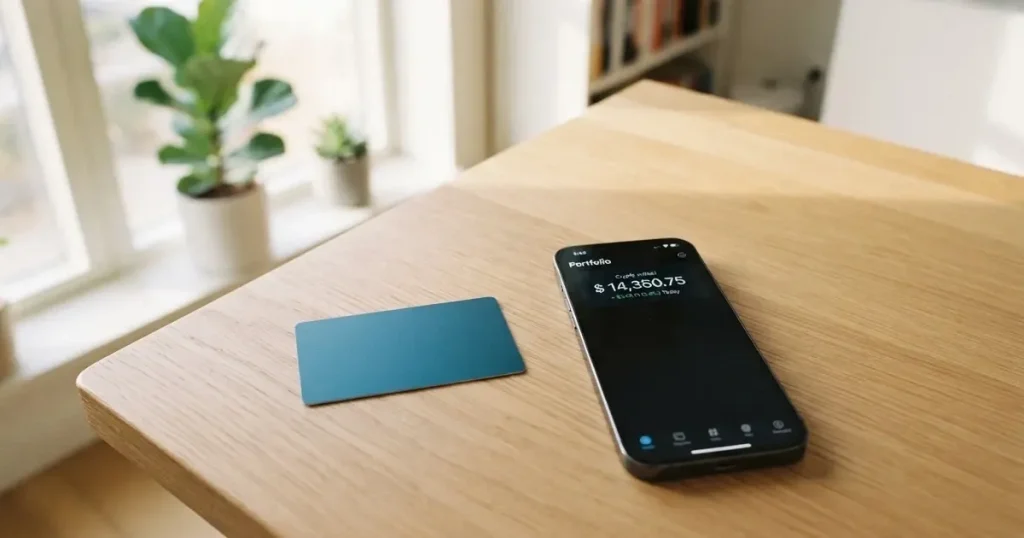
Card.Club is a crypto payment card aimed, in practice, at users who want several virtual cards they can load with stablecoins and spend on subscriptions and travel. On paper the shape of the product is sensible: three cards with different jobs, a card currency you can pick, mobile wallets on the travel card, and a plastic Visa for people who want something in their hand. In practice, almost none of that is stated by the company itself. The public website is empty. Everything I can tell you about eligibility, identity checks, card issuance, fees, limits and support comes from third-party sites and from user reviews — and the official side has not confirmed any of it.
That single fact colours the whole review. My score is 5.0 out of 10. It is not a bad product by the standards of this category, which is full of far shakier things. It is a product with a documentation problem serious enough that you would be making a financial decision on the word of strangers.
The conditions described below are current as of October 28, 2026.
| Criterion | Mark | Why |
|---|---|---|
| Who can get it | 7 / 10 | Unofficial sources say the card cannot be used in countries on the US sanctions list; the official site states nothing at all |
| Cost | 3 / 10 | Unofficial: issuance $20, $35 or $100; top-up from 4%; $0.25–0.50 per payment |
| Top-up options | 5 / 10 | Unofficial: SBP in rubles or USDT on TRC-20 and ERC-20 |
| Reliability and complaints | 5 / 10 | Unofficial: Webrex Co., Ltd, issuers unnamed; Trustpilot 3.7/5 on one review, crmindex.ru 4.8 on 35; complaints about fees |
| Everyday use | 5 / 10 | Unofficial: three cards, Apple Pay and Google Pay only on travel, a plastic Visa exists, no ATM support |
| Total | 5.0 / 10 | A workable product you cannot verify |
Who this card suits, and who it does not
The intended user, if I read the design correctly, is someone who pays for a lot of online subscriptions in a currency their own bank will not serve well, and who occasionally travels and wants a card that works in Apple Pay without the anxiety of a large balance sitting behind it. Three separate virtual cards is a genuinely good idea for that person: you can put the streaming bill on one, the travel spending on another, and keep the third quiet. People who want several virtual cards for subscriptions and travel are exactly the group this product is shaped for.
Who it does not suit is longer. If you need cash from an ATM, it is out — cash withdrawal is not supported. If you want a card whose issuer, fee schedule and complaint route are written down somewhere you can point at, it is out. If you are in a country under US sanctions, or travelling through one, the unofficial position is that the card will not work there at all. If you plan to hold a large balance on the card, the advice circulating is not to. And if you want to be able to withdraw your own money without asking permission, that is a support conversation rather than a button.
Will they give you the card?
Here is the honest answer: it looks broadly available, with a sanctions exclusion, and the company itself tells you nothing. The official site, at the time I checked, does not state eligibility at all — the page is empty. An earlier check of the company’s own card description put it as available worldwide except countries sanctioned by the United States, with Russia and Belarus named among them.
The unofficial picture, from third-party card directories, is that cards cannot be used in countries on the US sanctions list. The same sources add two things that matter more than the eligibility line itself: disputes are governed by British Virgin Islands law, and Russian-law consumer protection does not apply to you here. That is a big deal and it is easy to skim past. It means the ordinary backstop you might reach for in a dispute does not exist, and the rulebook is one you have probably never read.
Why does the sanctions point come up at all? Because of how these cards are built. The number on the front of every card starts with an issuer identification number — six or eight digits that tell any merchant or payment processor which institution issued it and where. Merchants can look that up. When the issuing country differs from the billing address on file, some merchants apply extra scrutiny, and a card issued in one country can look foreign to a shop in another. Sanctions screening is applied not only to where you live but to your nationality and country of birth, which is why a card can be refused to a person sitting in one country.
So the honest question is not “will they give me the card” but “will the card work everywhere I go”. Check both before you commit money to a top-up.
How to get it
The application is described by third parties as quick, and slow at exactly the same time. The official site says nothing about how to apply, what documents you need, or what levels of verification exist.
What unofficial sources describe is this: full access may require a passport, proof of address and sometimes a selfie, with a check taking one to two days. The same verification procedure is used to release a balance from a blocked or closed account — which tells you something important about how the company thinks about access to your own money. Once approved, issuance is described as taking five minutes, through an app or a Telegram bot. Apps for iOS and Android and a Telegram bot are mentioned by third parties, though I found no store listing when I searched.
That combination — two days of checks, then five minutes to issue — is normal for this category and not a red flag in itself. Identity checks like these exist because regulated businesses are required to verify customers and assess risk under anti-money-laundering and counter-terrorism-financing law. In the EU that due diligence covers name, address, date of birth, nationality, identity documents, a sanctions check, the purpose of the relationship, and whether you are a politically exposed person. If it cannot be completed, rules require the institution to decline the transaction or relationship, and where necessary end an existing one. That is exactly why accounts get frozen pending documents. It is the system working, not a trick aimed at you.
The cards themselves, again unofficial: a “For subscriptions” Mastercard on a Singapore BIN with no Apple Pay; a “For travel” Mastercard on a US BIN with Apple Pay and Google Pay; and a plastic Visa. Card currencies are USD and EUR. Delivery details for the plastic card are not published anywhere I could read.
Fees: what it really costs
Cheap to hold, not cheap to use. The official site publishes no fees. Everything below comes from third-party sources, and there is a genuine conflict in the reporting.
| Fee or limit | What unofficial sources say |
|---|---|
| Issuance | $20 for the subscriptions card, $35 for the travel card, $100 for the plastic Visa |
| Monthly servicing fee | Free |
| Top-up commission | From 4% |
| Per-payment fee | $0.25–0.50 (unofficial figure), including declined payments |
| FX / conversion | Double conversion when you pay in a currency other than the card currency |
| ATM | Cash withdrawal not supported |
| Limits | A minimum top-up of $25; limits exist on a single payment and on monthly volume, amounts not published |
There is a real disagreement about the issuance fee. One directory lists issuance as free; another records a reviewer paying 35 EUR on 25 March 2026. Both cannot be right in the same month. My working assumption is that the 20/35/100 figures are closer to reality because they are specific and internally consistent with three distinct card products, but I would not build a budget on that assumption without confirming it yourself.

Let me walk three ordinary payments through, because that is where the fee structure actually bites.
A $12 monthly subscription in USD, paid on the subscriptions card. Top up: 4% or more of the amount. Payment (unofficial figure): $0.25–0.50, whether it succeeds or not. Currency: the card is USD, the merchant bills USD, so no conversion layer. This is the cheap case, and it is the case the card was built for.
A $60 dinner in Rome, paid on the travel card. The card is denominated in USD or EUR — pick EUR and this gets better. But the user complaint that circulates is double conversion: a currency conversion by the network on one side, and the card’s own conversion on the other. This is the fee people notice first and complain about most, and it is the one to watch hardest if you travel.
A declined payment. You are charged the per-payment fee anyway, according to the sources. So a merchant that declines your card — a gambling site, a game platform, a crypto purchase — costs you a small sum for the privilege of being turned down. That is worth knowing before you tap a card on something that will not work anyway.
The published limits are worth pausing on: a $25 minimum top-up (unofficial figure) is harmless, but the existence of single-payment and monthly caps with no published amounts means you could hit a ceiling you did not know was there. There is no monthly fee, no annual fee, no inactivity fee and no minimum balance to fight you — for a card you actually use, that part is genuinely clean.
How to top it up
Two routes, both crypto-flavoured, and you need to pick the network before you send anything. The official site does not describe funding at all.
Unofficial sources describe: SBP in rubles, or USDT. The USDT route runs on TRC-20 and ERC-20, through a Telegram Mini App or the iOS/Android app. Minimum top-up $25 in USD or EUR, at a 4% fee, funded by ordinary currency or by crypto in the app.
The practical point is TRC-20 versus ERC-20. They are different networks, and picking wrong can be expensive in a way that feels unfair. ERC-20 is the Ethereum token standard, and its fees — gas — are paid only in ETH, which means a wallet holding USDT and no ETH cannot send at all. Tron’s network prices transactions with bandwidth and energy instead, often burning TRX, which is usually why it is the cheaper option for a stablecoin transfer. Get this wrong, or send to an address belonging to another network, and the transfer is irreversible: the blockchain cannot freeze or return it, so recovery means support and luck.
One more thing about USDT specifically, since it is the currency most people will hold: it is a token built on multiple blockchains with reserves intended to back it one-to-one, but stablecoins are not guaranteed to hold their value. TerraUSD collapsed in May 2022, and USDC briefly lost its peg in March 2023 during the US banking crisis. Stablecoin is the sensible unit for a payment card, not a risk-free one.
Getting money off the card is the weakest part of the product. Withdrawal is described as support-only. A May 2026 reviewer reports that funds can be withdrawn only by contacting support. A balance left on a closed account needs to pass KYC first. That is a significant structural difference from an ordinary prepaid card, where you press withdraw and the money arrives.
Paying with it every day
Good for recurring online spending, patchy elsewhere. Nothing about everyday use is stated officially.
The mobile wallets are the useful part, and they are limited: Apple Pay and Google Pay work on the travel card only. Not the subscriptions card, and not on any card I saw described. That is odd, because subscriptions are exactly what people add to a phone wallet — but it is the reported behaviour.
Category blocking is the part that will surprise you. Blocked categories include games, gambling, crypto purchases and financial services, and the allowed set is decided by the issuing bank rather than by Card.Club. Gambling is blocked on many cards by issuer policy rather than by law, and each issuer has its own list — so a category that works on one crypto card can be refused on another. Some users also report ChatGPT payments being refused depending on the card’s region.
Why do declines happen so often with cards like this? Three reasons stack up. Merchants can look at the issuing country and the card type from the number prefix and decline prepaid or foreign-issued cards on sight. Address verification — comparing the numeric parts of the billing address you typed with the issuer’s records — is mainly offered in the US, Canada and the UK, and is generally unavailable for foreign-issued cards, which causes declines. And a declined authorisation can leave a hold on your funds for several days, typically up to seven, so the money can be unavailable even though you never spent it.
One positive note on security design: when you add the card to Apple Pay, the card number is replaced with a device-specific number stored in the Secure Element on the phone, never on Apple’s servers, and each payment carries a one-time dynamic code. The issuer can still restrict that tokenised number — blocking it on magnetic stripe, phone or website use — which is a feature, not a bug.
What can go wrong
No official incidents. Quite a lot of unofficial ones. I found no dated events from the company and no regulatory action. What I found was a pattern of small frustrations and one or two genuinely alarming stories.
Company and structure first, because it explains the rest: Webrex Co., Ltd is named as a technology platform, with the cards issued by unnamed licensed partner issuers. That is the standard architecture for this category. Visa and Mastercard do not issue crypto cards to consumers themselves — they license issuers and can suspend a programme. The crypto brand is often just the programme manager and the front end. If the partner issuer changes, or the network decides to end the agreement, your card can stop working on a timetable set by someone you have never heard of. It has happened: Visa terminated its global agreements with FTX on 13 November 2022 and the FTX US debit card was wound down by its issuer; WaveCrest, a Visa issuer that supplied several crypto card brands, was suspended by Visa in Europe in 2018, closing all its programmes. Typical closures give notice, then stop spending and loading, then ask you to withdraw your balance. One 2026 closure reported by a secondary source ended new loads on 8 July 2026 and spending on 8 August 2026 — single source, unconfirmed, and a useful illustration of how fast a balance can become stranded.
The complaints that recur, from user reports rather than the company:
- Recurring $10 charges from a Singapore merchant after a card reissue, refunded the same day after contact (19 June 2026).
- Game and subscription merchants declining the card (5 December 2025).
- ChatGPT refused depending on card region (10 February 2026).
- High commissions, across several reviews from 2025 to July 2026.
- One unreliable article calling the service a scam. I found nothing to verify that, and I would weight it accordingly.
Review scores are thin and split: Trustpilot 3.7 out of 5 from a single review, dated 18 January 2026 and positive, so it tells you almost nothing; CRMIndex 4.8 from 35 reviews; InoKarti 3.8 from 18 reviews.
The custody question deserves its own paragraph. This is a custodial setup — the provider holds the credentials, so you are trusting them completely. Control of crypto belongs to whoever holds the private key; a seed phrase is typically 12 to 24 words and anyone who obtains it can restore the wallet and spend the funds. Transfers are typically irreversible, and a stolen key has no built-in recovery because the network cannot freeze or return anything. Custodial platforms have a real record of failure: Mt. Gox (about US$350 million reported stolen, 2011–2014), Coincheck (about US$400 million, 2018), Ronin Network (US$625 million, 2022). None of those were fraud by the people running the exchange in the everyday sense — they were failures of key management and security.
Against that, the unofficial advice is not to keep large sums on the card, and I agree with it. Note also that a high decline rate can itself trigger an account block, which is a strange way to be punished for using the card as intended.
Support is described as a Telegram bot only, with reviewers praising how fast replies come. Fast replies are worth something. They are not a substitute for a published complaints procedure or a regulator you can approach.
What to take instead
Three alternatives came up in the same category, and all three are documented better than Card.Club. None is perfect; I am not recommending any of them blindly either.
| Card.Club | CardFlow | HyperCard | Card.fi | |
|---|---|---|---|---|
| Score | 5.0 / 10 | 4.9 / 10 | 4.7 / 10 | 6.6 / 10 |
| Who it is for | Not stated officially | Nigeria and “global users”; no exclusions stated | No country list published; App Store says accepted in 176+ countries | Ships to 200+ countries, excluding sanctioned countries |
| Card | Three cards: subscriptions, travel, plastic Visa | Virtual USD Mastercard, about 3 minutes | Prepaid, network not stated | Virtual and physical Classic, Premium, metal |
| Issuance | $20 / $35 / $100 unofficial | Free virtual card | Not stated | $49 Virtual Classic, $249 Virtual Premium |
| Ongoing fees | Top-up from 4%, $0.25–0.50 (unofficial) per payment | Not stated | Not stated | Top-up 1.5% + $1.00 (Classic) or 1% (Premium); FX 3.5% or 2.5% |
| Funding | SBP in rubles, USDT on TRC-20 / ERC-20 | BTC, USDT, ETH or Naira transfer | Crypto deposited in the app | 32 coins across 5 networks |
| Rewards | Not stated | Not stated | Not stated | Cashback on spending, 0.8%–2% by tier |
CardFlow has the clearest single fact of the three: creating a virtual card is free. That is a real advantage if your use is one card for spendable balance. Its weakness is that everything else is thin — a virtual USD Mastercard created in three minutes, funding by Bitcoin, USDT, ETH or a Naira bank transfer with networks unstated, aimed at Nigeria and “global users” with no country list and no exclusions named. A lower score than Card.Club despite the free issuance, because the documentation is thinner where it matters most.
HyperCard is the least specified of the three and I would not commit money to it without asking questions first. Its own pages list no fees; the App Store page says the card works in more than 176 countries, which is a statement about acceptance, not eligibility — a distinction that catches people out. You deposit crypto such as USDT, BTC or ETH in the app, and it is converted to USD or EUR on the card. Networks not stated.
Card.fi is the strongest of the four on published terms, and at 6.6 / 10 it is the only one here I would describe as documented. The terms bar residents of, or orders from, “a country subject to sanctions that would prohibit the service” — stated as a rule rather than an omission. One-time fees are clear: Virtual Classic $49, Virtual Premium $249; physical and metal prices are not listed, though every physical order includes a virtual card. There is no monthly, annual, inactivity or minimum-balance fee. Ongoing costs are stated as a top-up fee of 1.5% + $1.00 on Classic and 1% on Premium, and FX of 3.5% and 2.5% respectively, with the conversion fee shown before each top-up — you see it before you confirm, which is more than any of the others manage. Funding covers 32 coins across five networks including Ethereum, Base, BNB Chain, Solana and Kaanch, with a deposit address per card and conversion at market rate on arrival; sending on the wrong chain risks permanent loss. Cashback is on card spending only: 0.8% on Classic capped at 10 USDT a month, 1% on Premium, and 1.2% or 2% on Metal against the stated caps, with a headline 10% at coffee shops capped at 10 USDT a month. It does not name Visa or Mastercard for its own cards, only licence from “the relevant card schemes”, and it does not state the card currency.
If your objection to Card.Club is the empty website, Card.fi is the direct answer: it costs more to start, it will not suit everyone, but you can read what you are agreeing to.
Who I would recommend it to
I would recommend it to one specific person: someone with several recurring online subscriptions and occasional travel who accepts that they are relying on third-party descriptions, keeps only a working balance on the card, and treats it as a convenience tool rather than a place to hold money.
That person gets three virtual cards that do different jobs, a plastic Visa if they want one, Apple Pay and Google Pay on the travel card, a $25 minimum top-up (unofficial figure) with no monthly or inactivity fee, and support that reportedly answers quickly on Telegram. Their costs are a 4% top-up, a fraction of a dollar per payment, and a possible double conversion when they spend outside the card currency.
Everyone else, I would steer elsewhere. If you need cash, this card cannot help you. If you need to withdraw your own balance without asking support first, this is the wrong product. If you need a card that works in a sanctioned country, or you are travelling through one, the unofficial answer is that it will not. If you are uneasy about an empty official website and unnamed issuing banks, pay attention to that feeling — the missing documentation is the finding, not a footnote. And if you want cashback or a loyalty layer, Card.Club has none described; that is a different card.
Two things I would check myself before topping up. First, ask support directly what the total cost of one realistic payment of your size is, in writing, in the card currency you plan to use — the double-conversion complaint is the one that can quietly double a cost. Second, ask what happens to your balance if the programme ends, because withdrawal is support-only and the answer determines how much of your own money should ever sit there.
Frequently asked questions
What is Card.Club card?
A prepaid crypto payment card that converts and loads a fiat or stablecoin balance for spending. Unofficial sources describe three cards: a subscriptions Mastercard, a travel Mastercard with mobile wallets, and a plastic Visa. Currencies are USD and EUR. It draws on a stored balance rather than a bank account, so it cannot overdraw. The company’s own public site does not describe any of this.
How does Card.Club card work?
You top up, then spend what you loaded. The card number carries an issuer identification prefix, and merchants can look that prefix up to see which institution and country issued it — which is why some shops treat it as foreign. Your model is custodial: the provider holds the credentials, so you are trusting them with access to the funds while they sit there.
Is Card.Club a bank?
No. It is described as a technology platform, Webrex Co., Ltd, with the cards issued by unnamed licensed partner issuers. That is a programme-manager arrangement, not a bank account. Funds are safeguarded differently from bank deposits and may not be covered by a deposit guarantee scheme.
Who owns Card.Club?
The named entity is Webrex Co., Ltd, a technology platform, per third-party sources. The banks or institutions that actually issue the cards are not named in any source I could read. The official site, empty, confirms nothing.
Does Card.Club card require KYC?
Probably yes for full access, though officially unstated. Third-party sources describe a passport, proof of address and sometimes a selfie, with a check taking one to two days. The same procedure applies to releasing a balance from a blocked or closed account, which matters if you ever need your money back.
How do I top up Card.Club card?
Unofficial routes are SBP in rubles or USDT on TRC-20 or ERC-20, through a Telegram Mini App or the iOS/Android app. The minimum is $25 and the fee is 4%. Choose your network carefully — a transfer to the wrong network or an unsupported one is irreversible.
Can I use Card.Club card in my country?
It depends on whether your country is on the US sanctions list. Unofficial sources say the cards cannot be used in countries on that list. There is no published eligibility list of any kind, so check before you pay a top-up fee you may not get back.
Is Card.Club card free to open?
No — the reports say otherwise. Unofficial figures are $20 for the subscriptions card, $35 for the travel card and $100 for the plastic Visa, with servicing free. One directory lists issuance as free while another records a reviewer paying 35 EUR in March 2026. Confirm the current figure before you assume either.
Is Card.Club card safe to use?
The safeguards are ordinary — mobile wallet tokenisation, 3-D Secure checks, category controls — and one reported unauthorised-charge case was refunded the same day after contact. Against that: it is custodial, high decline rates can get an account blocked, withdrawal is support-only, and no named issuer stands behind the card. Keep a working balance, not a large one.
Is Card.Club card worth it?
Worth it if you want three virtual cards for subscriptions and travel, spend in the card’s own currency, and value no monthly fee. Not worth it if you need cash, need to withdraw without asking support, expect reliable acceptance everywhere, or want published terms. Card.fi at 6.6 / 10 has clearer terms if documentation is what you are buying.
Virtual cards on the shortlist – cryptocardshortlist
Content created by the «cryptocardshortlist» team