
Bit.Store Card Review: Small Virtual Card, Unsettled Foundations
 Available in US

Bit.Store sells exactly one thing that a normal bank will not: a small, virtual, prepaid payment card you load with crypto and spend wherever cards are accepted. On paper that is a clean, useful idea for anyone who cannot get an ordinary card, or who wants a card limited to a small balance they can freeze or spend quickly. Read the same story from the outside, though, and the details get thin in exactly the places where a prepaid card needs to be solid — fees, licensing, who actually issues the plastic-free card, and what happens to your balance when something goes wrong.
I spent my time on the card’s public pages, its terms, and the record that has built up around it, and my honest summary is this: the product is small and useful, but the scaffolding under it is not where I want it to be. If you are deciding whether to load real money onto it, read the risk section before you read anything else.
The conditions described here are current as of October 28, 2026.
Verdict: 5.0 out of 10, and that is a fair reading
The score I am giving Bit.Store is 5.0 / 10. It is not a scam call, and it is not an endorsement. It is the number I land on after weighing a genuinely useful niche product against a company structure, a fee schedule and a complaint history that leave too much unanswered.
| Criterion | Mark | Why |
|---|---|---|
| Who can get it | 6 / 10 | Third-party reporting lists 54 countries as available and names Belarus, China, Cuba, Iran, North Korea, Russia, Syria and the United States as restricted — but the card publishes no complete applicant-country list, and you cannot confirm your own eligibility from official pages. |
| Cost | 5 / 10 | Issuance is reported as free, with a $1 monthly fee on a previously published schedule and no annual fee; the top-up fee has risen to 2.5%, and the FX fee depends on which card type you hold, with no full tariff public. |
| Top-up options | 7 / 10 | More than 10 cryptocurrencies, with BTC, ETH, USDT and USDC named, converted to your card balance on loading — a genuinely wide spread, even though the supporting networks are not named. |
| Reliability and complaints | 2 / 10 | Bitstore Europe UAB is a Lithuanian company that is not a bank or an e-money institution, the virtual issuer is unnamed, the physical card was closed in March 2026 after a regulatory event at its issuer, and Trustpilot shows 1.8 out of 5 from 23 reviews. |
| Everyday use | 5 / 10 | A virtual card, with Apple Pay and Google Pay advertised from launch, but no ATM support and no physical card after March 2026. |
| Total | 5.0 / 10 | A small product with a real use case, held back by the structure underneath it. |
Who this suits: someone who wants a small virtual card topped up with crypto, who will not be hurt badly by a capped balance, and who treats the card as a convenience rather than as somewhere to keep money for weeks. Who it does not suit: anyone planning to hold a meaningful balance, run a business through it, or depend on a chargeback when a shop takes the money and does not deliver.
I want to be careful about one thing up front. Bit.Store’s own public pages do not say most of what follows. Where a fact comes from a third-party comparison site rather than the card itself, I mark it as unofficial and unconfirmed by the card, and you should weigh it accordingly. I have not tested the card, and nothing here is a promise that your funds will be safe.
Who can get the card
The honest answer is: the card’s public pages do not publish a full list, so you cannot rely on them to tell you whether you qualify.
What is reported, unofficially, is that 54 countries are listed as available and that eight are restricted — Belarus, China, Cuba, Iran, North Korea, Russia, Syria and the United States. Both Russia and Belarus appear in that restricted list. This comes from a third-party comparison site as of August 2026, not from the card, and no complete list of applicant countries has ever been published, so the number 54 and the exclusions are the best available picture rather than a promise.
That gap matters more than it sounds. A country list is the first thing you check when you are somewhere the card might not be welcome, and having to rely on someone else’s compilation means the list could be out of date or simply wrong about where you live. If you are in one of the eight restricted countries, the answer is straightforwardly no. If you are elsewhere, the picture is genuinely unclear.
There is a second, subtler restriction that is worth understanding. Sanctions screening and issuer risk policy are usually applied to citizenship and country of birth, not just to where you currently live. So a card can be unavailable to you because of your nationality even if you are living and banking somewhere else. Bit.Store does not publish a rule about how it treats nationality versus residence, which means you may be applying to a rule nobody has written down.
My advice is the unglamorous one: if your country is not obviously on the safe side of that unofficial list, treat the eligibility question as unresolved until the card’s support answers it in writing.
How to get it
The card’s public pages do not provide documented steps for identity verification, the specific card you receive, delivery, or any tiered KYC levels. What is reported, unofficially, is this:
- The virtual-card page describes “Simple KYC verification,” and the original 2023 launch described the card as KYC-free. The minimum age is inconsistent between sources: 18+ in the FAQ, 16+ in the User Agreement.
- The card is a virtual Visa or Mastercard depending on which card type you choose. The former physical card was a Mastercard issued through Paytend. At its 2023 launch the product was described as a Mastercard prepaid virtual card.
- There is no delivery to speak of, because the physical card has been discontinued; what lands in your account is a virtual card.
On KYC itself, it is worth knowing what the word covers generally. Under anti-money-laundering law, regulated businesses must verify customers and assess risk, including ongoing transaction monitoring and suspicious-activity reporting. In the EU, customer due diligence covers name, address, date of birth, nationality and identity documents, a sanctions check, the purpose of the relationship, and whether you are a politically exposed person. If that due diligence cannot be completed, the institution is required to hold back from the transaction, and where necessary to end the relationship. That is the normal, lawful reason accounts get frozen pending documents — not a sign that anything is wrong with you.
The conflict between the FAQ and the User Agreement on age is a small thing, but it is a useful example of the pattern here: when two official documents disagree, you are left guessing. For a prepaid card aimed at adults, 18 is the safer assumption.
Fees: what it really costs
Nothing about fees is stated on the card’s public pages — no schedule, no tariff, no list. The figures below are reported unofficially by a third-party comparison site as of August 2026, and they are what I would budget against, not what the card contractually promises you.

| Fee or limit | Reported figure |
|---|---|
| Issuance | Free |
| Monthly fee | $1 (per a previously published schedule) |
| Annual fee | $0 (reported unofficially) |
| Top-up fee | 2.5% (previously 1.5%) |
| FX and purchase fees | Depend on card type; no complete public schedule |
| ATM | Not applicable to the virtual card |
| Limits | Virtual card: $10,000 (reported unofficially) monthly headline; the basis of that figure is unclear |
The two facts I would not skip past: the top-up fee has gone up, from 1.5% to 2.5%, and the FX and purchase fees vary by card type with no published tariff. A fee that has already moved once and a fee you cannot look up are both reasons to keep loaded balances low.
Let me make that concrete with three ordinary payments, so you can see where the money goes.
- A $20 subscription or app charge. You pay the face value of whatever the merchant charges, but if the merchant prices in euros and your card balances in dollars, the FX fee applies on top. The top-up fee of 2.5% was already charged when you loaded the balance. So a small purchase carries a fee you may have forgotten about and another you cannot predict without the full schedule.
- A $500 monthly payment, say a hosting bill. The same shape, at a scale where 2.5% of your load is more visible and the missing FX tariff matters more. At the 2023 launch, there was reported to be no purchase fee on transactions up to $10,000 (unofficial and unconfirmed) — but that was 2023, and the current schedule is not published.
- Anything bought in another currency. This is where the unknown lives. The FX fee depends on which card type you hold and there is no public rate table to check it against, so you cannot know the total cost of the payment before you make it.
There is one limit figure that is reported but ambiguous: a $10,000 (reported unofficially) monthly headline for the virtual card, where it is not clear whether that counts top-ups, spending, or balance. A number that means three different things is not a number you can plan against. For context, the now-discontinued physical card was reported at a €100,000 maximum balance, €50,000 monthly load, and €5,000 daily load and payments. None of the card’s own pages state any of this.
Top up
The card’s public pages do not state their funding method, their minimum, or whether you can withdraw — so this too is unofficial, from a third-party site as of August 2026.
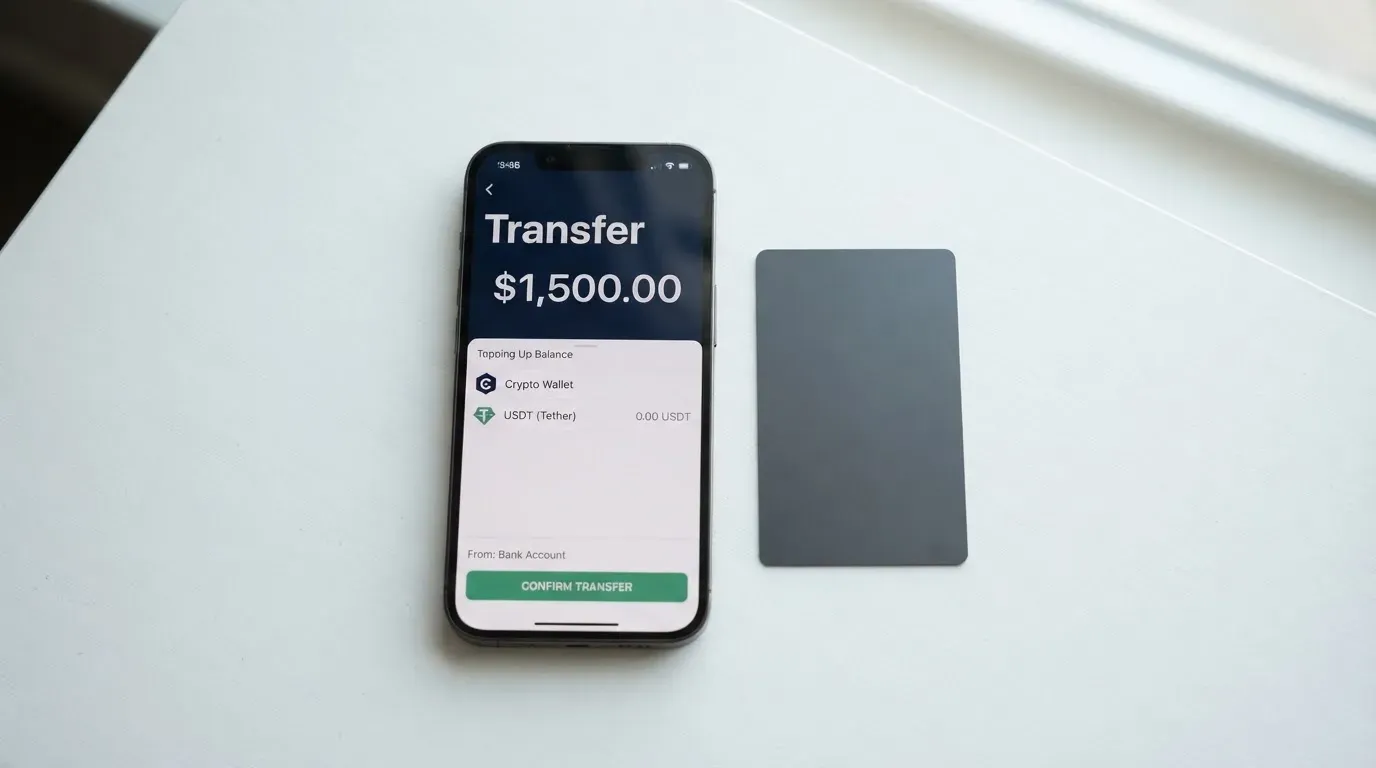
What is reported: 10+ cryptocurrencies are supported, with BTC, ETH, USDT and USDC named. Crypto is converted to your card balance at the moment of loading. The networks are not stated. The top-up fee is 2.5%, and a minimum top-up of $15 (reported unofficially) appeared in a previously published flow, to be confirmed at checkout. Fiat top-up routes are not stated at all, and neither is the withdrawal policy.
The networks point deserves more than a shrug, because it is where money actually gets lost. A blockchain transfer is irreversible. If you send on a network the provider does not support, or to an address belonging to a different network, the deposit can be lost or need manual support recovery with no guarantee of success. There are stablecoins with genuinely complicated paths: ERC-20 tokens are the Ethereum standard, where gas must be paid in ETH, so a wallet holding USDT with no ETH cannot send it at all; Tron prices fees through bandwidth and energy and often burns TRX; and Circle stopped supporting USDC on Tron in February 2024, so “USDC over TRC20” is not a native option. Circle lists USDC as natively supported on 38 networks as of 16 September 2026, including Ethereum, Solana, Base, Polygon PoS, Avalanche, Arbitrum and Stellar, and Tether has issued USDT on Ethereum, Tron, Solana, Polygon, Avalanche and others.
None of that means a Bit.Store transfer is dangerous — it means the card does not tell you which of these paths to use. Before your first load, the only responsible step is to get the exact network from the card’s own interface or its support, in writing, and to send a small test amount rather than a real one.
One more thing about stablecoins that people are surprised by: the name is aspirational. USDC temporarily lost its dollar peg in March 2023 during the US banking crisis, and TerraUSD collapsed outright in May 2022. A card balance funded with a stablecoin can therefore be worth slightly less than you expected on the day you need it.
Paying with it every day
Daily use is where a virtual card is either pleasant or frustrating, and Bit.Store’s shape here is simple: one card, no ATM, two mobile wallets.
Reported unofficially: Apple Pay and Google Pay have been advertised since launch, and whether they work can depend on the BIN, your device region, and the wallet itself. Blocked merchant categories are not stated. The card’s own pages do not say anything about wallets, rewards, the app, or how disputes are handled — and replacement and dispute fees are not publicly itemised.
Adding a card to Apple Pay is worth understanding in the abstract. Apple Pay replaces your card number with a device-specific Device Account Number held in the Secure Element, never on Apple’s servers, and each payment uses a one-time dynamic security code. That is a genuinely strong design. It is also a reason your setup depends on the card issuer staying alive and the token staying enabled: the issuer can restrict a tokenised number, for example blocking it on magnetic-stripe, phone or website use.
Two practical realities about cards in general shape your daily experience here:
- Some merchants quietly decline prepaid or foreign-issued cards. A card number begins with a six- or eight-digit issuer identification number, the BIN, and merchants can look it up to see which institution and which country issued the card. If the issuer country differs from the billing address on file, some shops apply extra scrutiny or decline outright. This is normal, not a malfunction, and it is more likely with a card whose BIN does not look locally issued.
- A declined payment can still hold your money. A failed authorisation may leave a hold that can remain for several days, typically up to seven. So a card with a small balance can feel unavailable for a week because of one unsupported shop.
Against that background, a virtual card with Apple Pay and Google Pay and no ATM is a coherent small tool. It is not a replacement for a primary card, and it should not be asked to be one.
What can go wrong
This is the section I would read twice, because the problems here are not theoretical edge cases. They are the substance of the review.
- The company is not a bank or an e-money institution. Reported unofficially: Bitstore Europe UAB, Lithuania, company number 306465386, registered in 2024 as a virtual-currency exchange and depository-wallet operator. As of August 2026 it holds no bank or EMI licence and does not appear in the Bank of Lithuania EMI register. The former physical card was issued by Paytend Europe UAB; the current virtual issuer is not publicly named, and custody is advertised as handled by Cobo. In EU terms, an electronic money institution is the kind of body that can issue e-money and payment cards under a network’s licence; a company without that licence is doing something different, and you should know which it is.
- The physical card was closed in March 2026 after a regulatory event at the issuer, Paytend. The card publishes no official incident notice. Programme closures typically follow a pattern: a notice period, then loading and spending stop, then users are asked to withdraw remaining balances. That sequence is the single most important thing to understand about holding a balance on any prepaid card, and it is exactly what happened here.
- User reports describe suspended cards and frozen balances. From late 2024 through 2025, reports include virtual cards suspended for “maintenance,” balances that could be neither spent nor withdrawn, monthly deductions that continued regardless, and slow support responses. Some users recovered; others report being blocked for months.
- The complaint score is very low. Trustpilot shows 1.8 out of 5 from 23 reviews, with 82% one-star. I did not read Trustpilot directly, so I treat the themes as reported rather than verified — but the themes match the user reports above: suspended cards, blocked balances, ongoing monthly charges, slow support.
- It is a custodial setup. The card advertises custody with Cobo. That means the provider holds the credentials, so you must trust the provider completely. Custodial platforms have a real record of failure: Mt. Gox (about US$350 million reported stolen, 2011–2014), Coincheck (about US$400 million, 2018), and Ronin Network (US$625 million, 2022). A self-custody-linked card keeps your funds in your own wallet until the moment of payment, but that shift moves the risk to you — key loss, phishing, and clipboard malware that swaps a copied address are all yours.
- Fees are not fully public, and one has already risen. The top-up fee moved from 1.5% to 2.5%, and the FX and purchase fees vary by card type with no published schedule. A card you cannot cost in advance is a card you load conservatively.
- Regulatory ground is still moving under cards like this. MiCA, the EU’s markets-in-crypto-assets regulation, took legal effect in June 2023; its rules on stablecoins applied from 30 June 2024 and the remaining CASP provisions from 30 December 2024. Its transitional period lets existing providers continue only until 1 July 2026 or until they are authorised or refused, whichever comes first. ESMA maintains a public register of authorised CASPs and of non-compliant entities. For a small Lithuanian operator in this space, checking that register is not an academic exercise.
- Networks and card schemes can close programmes. Visa and Mastercard do not issue crypto cards to consumers themselves; they license issuers and can suspend a programme. Visa terminated its global agreements with FTX in November 2022 and the FTX US debit card was wound down; Visa suspended WaveCrest in Europe in 2018, closing all WaveCrest-issued Visa programmes. A licensed card programme is a dependency, not a guarantee.
Two protections exist and are worth knowing. A chargeback is a refund ordered by the issuer to settle a dispute, with reason codes such as fraud, duplicate billing, or goods not received — but your protection depends on your legal position, and US debit card reversal rights come from Regulation E while prepaid-card coverage varies and should not be assumed. And under 3-D Secure, liability for a fraudulent online payment can shift from the merchant to the cardholder’s bank, or, per its critics, to the cardholder.
What to take instead
If the shape of Bit.Store appeals but the foundations do not reassure you, there are three other cards in this category I looked at. None is a blanket recommendation; they have their own gaps. Here is how they compare on what is actually published.
| CardFlow | HyperCard | Card.fi | |
|---|---|---|---|
| My score | 4.9 / 10 | 4.7 / 10 | 6.6 / 10 |
| Who it is for | Aimed at Nigeria — “Nigeria’s smartest fintech card platform” — and “Nigerians and global users”; no country list or exclusions stated | Official pages state no country list; the App Store says it works in “more than 176 countries” (where it is accepted, not who can sign up) | Cards ship to “200+ countries”; terms bar residents of, or orders from, a sanctioned country; no citizenship-vs-residence rule beyond that |
| Card | Virtual USD Mastercard, created in about 3 minutes | Prepaid “HyperCard”; network not stated on the App Store page; balance in USD or EUR | Virtual Classic and Premium, physical Classic and Premium, and a metal card; every physical order includes a virtual card; scheme not named |
| Cost | “Creating a virtual card is completely free”; monthly fee not stated | Not stated; the App Store page lists no fees | One-time $49 Virtual Classic, $249 Virtual Premium; physical and metal prices not listed; no monthly, annual, inactivity or minimum-balance fee |
| Fees | Not stated | Not stated on the pages I could read | Top-up 1.5% + $1.00 (Classic) or 1% (Premium); FX 3.5% (Classic) or 2.5% (Premium); conversion fee shown before each top-up |
| Funding | Bitcoin, USDT, ETH, or a Naira bank transfer; networks not stated | Deposit USDT, BTC or ETH in the app, converted to USD or EUR; networks not stated | 32 coins across 5 networks, converted at market rate on arrival; each card has its own deposit address; sending on the wrong chain risks permanent loss |
| Rewards | Not stated | Not stated | Cashback on spending only: 0.8% Classic (capped 10 USDT/month), 1% Premium, 1.2% or 2% on Metal at higher caps |
Read that table the way you would read a set of trade-offs, not a ranking. CardFlow is the cheapest to open and clearly built for a Nigerian market, but it tells you almost nothing about its fees. HyperCard is the vaguest: no network stated, no fees stated, no eligibility list. Card.fi is the most transparent of the three — its fees and its coin-and-network list are published in a way that lets you actually calculate a payment — and it is the only one of the three that states its costs in its own terms.
The honest summary is that transparency, not price, is what separates them. Card.fi publishes a tariff; the other two ask you to trust them. That is worth more to me than a headline reward rate, and I would weight your own decision the same way.
Who I would recommend it to
I would recommend the Bit.Store card to someone who has decided they want a small virtual card, topped up with crypto, that they can hold for a short window and spend quickly — and who will keep a small balance by instinct rather than by instruction. If that describes you, the product is competently built for that job and the wide coin support is a real convenience.
I would not recommend it to you if any of the following is true of your situation:
- You plan to keep a working balance on it for weeks. The card’s own history is a physical programme closing in March 2026 with balances left in limbo, and that tells you exactly what a closure looks like from the inside.
- You need a chargeback you can rely on, or you are dealing with anything above the deposit limit that consumer protection schemes usually assume.
- You cannot get a public fee schedule before you commit money. A card that will not tell you its FX cost in advance is a card you load in small amounts, every time.
- You are in a restricted country, or your citizenship is one you cannot confirm is accepted.
- You need an ATM, a physical card, or a support response on the timescale of an emergency.
If you are reading this and thinking “I will try it with $20” — that is, I think, the correct posture for this product. Small, disposable, understood to be exactly what it is. What I am warning you against is scaling it up on the strength of a good week.
Frequently asked questions
What is the Bit.Store card?
It is a prepaid, virtual payment card. You load it with crypto, it converts into a card balance, and you spend that balance like ordinary card money — in shops, online, or through Apple Pay and Google Pay. It is virtual only: the physical card was discontinued in March 2026, so there is nothing to receive in the post. There is no ATM support.
How does the Bit.Store card actually work?
Two steps. You send crypto to the card, and it converts to a fiat balance attached to the card; then the card spends that balance wherever cards are accepted. Because it is prepaid rather than a debit card linked to your bank account, it draws on stored money and cannot overdraw. Behind the scenes an issuer holds the card programme — though for the current virtual card, that issuer is not publicly named.
Is Bit.Store a bank?
No. Bitstore Europe UAB is a Lithuanian company, registered in 2024 as a virtual-currency exchange and depository-wallet operator. It is reported as holding neither a bank nor an electronic money institution licence, and as not appearing in the Bank of Lithuania EMI register as of August 2026. It markets the card; a separate licensed issuer is supposed to stand behind it.
Who owns Bit.Store?
The operating company is Bitstore Europe UAB, company number 306465386, in Lithuania. Ownership itself is not stated on the public pages I could see. The former physical card was issued by Paytend Europe UAB, which is also the entity whose regulatory event in March 2026 led to that card being closed.
Does the Bit.Store card require KYC?
Reported unofficially, yes — the virtual-card page says “Simple KYC verification,” while the 2023 launch described the card as KYC-free. The age requirement is also inconsistent: 18+ in the FAQ, 16+ in the User Agreement. Expect to provide identity documents, and know that under anti-money-laundering rules a provider can decline a relationship or freeze an account if due diligence cannot be completed.
Is Bit.Store card free?
Issuance is reported as free, with a $1 monthly fee on a previously published schedule and no annual fee. It is not free to use, though: the top-up fee is 2.5% (it used to be 1.5%), and FX and purchase fees depend on your card type with no complete public schedule. Treat it as a low-cost card, not a free one.
How do I top up the Bit.Store card?
Reported unofficially, you send one of 10+ supported cryptocurrencies — BTC, ETH, USDT and USDC are named — and it converts to your card balance on arrival. The fee is 2.5%, and a $15 minimum appeared in a previously published flow. The networks are not stated, which matters: transfers are irreversible, so send a small test first and confirm the correct chain before sending anything real.
Can I use the Bit.Store card in my country?
Maybe — the card publishes no complete applicant list. A third-party site reports 54 countries available with Belarus, China, Cuba, Iran, North Korea, Russia, Syria and the United States restricted, as of August 2026. Note that eligibility is often screened on citizenship as well as residence, so your nationality may matter even where you live. Ask the card directly before you rely on it.
Is the Bit.Store card safe?
It is a custodial, small-balance convenience product, and I would not use it as a place to hold money. The card itself shows 1.8 out of 5 on Trustpilot from 23 reviews, and user reports from late 2024 through 2025 describe suspended cards, balances that could not be spent or withdrawn, and continued monthly charges. Its physical card closed in March 2026 after a regulatory event at its issuer, with no official incident notice.
Is the Bit.Store card worth it?
Worth it if you want a small virtual card for crypto and will load it lightly and often. Not worth it if you are looking for a primary card, a place to keep a balance, or a card that publishes its full fee schedule before you commit. The card’s transparency gap and its complaint history are the deciding factors for me, and on both counts it is thinner than alternatives like Card.fi, which at least shows you its tariff.
Virtual cards on the shortlist – cryptocardshortlist
Content created by the «cryptocardshortlist» team